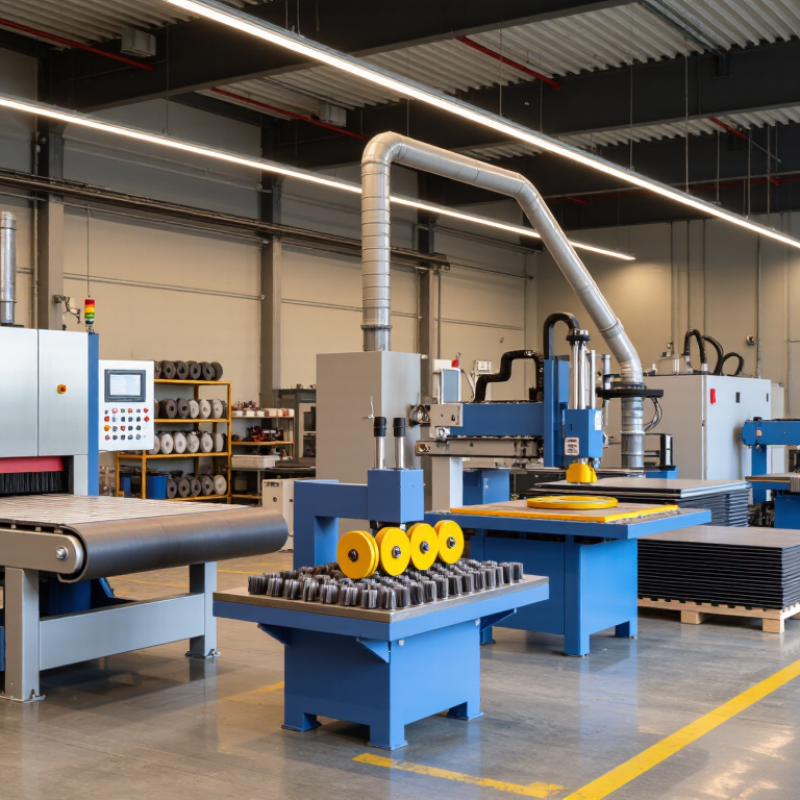
| Wide-Belt Sanding Machine | High-volume deburring, weld blending, scale removal, and uniform finishing of sheet, plate, and fabricated components. | Coated abrasive belts, non-woven abrasive belts, and brush heads. | Approx. P24–P320; finer non-woven grades are also available. | Very high | Consistent linear finish; can produce a brushed or satin appearance when non-woven abrasives are used. | Carbon steel, stainless steel, aluminum, brass, and some coated metals. | High productivity, repeatable results, and easy integration into production lines. | Requires sufficient floor space; setup must match part width, thickness, and abrasive pressure. |
| Long-Belt Sanding Machine | Large panels, welded frames, tanks, doors, structural parts, and components with long seams. | Long coated-abrasive belts, commonly supported by a contact shoe or platen. | Approx. P24–P240. | High | Flat, directional finish with good control over weld leveling and surface blending. | Carbon steel, stainless steel, aluminum, and other sheet metals. | Handles large workpieces and gives operators good visual control. | Usually slower and more operator-dependent than automated wide-belt systems. |
| Centerless Belt Grinder | Continuous finishing of round tubes, bars, rods, shafts, and cylindrical profiles. | Endless coated-abrasive belts, contact wheels, and regulating wheels. | Approx. P24–P400; polishing belts may use finer grades. | High | Uniform circumferential finish; suitable for satin finishing or controlled stock removal. | Stainless steel, carbon steel, aluminum, copper, and brass. | Fast processing of cylindrical parts with consistent diameter and appearance. | Not suitable for flat sheets or irregular profiles; alignment is critical. |
| Disc Sander or Disc Grinding Machine | Edge deburring, weld removal, beveling, small-part finishing, and localized stock removal. | Resin-fiber discs, flap discs, abrasive discs, and non-woven discs. | Approx. P24–P320. | Medium to high | Localized directional finish; quality depends strongly on disc selection and operator technique. | Steel, stainless steel, aluminum, cast iron, and non-ferrous alloys. | Versatile, compact, and effective for edges, corners, and weld areas. | Can create uneven marks or heat discoloration if pressure and speed are excessive. |
| Rotary Brush Deburring Machine | Edge radiusing, burr removal, oxide removal, and finishing of laser-cut, punched, or plasma-cut parts. | Abrasive nylon brushes, wire brushes, and abrasive flap brushes. | Commonly equivalent to approximately P80–P320, depending on brush construction. | Medium | Soft, uniform edge rounding with a satin or low-glare finish. | Carbon steel, stainless steel, aluminum, and galvanized sheet. | Finishes multiple edges at once and reduces sharp-edge hazards. | Less effective for deep weld leveling or heavy stock removal. |
| Orbital or Random-Orbit Sander | Final surface preparation, blending, paint preparation, and removal of light scratches. | Hook-and-loop or pressure-sensitive abrasive discs, sanding nets, and interface pads. | Approx. P80–P600; ultra-fine finishing grades are available. | Low to medium | Fine blended finish with reduced visible swirl marks when used correctly. | Stainless steel, aluminum, mild steel, and painted or coated surfaces. | Good finish control, flexible operation, and suitable for curved or contoured areas. | Not ideal for high-volume heavy grinding; dust extraction is important. |
| Belt File or Narrow-Belt Finishing Machine | Internal corners, narrow welds, tubing, handrails, small profiles, and hard-to-reach areas. | Narrow coated-abrasive belts and non-woven belts. | Approx. P36–P400. | Medium | Controlled linear finish in confined areas; can blend welds and remove localized scratches. | Stainless steel, carbon steel, aluminum, and brass. | Excellent access to narrow sections and complex geometries. | Small working width limits throughput and makes flatness control more difficult. |
| Cylindrical or Internal Grinding Machine | Precision finishing of shafts, bores, sleeves, bearings, and rotational components. | Grinding wheels, abrasive stones, honing tools, and superabrasive wheels. | Commonly equivalent to coarse grinding through fine finishing; exact range depends on wheel specification. | High precision | Accurate dimensions and low surface roughness when correctly dressed and controlled. | Hardened steel, tool steel, stainless steel, cast iron, ceramics, and selected alloys. | High dimensional accuracy and excellent control of roundness and surface quality. | Higher equipment cost, longer setup, and greater technical skill requirements. |
| Robotic Abrasive Sanding Cell | Repeated deburring, weld blending, contour finishing, and automated processing of complex parts. | Abrasive belts, flap wheels, discs, brushes, and compliant finishing tools. | Approx. P24–P600, depending on the process stage. | Medium to high | Repeatable finish across programmed paths; suitable for multi-stage surface preparation. | Steel, stainless steel, aluminum, castings, and welded fabrications. | Reduces manual labor, improves repeatability, and supports hazardous or dusty operations. | Higher initial investment; programming, fixturing, and process validation are required. |