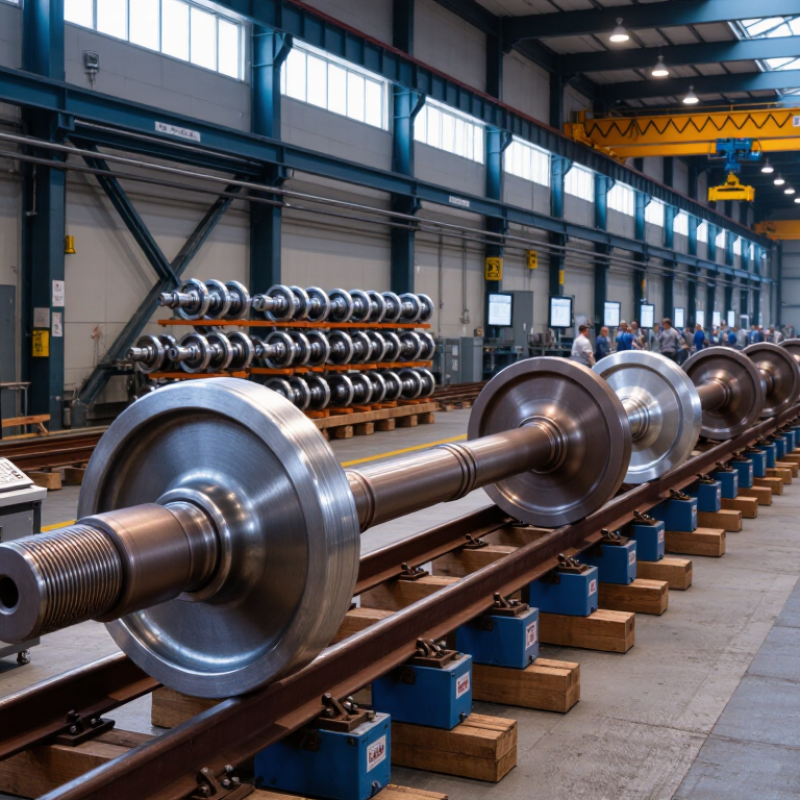
| Solid Forged Axle | One-piece axle manufactured from forged steel, followed by heat treatment, machining, and non-destructive testing. | Normalized or normalized-and-tempered carbon and alloy steels; EN 13261 grades such as EA1N, EA1T, and EA4T may be specified according to the design. | General-purpose freight wagons, mineral wagons, container wagons, and intermodal vehicles. | Common freight designs: approximately 20–25 tonnes per axle; heavy-haul designs may be rated at 25–30 tonnes or more when approved by the vehicle design authority. | Wheel seat, journal, and gear-seat diameters are determined by the approved drawing. Common freight journal sizes are often in the approximate 130–160 mm range. Axle end design may use threaded or bolted fastening systems. | EN 13261, AAR M-101, or the applicable national railway specification; dimensional inspection, ultrasonic testing, magnetic-particle testing, hardness testing, and metallurgical verification. |
| Hollow Forged Axle | Forged axle with a controlled internal bore, designed to reduce mass while maintaining the required fatigue strength and stiffness. | High-quality alloy axle steels, commonly selected from approved EN 13261 or equivalent material grades. | Weight-sensitive freight platforms, specialized wagons, passenger-derived freight equipment, and applications requiring reduced unsprung mass. | Typically designed for the same vehicle load class as a comparable solid axle, subject to fatigue calculations and route approval. | Requires controlled bore diameter, wall thickness, concentricity, and surface quality. Internal ultrasonic inspection is essential because the bore introduces additional fatigue-critical surfaces. | EN 13261 or an equivalent approved specification; ultrasonic inspection from multiple directions, dimensional gauging, fatigue assessment, hardness checks, and traceability of heat treatment. |
| Low-Alloy Steel Axle | Forged and heat-treated axle using alloying elements to improve strength, toughness, and resistance to fatigue damage. | Low-alloy steels containing controlled additions such as chromium, nickel, or molybdenum; the exact chemistry must comply with the selected railway standard. | High-load freight wagons, heavy-haul mineral service, and routes with demanding duty cycles. | Often selected for 25-tonne-per-axle and higher-load applications when permitted by the wagon, track, and operating authority. | Important parameters include tensile strength, yield strength, impact toughness, fatigue performance, hardenability, and dimensional stability after heat treatment. | Material certificates, heat-treatment records, tensile and impact testing, ultrasonic testing, magnetic-particle testing, and fatigue or design validation where required. |
| Carbon Steel Axle | Forged axle manufactured from controlled carbon steel with normalization or other specified heat treatment. | Railway-approved carbon axle steels, including grades used under freight axle specifications such as AAR-approved material categories. | Standard freight wagons operating under moderate axle-load and speed conditions. | Commonly used for conventional freight axle loads around 20–23 tonnes, depending on the design and governing standard. | Offers a cost-effective solution when the required strength, toughness, and fatigue life can be achieved. Surface finish and transition radii are critical at journals and wheel seats. | Applicable AAR, EN, or national standard; chemical analysis, tensile testing, hardness testing, ultrasonic testing, magnetic-particle inspection, and dimensional checks. |
| Powered or Gear-Seat Axle | Axle includes a machined gear seat or other interface for transmitting traction torque; it may be solid or hollow depending on the vehicle design. | Alloy steel with strength and toughness suitable for combined bending, torsion, and fatigue loading. | Powered freight vehicles, maintenance vehicles, hybrid rail equipment, and specialized wagon-like rail vehicles. | Determined by the combined vertical axle load and traction torque rather than vertical load alone. | Requires accurate gear-seat geometry, runout control, torsional-strength verification, transition-radius control, and compatibility with the selected gearbox or drive system. | Applicable axle standard plus vehicle-specific traction and fatigue requirements; dimensional inspection, ultrasonic testing, magnetic-particle testing, and torsional or system-level validation. |
| Trailer Wheelset Axle | Non-powered axle fitted with two wheels and intended to support and guide a wagon through the rail-wheel interface. | Approved forged carbon or low-alloy axle steel, selected according to axle load, speed, environmental conditions, and regulatory requirements. | Most conventional freight wagons, including box wagons, gondolas, flat wagons, tank wagons, and covered hopper wagons. | Typical designs range from approximately 20 to 25 tonnes per axle, with heavier ratings requiring specific infrastructure and vehicle approval. | Gauge, wheel-seat spacing, journal dimensions, bearing arrangement, back-to-back wheel dimension, wheel diameter, and brake-disc or brake-rigging interfaces must match the wheelset drawing. | EN 13260 for wheelsets, EN 13261 for axles, EN 13262 for wheels, or applicable national freight standards; complete wheelset dimensional and running-surface inspection. |
| Standard-Gauge Wheelset Axle | Axle designed for a 1,435 mm nominal track gauge wheelset. | Railway-approved forged axle steel; material selection depends on axle load, speed, and regional approval requirements. | International and domestic freight wagon fleets using standard-gauge infrastructure. | Frequently designed around 22.5 tonnes per axle in European freight service, with 25-tonne and higher designs used on selected heavy-haul networks. | Nominal track gauge: 1,435 mm. Wheelset back-to-back distance, wheel profile, journal spacing, and bearing arrangement must follow the applicable regional standard. | EN 13260–EN 13262 series or the applicable national railway standards; gauge, wheel profile, axle runout, wheel-seat position, and bearing-seat tolerances must be verified. |
| Broad-Gauge Wheelset Axle | Axle designed for a broad-gauge wheelset, with dimensions adapted to the relevant network and vehicle envelope. | Forged carbon or low-alloy railway axle steel complying with the purchasing authority’s material specification. | Freight wagons operating on broad-gauge networks, including 1,520 mm and 1,676 mm systems. | Common axle-load classes vary by network and wagon type; approximately 22.5–25 tonnes per axle is used in many freight applications, subject to local approval. | Nominal track gauge may be 1,520 mm or 1,676 mm. Axle overall length, wheel-seat spacing, bearing arrangement, and wheel profile are network-specific. | Applicable regional standards and railway authority requirements; gauge verification, wheelset geometry checks, ultrasonic testing, and full material traceability. |
| Meter-Gauge Wheelset Axle | Compact axle and wheelset designed for a nominal track gauge of 1,000 mm. | Forged axle steel selected for the lower vehicle envelope and the required load, speed, and fatigue duty cycle. | Regional freight wagons, industrial railways, mining lines, and narrow-gauge logistics systems. | Often below standard-gauge freight axle loads, but the exact rating is determined by the infrastructure and wagon design. | Nominal track gauge: 1,000 mm. Compact bearing spacing and wheel diameter may be required; axle strength must account for lateral forces and curve loading. | Applicable national or project-specific standard; wheelset gauge, axle geometry, bearing seats, wheel profile, ultrasonic testing, and fatigue validation. |
| Heavy-Haul Axle | High-capacity forged axle optimized for severe cyclic loading, high gross wagon mass, and demanding operating environments. | High-toughness carbon or low-alloy forged steel with tightly controlled cleanliness, heat treatment, and fatigue performance. | Coal, ore, aggregate, and other bulk-material wagons operating on dedicated heavy-haul routes. | Commonly 25–30 tonnes per axle in approved heavy-haul applications; higher values require specific infrastructure and regulatory authorization. | Requires high fatigue resistance, robust transition radii, controlled surface finish, reliable bearing seats, and compatibility with high-capacity wheels and bearings. | Applicable heavy-haul railway specification; enhanced ultrasonic inspection, magnetic-particle testing, fatigue design review, hardness mapping, and full production traceability. |
| Corrosion-Resistant Service Axle | Standard forged axle protected through controlled surface treatment, coating, sealing, and maintenance procedures rather than relying solely on a corrosion-resistant alloy. | Approved axle steel with suitable toughness and fatigue properties; protective systems must not mask cracks or interfere with inspection. | Tank wagons, chemical-service wagons, coastal routes, humid climates, and environments exposed to de-icing salts or corrosive materials. | Based on the wagon’s structural design; corrosion protection does not by itself increase the permitted axle load. | Critical controls include surface preparation, coating thickness, drainage, sealing of vulnerable interfaces, corrosion allowance where specified, and inspection access. | Applicable axle standard plus coating and hazardous-material wagon requirements; corrosion inspection, coating verification, ultrasonic testing, and periodic in-service examination. |