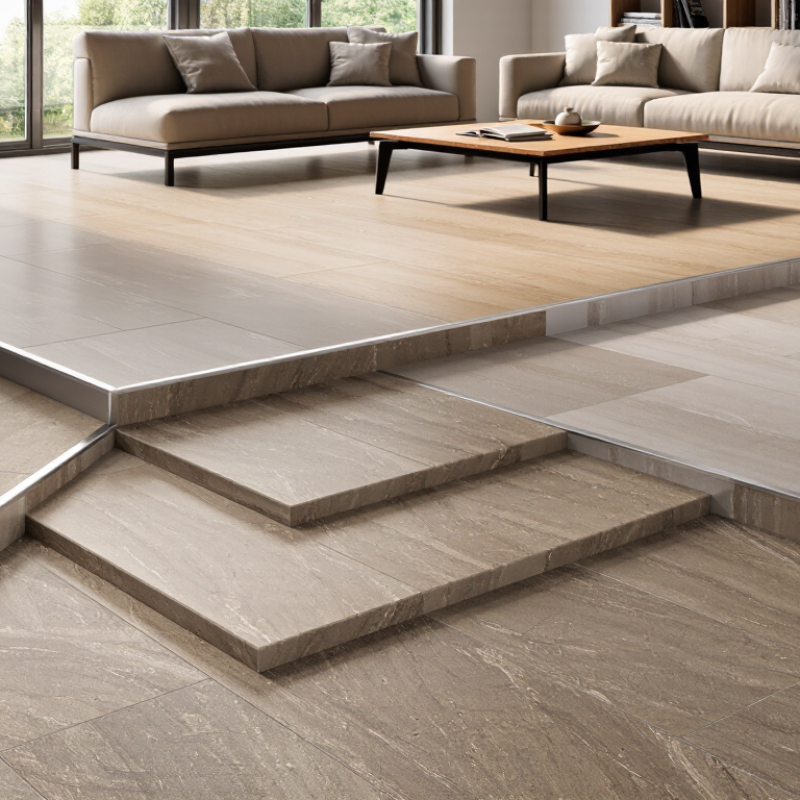
| What stone-look SPC flooring is | A rigid-core resilient flooring product with a printed decorative layer designed to resemble materials such as marble, slate, or concrete. | The stone appearance comes from the printed design and surface finish; the product itself is not a slab of natural stone. |
| Main core ingredients | The core commonly combines calcium carbonate mineral filler with polyvinyl chloride (PVC) resin and processing additives. | Formulations differ by manufacturer. Ask for the product’s technical data and confirm that the declared composition and performance meet the intended market’s requirements. |
| How the core is made | Ingredients are blended, heated and processed into a rigid sheet or profile, then calibrated and cooled to control thickness and surface flatness. | Mixing, temperature, pressure, and cooling affect consistency. Production descriptions and quality controls should be verified with the supplier. |
| Typical product layers | Common construction includes a UV or protective finish, a transparent wear layer, a printed décor film, the SPC core, and sometimes an attached underlay. | Layer arrangements vary. Check whether an underlay is attached and whether an additional underlay is permitted by the installation instructions. |
| Wear-layer options | Common stated wear-layer thicknesses include approximately 0.3 mm, 0.5 mm, and 0.7 mm. | A thicker wear layer can provide more material above the décor, but it does not by itself establish overall quality. Review test results, finish type, and warranty conditions. |
| Overall plank or tile thickness | Rigid-core products are sold in a range of total thicknesses; the selected thickness includes the core and any surface layers or attached underlay. | Compare like-for-like specifications and confirm the actual thickness of the product, not just a general product-family range. |
| Formats and stone designs | Available formats can include rectangular planks and square or rectangular tiles, with printed designs that imitate different stone patterns. | Request samples or current design files to assess pattern repeat, color variation, edge detail, and how the design looks under the project’s lighting. |
| Surface texture and finish | Finishes may be smooth, embossed, or textured; some products align surface texture with visual details in the printed design. | Confirm slip-resistance test results for the intended use. A textured appearance alone does not establish a specific slip rating. |
| Water exposure | The rigid-core construction is generally designed to resist water-related damage to the flooring material. | Water resistance does not make every installation waterproof. Perimeter sealing, joints, subfloor conditions, and standing-water guidance depend on the product and installation method. |
| Installation system | Many SPC products use a click-lock floating installation; other installation methods may be offered for particular products. | Check subfloor flatness, expansion clearances, room-size limits, and transition requirements in the installation instructions before ordering. |
| Underfloor heating | Some products are suitable for use over underfloor heating when installed within stated temperature and installation limits. | Suitability is product-specific. Obtain written limits for operating temperature, heat-up procedure, and any required underlay. |
| Quality checks for import orders | Relevant checks may include dimensional tolerances, locking-joint fit, surface appearance, wear-layer measurement, and results from applicable performance tests. | Agree on the specification, sampling method, and acceptance criteria before production. Request test reports that identify the tested product and method. |
| Market documentation | Required documentation depends on the destination country, application, and sales channel. | Confirm applicable product, chemical, emissions, fire, and labeling requirements with the importer or local compliance specialist before shipment. |