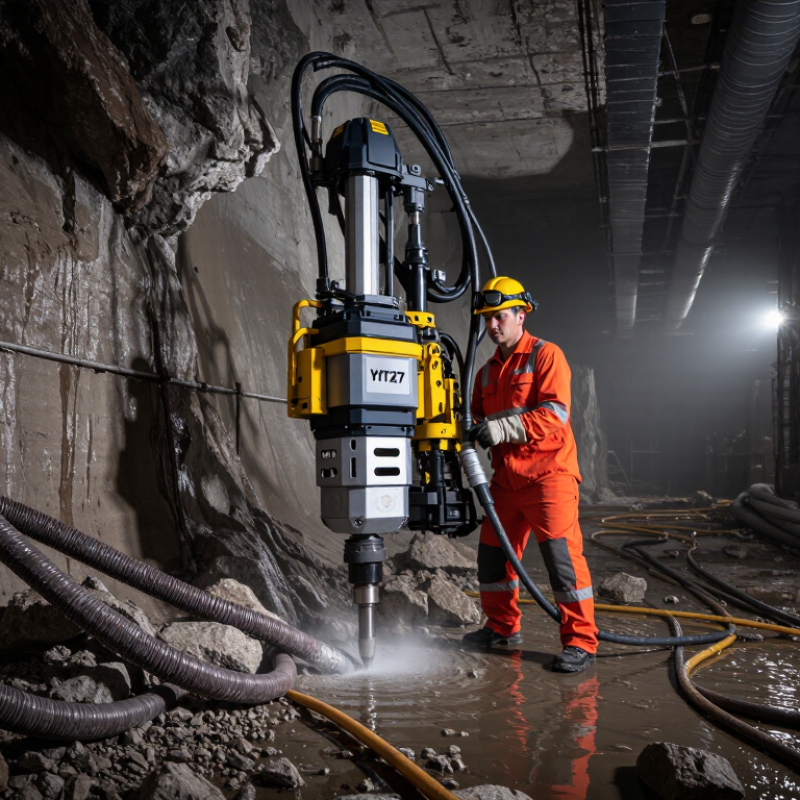
| Definition and Operating Principle |
| Equipment type | Pneumatic rotary-percussive rock drill with an air-leg support system | Combines impact energy, bit rotation, and feed support for handheld drilling. | Suitable for underground development, tunneling, quarrying, and secondary breaking. |
| Power source | Compressed air | Requires a properly sized compressor, air hose, filters, valves, and lubricator. | Useful in mines where compressed-air networks are already available and electrical equipment may be restricted. |
| Primary drilling method | Percussive impact with rotary flushing | Delivers repeated piston impacts while the drill steel rotates and compressed air removes cuttings. | Designed for short-to-medium hole drilling in hard and medium-hard rock formations. |
| Typical Technical Specifications |
| Machine weight | Approximately 27 kg | Low enough for manual underground handling, but the complete working setup also includes the air leg, hose, and drill steel. | Appropriate for face drilling where operators must reposition equipment frequently. |
| Overall drill length | Approximately 668 mm | A compact body helps operators work in confined headings and narrow underground spaces. | Practical for narrow tunnels, mine headings, raise preparation, and drift development. |
| Cylinder diameter | Approximately 80 mm | Supports the piston and contributes to the drill's impact performance. | Provides a balance between drilling output, machine size, and compressed-air demand. |
| Piston stroke | Approximately 60 mm | Longer piston travel generally supports effective impact transfer into the drill steel. | Well suited to drilling in competent rock where repeated impact energy is required. |
| Rated working air pressure | Approximately 0.63 MPa (6.3 bar) | The compressor and air distribution system should maintain pressure at the drill inlet under load. | Stable pressure helps maintain drilling speed and reduces inconsistent performance. |
| Air consumption | Approximately 83 L/s at rated conditions | Compressor capacity must account for line losses, simultaneous tools, altitude, and duty cycle. | Important for mines operating several pneumatic drills or other air-powered equipment at the same time. |
| Drilling speed | Approximately 250 mm/min in suitable rock and operating conditions | Actual speed varies with rock strength, bit condition, hole depth, operator technique, and air pressure. | Useful for estimating face-drilling time rather than guaranteeing a fixed production rate. |
| Common drill-hole diameter | Approximately 34–42 mm | Final diameter depends on the selected drill bit, steel, rock type, and hole purpose. | Commonly used for blast holes, bolt holes, drainage holes, and small service openings. |
| Common shank configuration | Typically 22 mm × 108 mm; verify before ordering | Shank compatibility must be confirmed with the drill steel, chuck, retaining parts, and bit system. | Prevents delays caused by incompatible consumables or incorrect replacement parts. |
| Air-leg support | Adjustable pneumatic leg, commonly supplied in a short- or long-leg configuration | Provides feed force and reduces the operator's manual load during drilling. | Supports upward, horizontal, and downward drilling in underground headings and stopes. |
| Purpose and Mining Applications |
| Face drilling | Drilling blast holes in tunnel or mine headings | Allows multiple holes to be positioned around the face before controlled blasting. | Common in underground metal mines, non-coal mines, and civil tunneling projects. |
| Development drilling | Short-hole drilling for advancing drifts, crosscuts, and access drives | Compact dimensions and air-leg feed are useful where working space is limited. | Supports mine access development and preparation of new production areas. |
| Roof and wall drilling | Drilling holes for rock bolts, mesh anchors, and small support systems | Hole length and support compatibility should be checked against the ground-control plan. | Applicable to selected roof, back, rib, and wall-support tasks where the hole size is suitable. |
| Secondary breaking | Drilling small holes in oversize rock before secondary blasting or mechanical breaking | Improves handling of large fragments that cannot pass through crushers or drawpoints. | Useful in quarry benches, underground drawpoints, ore passes, and crushing areas. |
| Drainage and service holes | Short exploratory, drainage, ventilation, or utility holes | Hole diameter and flushing performance should match the required depth and ground condition. | Can support water management, gas relief, ventilation, and local ground investigation. |
| Buyer Evaluation Criteria |
| Rock hardness suitability | Best suited to medium-hard and hard rock within the drill's impact and bit limits | Extremely abrasive or highly fractured ground may require different bits, flushing methods, or drilling systems. | Review geological data, uniaxial compressive strength, abrasivity, and fracture conditions before purchase. |
| Compressor requirement | Select capacity for approximately 0.63 MPa working pressure and about 83 L/s drill demand, plus system margin | Undersized compressors can reduce impact frequency, rotation, and flushing effectiveness. | Particularly important in multi-drill headings and mines with long air lines. |
| Consumables | Compatible drill steel, bits, shank adapters, retainers, hoses, and lubricator components | Consumable availability and standardization often affect total operating cost more than initial purchase price. | Maintain a documented inventory for the selected hole diameter and shank system. |
| Water-flushing option | Optional or configuration-dependent; confirm before ordering | Water injection can improve dust suppression and hole cleaning, subject to site rules and equipment configuration. | Important where occupational dust controls and wet-drilling procedures are required. |
| Operator controls | Typically includes air inlet control, rotation control, impact control, and air-leg control | Controls should be accessible, clearly marked, and compatible with the mine's safety procedures. | Good control layout improves positioning accuracy and reduces unnecessary air consumption. |
| Maintenance requirements | Routine lubrication, air filtration, hose inspection, flushing checks, and wear-part replacement | Clean, lubricated air and timely maintenance help preserve impact performance and service life. | Plan inspections around shift schedules and maintain spare seals, valves, chucks, and retainers. |
| Safety considerations | Use approved personal protective equipment, secure the air leg, control hose movement, and inspect connections | Operators should be trained in pneumatic-tool isolation, rock-fall awareness, dust control, and safe drilling posture. | Site-specific risk assessments and local mining regulations must govern operation. |
| Total cost of ownership | Purchase price plus compressed air, bits, drill steel, lubrication, maintenance, downtime, and labor | Compare cost per drilled metre rather than equipment price alone. | Best value is achieved when the drill matches the mine's rock conditions, air system, and production cycle. |
| Selection Summary |
| Recommended buyer profile | Mines and contractors needing a manually operated pneumatic drill for confined drilling locations | Particularly suitable where compressed air is available and mobility is more important than automated drilling. | Underground development, small-scale production, construction tunneling, quarrying, and repair work. |
| Key strengths | Compact body, air-leg feed, straightforward pneumatic design, and broad short-hole versatility | Offers practical operation in locations that may be difficult to access with larger mechanized rigs. | Useful as a primary drill for small headings or as a supplementary drill in larger operations. |
| Primary limitations | High compressed-air demand, manual operation, operator exposure to vibration and noise, and limited hole length compared with mechanized rigs | Not automatically the best choice for long-hole drilling, high-volume production, or sites without adequate air infrastructure. | Consider hydraulic, electric, or fully mechanized alternatives when productivity, automation, or long-hole capability is the priority. |