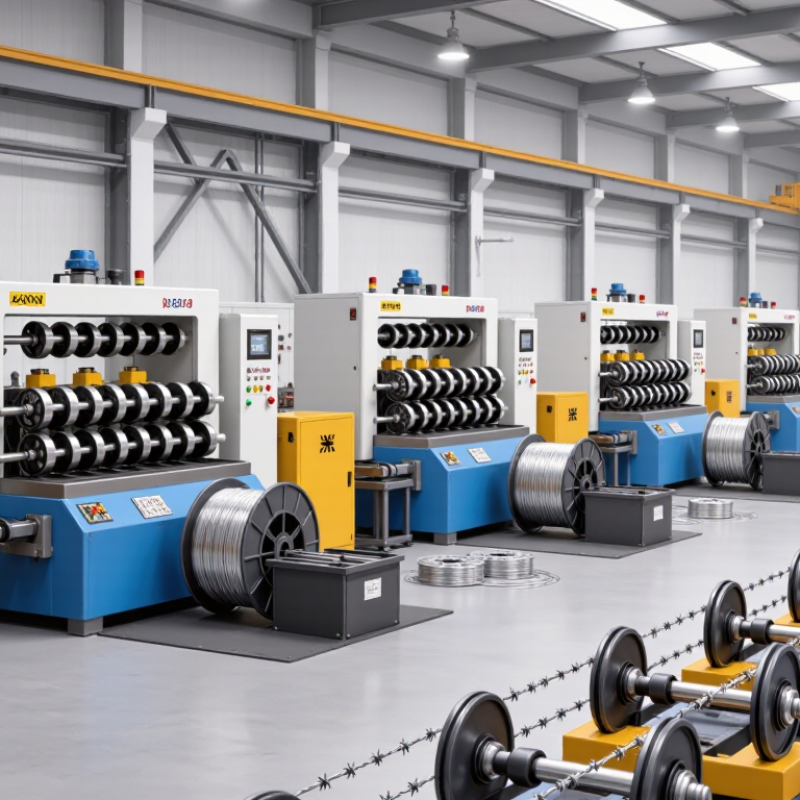
| Machine Definition | Automatic barbed wire forming equipment | A barbed wire making machine continuously twists one or two line wires and inserts or forms sharp barbs at preset intervals. The finished product is normally collected into coils for fencing and perimeter-security applications. |
| Basic Product Structure | Two-strand line wire with four-point barbs | The most common commercial configuration uses two longitudinal wires with four-point barbs. Two-point and other configurations may be available when the machine is equipped with different barb-forming tooling. |
| Compatible Wire Material | Low-carbon steel wire, galvanized steel wire, or coated steel wire | Machine selection should match the actual surface condition, tensile strength, coating, and diameter of the wire. Galvanized steel is widely used because the zinc coating improves resistance to atmospheric corrosion. |
| Line Wire Diameter | Approximately 1.6–2.5 mm | This is a common working range for general-purpose barbed wire equipment. The exact range depends on the forming dies, twisting system, wire tensile strength, and machine design. |
| Barb Wire Diameter | Approximately 1.6–2.5 mm | The barb wire is usually selected within a similar diameter range to the line wire. The selected diameter must be compatible with the cutting and twisting mechanism to prevent broken barbs or uneven points. |
| Barb Spacing | Commonly 75–150 mm | Barb spacing is normally adjustable through the machine control system or gear arrangement. Typical products include approximately 75 mm, 100 mm, and 150 mm spacing, depending on the target fencing specification. |
| Production Speed | Approximately 20–60 m/min | Actual output speed depends on wire diameter, barb spacing, material quality, machine condition, and operator settings. Higher speed should not reduce barb sharpness, spacing accuracy, or coil consistency. |
| Typical Daily Output | Approximately 1.0–3.0 tonnes per 24 hours | Daily production is affected by operating hours, wire size, coil changes, maintenance stops, and product specifications. A quoted capacity should always identify the wire diameter and barb spacing used for the calculation. |
| Main Drive Motor | Approximately 2.2–5.5 kW | Motor power varies according to machine size, wire diameter, number of twisting units, and automation level. A properly sized motor should provide stable torque without excessive vibration or overheating. |
| Barb Forming Method | Cut-and-twist or integrated forming system | The machine cuts short barb sections or forms barbs from supplied wire and then twists them around the line wires. Tooling quality directly affects point sharpness, barb alignment, and production reliability. |
| Control System | Mechanical control or PLC-based automatic control | Basic machines may use mechanical gears and switches, while automated models can provide adjustable speed, length counting, fault alarms, emergency-stop functions, and easier recipe changes. |
| Finished Coil Weight | Commonly 20–50 kg per coil | Coil weight depends on product diameter, winding equipment, customer handling requirements, and shipping limitations. An automatic take-up unit can improve coil shape and reduce manual handling. |
| Length Measurement | Electronic or mechanical meter counting | A length counter helps maintain consistent coil quantities and supports production records. For accurate sales length, the counting system should be checked periodically against a measured sample. |
| Electrical Supply | Three-phase industrial power; voltage varies by country | Common industrial installations use three-phase power, but the required voltage and frequency must be confirmed before ordering. Electrical components should comply with the installation region and local safety requirements. |
| Safety Equipment | Guards, emergency-stop switches, and protective covers | Rotating shafts, gears, cutting tools, and wire-feed areas should be guarded. Operators should use appropriate eye, hand, and hearing protection and follow lockout procedures during maintenance. |
| Input Wire Preparation | Uniformly wound wire coils with controlled tension | Wire should be free from severe kinks, excessive rust, and inconsistent diameter. A stable pay-off stand and correctly adjusted tension reduce wire breaks and improve barb spacing. |
| Quality Control Points | Wire diameter, barb spacing, barb sharpness, twist tightness, and coil weight | Finished products should be inspected for regular spacing, secure barb attachment, consistent twisting, straightness, surface condition, and accurate coil length or weight. |
| Applicable Product Standards | ASTM A121, ASTM A641, EN 10223-1, or customer specifications | Applicable standards depend on the destination market and product type. ASTM A121 addresses zinc-coated steel barbed wire, ASTM A641 covers zinc-coated carbon steel wire, and EN 10223-1 is used for steel wire fencing products in relevant European applications. |
| Common Applications | Agricultural fencing, boundary fencing, livestock enclosures, and security barriers | Barbed wire is used where a low-cost physical deterrent and boundary marker are required. Product selection should consider corrosion exposure, animal safety, installation method, and local regulations. |
| Key Manufacturer Evaluation Factors | Verified capacity, tooling life, automation, spare parts, and after-sales support | When comparing suppliers, request a production test using the intended wire diameter and spacing. Also verify machine documentation, electrical standards, replacement tooling availability, warranty terms, training, and service response. |