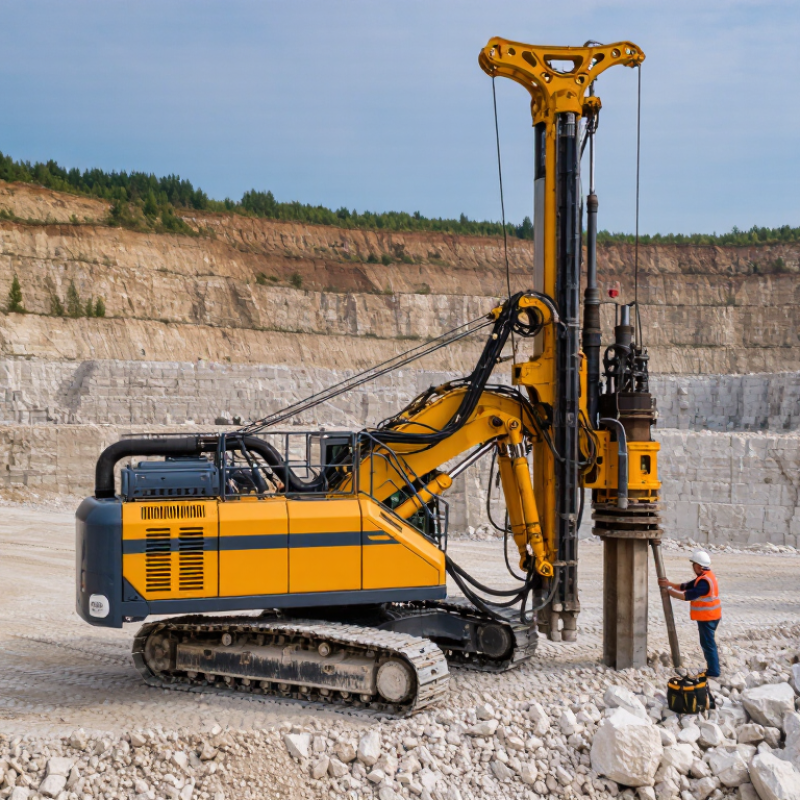
| Primary Machine Type | Crawler-mounted down-the-hole (DTH) drilling rig | Combines tracked mobility with percussion drilling for hard and abrasive formations. | Confirm that the rig is designed for surface drilling and compatible with the planned hole diameter. |
| Recommended Drilling Depth | Approximately 100–300 m, depending on rod length, hole diameter, formation, and compressor capacity | Suitable for quarry blast holes, geotechnical investigation, water-well work, and selected foundation drilling. | Treat depth as an indicative planning range rather than a guaranteed output. |
| Typical Hole Diameter | Approximately 90–305 mm | Covers many common quarry blast-hole sizes and medium-diameter exploration holes. | Larger diameters generally require higher air delivery, stronger rods, and greater feed force. |
| Suitable Rock Conditions | Medium-hard to very hard, competent rock; commonly used in igneous, metamorphic, and hard sedimentary formations | DTH percussion transfers impact energy directly to the bit, supporting effective penetration in hard rock. | Highly fractured, soft, or unstable formations may need casing, foam, drilling fluid, or an alternative method. |
| Drilling Method | Compressed-air DTH hammer with a button or cross-bit | Provides efficient rock breaking and carries cuttings to the surface through the annulus. | Select bit geometry and hammer size according to rock abrasiveness, strength, and hole diameter. |
| Compressor Air Delivery | Often approximately 17–35 m³/min for medium-to-large surface DTH applications | Adequate airflow helps power the hammer and remove cuttings from deeper holes. | Match free-air delivery and working pressure to the hammer manufacturer’s operating requirements. |
| Typical Working Pressure | Commonly about 1.2–2.5 MPa at the compressor outlet, subject to system losses and hammer design | Supports reliable hammer operation in hard-rock quarrying applications. | Check pressure at the hammer, not only the compressor, because hose and valve losses reduce available pressure. |
| Crawler Mobility | Steel-track undercarriage with independent or combined track travel control | Improves movement across uneven benches, loose aggregate, and rough quarry access roads. | Review track width, ground clearance, gradeability, turning radius, and transport dimensions. |
| Feed System | Hydraulic chain, cylinder, or rack-and-pinion feed; commonly configured for multi-rod drilling | Provides controlled thrust and rotation during long-hole drilling. | Compare feed stroke, maximum pullback force, rod-changing method, and service accessibility. |
| Drill Rod Configuration | Common rod lengths of approximately 3–6 m, assembled progressively to reach the target depth | Allows the rig to reach 100–300 m while maintaining manageable handling and transport requirements. | Select thread type, rod diameter, straightness tolerance, and replacement availability carefully. |
| Drilling Angle | Usually adjustable from near-vertical to inclined drilling; exact range depends on mast design | Supports vertical blast holes and inclined holes used for controlled quarry fragmentation. | Confirm angle-locking accuracy, mast rigidity, and stability on sloped benches. |
| Rotation Speed | Often approximately 20–100 rpm, depending on bit diameter, rock type, and hydraulic setup | Adjustable rotation helps balance penetration rate, bit wear, and hole straightness. | Higher speed is not always better; abrasive rock may require lower speed and controlled torque. |
| Typical Production Rate | Approximately 10–30 m/h in hard rock under favorable operating conditions | Can support regular quarry blast-hole production when setup, rod changes, and repositioning are efficient. | Actual output varies significantly with rock strength, jointing, hole size, depth, and operator practice. |
| Power System | Diesel-hydraulic power unit is common; electric-hydraulic configurations are also used where grid power is available | Diesel power supports remote quarry operation, while electric systems can reduce on-site emissions. | Compare engine power, fuel consumption, electrical supply requirements, emissions rules, and maintenance support. |
| Dust Management | Dry dust collection, wet suppression, or a combined dust-control arrangement | Helps control respirable silica dust and improves visibility around the drilling area. | Verify filter area, collector efficiency, water consumption, maintenance intervals, and local occupational requirements. |
| Best-Fit Quarry Applications | Production blast holes, perimeter holes, secondary breaking, bench development, and selected exploration work | Provides a versatile solution for surface mines and aggregate quarries with hard-rock conditions. | For very large holes, loose overburden, or highly sensitive vibration zones, compare alternative drilling methods. |
| Key Advantages | Good hard-rock penetration, accurate hole alignment, strong mobility, and scalable depth capability | Well suited to repeated drilling cycles across changing quarry benches. | Assess total operating cost, including compressor fuel, bits, rods, hammer parts, dust filters, and labor. |
| Main Limitations | High air demand, noise, dust-control requirements, and reduced performance in unstable or water-sensitive formations | Operating conditions can strongly affect penetration, hole cleaning, and component life. | Complete a formation test and verify local noise, dust, emissions, and site-access requirements before purchase. |
| Best Buyer Profile | Quarry operators, aggregate producers, contractors, mining service companies, and geotechnical drilling teams | Provides a balanced option for buyers needing repeated surface drilling at moderate-to-deep depths. | Prioritize local parts availability, technician support, operator training, and lifecycle service capability. |