2026 Top Types of Ropes for Global Buyers
ROPES are rarely a one-specification purchase. A dock line exposed to salt spray faces different demands from a climbing rope, a cargo sling, or a polypropylene line used around water. For global buyers, material, construction, diameter, stretch, abrasion resistance, and inspection needs all affect performance. The right choice starts with the job—not the label.
Market figures show why this category deserves careful comparison. Grand View Research’s Ropes Market report estimates that the global market was valued at USD 11.6 billion in 2023, with projected growth from 2024 to 2030. Market estimates can vary with product definitions, so treat them as context, not a purchasing forecast. Still, broader demand makes clear that buyers encounter many options, from natural-fibre ropes to nylon, polyester, polypropylene, and high-performance fibres. Each has trade-offs. A rope that handles wet conditions well may not provide the stretch or heat resistance another application needs.
Standards and product data help narrow the field. ISO 2307:2019 describes methods for determining physical and mechanical properties of fibre ropes, offering a useful basis for comparing test results. Check the rope’s intended use, working-load information, construction, and care guidance against the manufacturer’s documentation. Small details matter. A rough coating, stiff splice, or unclear specification can signal questions worth asking before an order. Not every catalog makes comparison easy. This guide reviews the top types of ROPES for global buyers in 2026, with practical differences in view—and a reminder that no single material is best for every job.
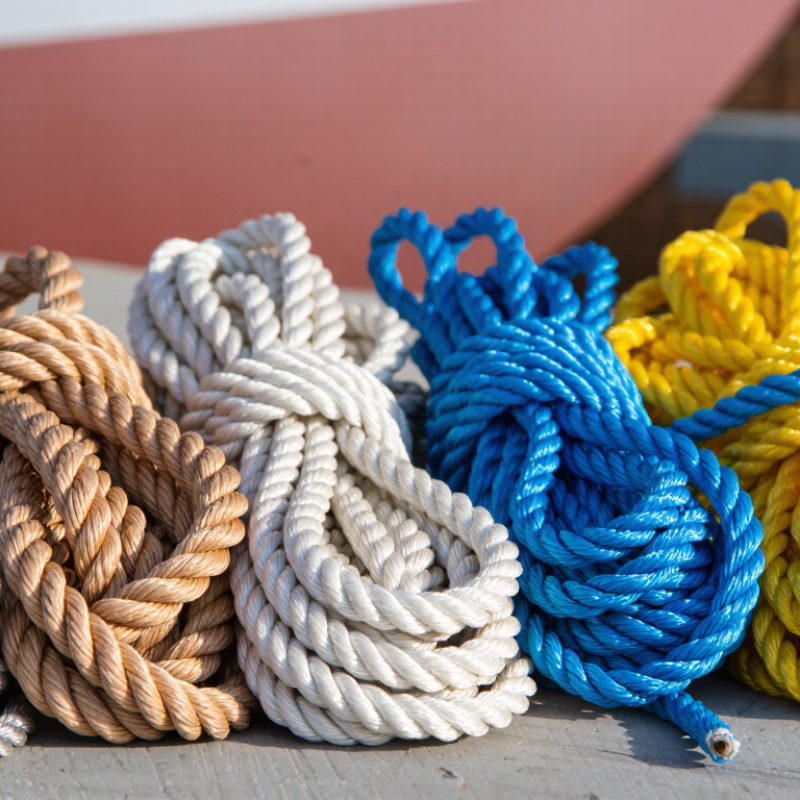
How Global Buyers Classify Ropes by Fibre, Construction, and Load Rating
Global buyers can start by identifying the fibre, since it shapes a rope’s weight, stretch, and resistance to water or sunlight. Nylon stretches under sudden force, which can help absorb shock, while polyester usually stretches less and handles outdoor exposure well. Polypropylene floats and is lightweight, but heat and abrasion can shorten its service life. No fibre wins every job.
Construction matters just as much. Three-strand rope is easy to inspect and splice, though it can twist under load. Braided rope often feels smoother in the hand and may run neatly through pulleys. A double-braid design combines a load-bearing core with a protective cover. Look closely at the finish: loose fibres, uneven strands, or flattened sections deserve attention. Small details count.
Load ratings need careful reading. Breaking strength is not the same as working load limit; the latter includes a safety margin set for a particular application. Check the manufacturer’s test data, rope diameter, and any conditions that reduce capacity, such as knots, wear, or sharp edges. Labels can be confusing, and buyers sometimes compare unlike figures. That is worth questioning. A sample inspection and clear documentation can help confirm that the selected rope suits the actual load and handling conditions.
2026 Top Types of Ropes for Global Buyers
How global buyers classify ropes by fibre, construction, and load rating
How to read this chart: Fibre density is a useful material characteristic, not a measure of rope strength. Polypropylene and polyethylene float in water; nylon, polyester, and aramid are denser than water. HMPE is a high-strength, low-density fibre.
Buyers also compare construction—such as laid (twisted), braided, or kernmantle—and the manufacturer’s rated breaking strength or working load limit (WLL). Load ratings depend on rope diameter, construction, terminations, condition, and applicable safety factors; confirm them from the product documentation rather than inferring them from fibre type.
Approximate solid-fibre densities at room temperature; actual values vary by grade and formulation. Density values are not rope load ratings.
Natural-Fibre Ropes: Manila and Sisal for Traditional Applications
Manila and sisal ropes remain useful where traditional handling and a natural-fibre feel matter. Manila, made from abaca fibres, is comparatively soft and flexible. Its strands grip well in the hand, which helps with general marine work, farm tasks, and heritage-style rigging. It can handle damp conditions better than some natural fibres, but that does not make it immune to rot or weathering. Sunlight and repeated wetting still shorten its service life.
Sisal feels coarser and stiffer. Its rough surface can be useful for tying, bundling, and decorative work, while its limited flexibility makes it less comfortable for frequent handling. I would not assume that either fibre is suitable for a load-bearing job just because it looks substantial. Natural ropes can vary in thickness and condition, and a frayed section may be hard to judge by sight alone. That detail is easy to overlook.
Tips: Match the rope to the task, then check its stated working load and inspect it before use. Keep it clean and dry between jobs when practical. Look closely for powdery fibres, hard spots, or a musty smell. Replace questionable rope rather than relying on a quick visual check. It is not always convenient.
Synthetic Ropes: Nylon, Polyester, and Polypropylene Compared
For global buyers, nylon, polyester, and polypropylene suit different loads and working conditions. Grand View Research’s 2023 Global Rope Market report estimated the market at about USD 12.6 billion in 2022, with projected annual growth of 5.2% through 2030. That figure covers rope types broadly; it does not rank individual fibers. Nylon stretches under sudden loading, which can soften shock from a moving load. However, moisture can affect its strength and handling. Check wet-condition test results, not just the dry breaking-strength figure.
Polyester stretches less and generally holds up well under sunlight and abrasion, making it useful where dimensional stability matters. Polypropylene has a density near 0.91 g/cm³, so it floats in water. It can suit buoyant lines, but heat and abrasion deserve attention. Small details matter. For example, a rope rubbing over a rough metal edge may wear faster than its specification suggests.
Compare construction, diameter, splice method, and test conditions alongside fiber type. ASTM D2256 describes tensile testing for yarns; rope buyers should request comparable rope-level test reports. The least obvious choice is sometimes the safer one. I would still reassess any selection after seeing the actual load path and storage conditions.
HMPE Ropes: A Specific Gravity of About 0.97 and Buoyancy
HMPE rope has a specific gravity of about 0.97, so its material is less dense than fresh water and seawater. It floats. This can help keep a working line visible near the surface and reduce the effort needed to recover slack from the water. For crews handling long lengths from a deck, that difference can make retrieval less awkward, especially when the rope is wet and moving with the swell.
The number describes the rope fibre, not every finished assembly. Splices, protective covers, shackles, and attached loads can change how a line sits in the water. Under tension, a floating rope may still dip below the surface or become hard to track in waves. Buoyancy also does not prevent abrasion against a rough edge or damage from heat and repeated loading. It is useful, but not a safety margin by itself. Buyers should check the construction, diameter, and intended working load, then inspect the line for flattened areas, cuts, or glazing. A small detail matters: a rope that floats can still be difficult to see in glare or choppy water.
How ISO 2307 Measures Rope Diameter, Linear Density, and Breaking Force
For global buyers comparing rope types, ISO 2307 provides a consistent way to assess key physical properties. Diameter is measured under specified conditions, since a soft rope can flatten when handled or loaded. A caliper reading taken without controlled tension may not match a standardized result. Small differences matter.
Linear density is the mass of a measured rope length, commonly expressed in grams per metre or kilograms per kilometre. It helps buyers compare material use and shipment weight, but it does not identify rope construction by itself. Two ropes with similar mass can differ in fibre, braid, or core. Check that test reports identify the sample and measurement conditions.
Breaking force is measured by pulling a rope specimen in a tensile-testing machine until it fails. The recorded result helps compare samples tested by the same method. It is not a safe working load; service loads, knots, wear, and environmental exposure require separate consideration. Ask for the test date, specimen details, and results from calibrated equipment. I would also question a report that gives only one impressive number. Real samples vary, and a neat figure can hide that variation.
