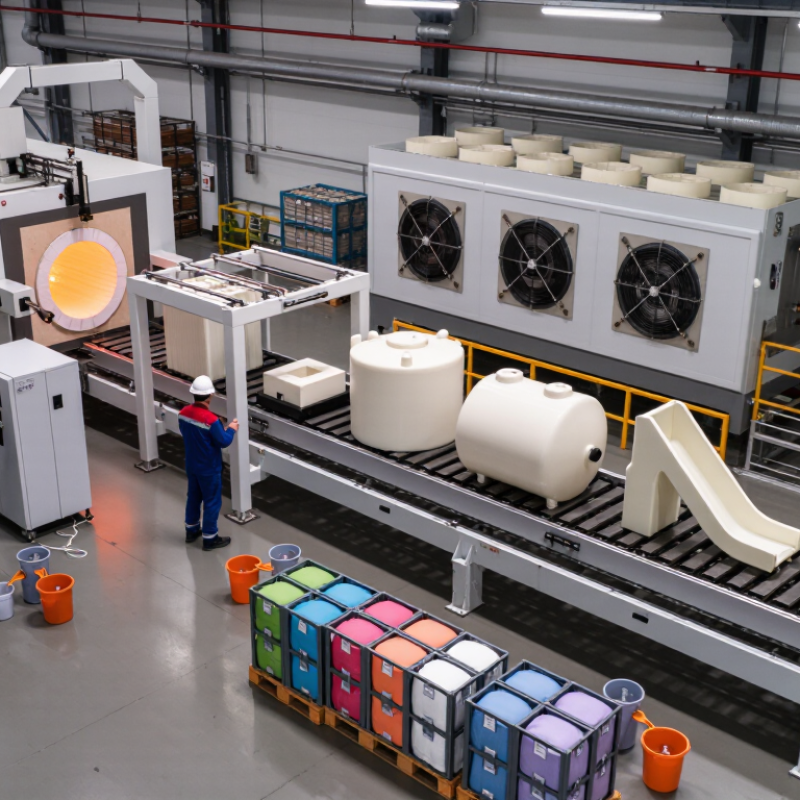
| Single-Station Shuttle Machine | One mold carriage moves between the heating chamber and the cooling or loading area. | Small to medium hollow parts; size depends on the chamber and carriage dimensions. | Polyethylene, cross-linked polyethylene, polypropylene, polyamide, and selected engineering resins. | Tanks, containers, planters, toys, housings, and agricultural components. | Plastic powder is loaded into a mold. The carriage enters a heated chamber and rotates on two perpendicular axes so the softened polymer coats the mold wall. The mold then moves out for controlled cooling. | Simple layout, moderate investment, flexible mold changes, and easy access for manual loading. | Production output is limited by the single mold cycle; labor and cooling control should be assessed carefully. |
| Two-Station Shuttle Machine | Two mold carriages or two working positions share a heating chamber and a cooling or loading zone. | Small, medium, or large parts depending on oven width, carriage capacity, and mold envelope. | Rotomolding-grade polyethylene is most common; other compatible thermoplastics may be used after process validation. | Storage tanks, road barriers, industrial containers, ducts, and medium-sized technical parts. | One carriage is heated while the other is unloaded, loaded, or cooled. Each mold rotates biaxially during heating to distribute material without internal pressure. | Better utilization of the oven, shorter idle time, and higher productivity than a basic single-station layout. | Requires accurate timing between heating, transfer, cooling, and mold preparation operations. |
| Independent Double-Shuttle Machine | Two shuttles operate independently, allowing different molds or products to follow separate cycle schedules. | Mixed-size production, from compact parts to large rotationally molded components. | Polyethylene grades, polypropylene, polyamide, and other thermoplastics approved for rotational molding. | Manufacturers producing several product sizes, replacement parts, bins, tanks, and customized components. | Each shuttle can be positioned and timed separately. Biaxial rotation continues during the heating stage, while independent cooling parameters help accommodate different wall thicknesses. | High scheduling flexibility, improved equipment utilization, and reduced disruption when molds or products change. | Higher control-system complexity and greater floor-space requirements than a basic shuttle arrangement. |
| Multi-Arm Shuttle Machine | Several mold arms or carriages move between a common heating chamber and separate service areas. | Medium to large parts, or multiple smaller molds loaded on one arm. | Most commonly rotational-molding polyethylene and other thermoplastics with suitable melt-processing behavior. | Large containers, pallets, seating products, playground components, and industrial equipment covers. | Molds are heated while rotating around two axes. Multiple arms are sequenced so heating, cooling, demolding, and loading activities can overlap. | Higher throughput, better use of oven capacity, and the ability to run multiple mold configurations. | Arm payload, interference clearance, oven uniformity, and maintenance access must be checked before purchase. |
| Large-Part Shuttle Machine | Heavy-duty shuttle carriage with a large oven and reinforced rotation system for oversized molds. | Large tanks, cabins, containers, ducts, and other hollow products with substantial mold dimensions. | Primarily polyethylene; material selection depends on impact, chemical, temperature, and structural requirements. | Water and chemical tanks, traffic products, marine components, agricultural tanks, and large housings. | A measured polymer charge is placed inside the mold. Heat softens the polymer while controlled biaxial rotation builds a hollow wall. Cooling solidifies the part before demolding. | Supports large products with relatively low tooling pressure and can produce seamless hollow structures. | Higher energy demand, longer heating and cooling times, heavy mold handling, and stricter foundation requirements. |
| Electric-Drive Shuttle Machine | Electric motors and electronically controlled drives operate arm rotation, carriage movement, and auxiliary functions. | Small to large products, subject to motor torque, arm payload, and oven dimensions. | Compatible with standard rotational-molding thermoplastics when the machine provides suitable process temperatures. | Precision parts, repeat production, containers, technical housings, and applications requiring process data recording. | Programmable drive systems control rotational speed, axis ratio, heating time, cooling time, and movement sequences. Rotation remains coordinated while the polymer melts and coats the mold. | Accurate speed control, clean operation, reduced hydraulic-oil use, and easier recipe repeatability. | Electrical infrastructure, drive protection, software support, and replacement-part availability should be evaluated. |
| Hydraulic-Drive Shuttle Machine | Hydraulic motors and cylinders provide carriage movement, arm rotation, clamping, or auxiliary actuation. | Medium to large products where high torque and heavy-duty movement are required. | Common rotational-molding thermoplastics, including various polyethylene grades. | Heavy tanks, industrial containers, large molds, and demanding production environments. | Hydraulic power transfers torque to the rotating arms and moves the shuttle carriage. Heating melts the charge, while biaxial rotation distributes the material over the mold surface. | High torque capability, robust movement, and suitability for heavy molds and large equipment. | Hydraulic-temperature control, leakage prevention, filtration, noise, and maintenance costs require attention. |
| Gas-Fired Shuttle Machine | A combustion heating system supplies hot air to the oven through a controlled burner and circulation system. | Medium to large products, depending on thermal capacity and oven volume. | Thermoplastics selected for the required processing window, especially rotational-molding polyethylene. | Large tanks, bins, barriers, agricultural products, and general-purpose hollow components. | Controlled hot air transfers heat to the mold and polymer charge. Biaxial mold rotation promotes even coating, while sensors and controls manage the thermal cycle. | High heating capacity and suitability for large ovens and heavy molds. | Ventilation, combustion safety, fuel supply, exhaust management, and temperature uniformity are essential. |
| Electric-Heated Shuttle Machine | Electrical heating elements and circulation fans create and distribute hot air inside the oven. | Small to medium products, with larger configurations available for higher electrical capacity. | Polyethylene and other thermoplastics that meet the machine's temperature range and process requirements. | Indoor production, technical parts, containers, small tanks, and operations requiring clean heating. | Heating elements raise the oven-air temperature. The rotating mold transfers heat to the polymer charge, which melts and forms a continuous hollow layer against the mold wall. | Clean operation, straightforward temperature control, and no combustion exhaust at the machine. | Electrical load, heating-element replacement, insulation quality, and operating cost should be compared with fuel-based systems. |
| Automated Shuttle Rotomolding Cell | Shuttle equipment is integrated with automated dosing, mold handling, temperature monitoring, cooling, and demolding functions. | Repeated production of small, medium, or large parts, depending on cell design. | Validated rotational-molding thermoplastics, with material handling matched to powder size and formulation. | High-volume containers, repeatable industrial parts, automotive components, and products with strict process records. | Automated systems control the material charge, mold movement, biaxial rotation, heating profile, cooling sequence, and production data collection. | Consistent cycle control, lower manual handling, improved traceability, and potential labor savings. | Higher initial investment; integration, programming, safety guarding, and operator training are critical. |
| Manual or Semi-Automatic Shuttle Machine | Operators manually load powder, install molds, monitor selected steps, and remove finished parts; movement may be powered. | Small to medium products and low-to-moderate production volumes. | Common rotational-molding powders, especially polyethylene grades suitable for the mold and cycle. | Prototypes, custom parts, short production runs, replacement components, and frequent mold changes. | The operator prepares the mold and charge, while the machine performs controlled heating and biaxial rotation. Cooling and demolding are completed according to the production procedure. | Lower entry cost, flexible production, and practical for varied or low-volume products. | Output and consistency depend more heavily on operator skill, work instructions, and process monitoring. |