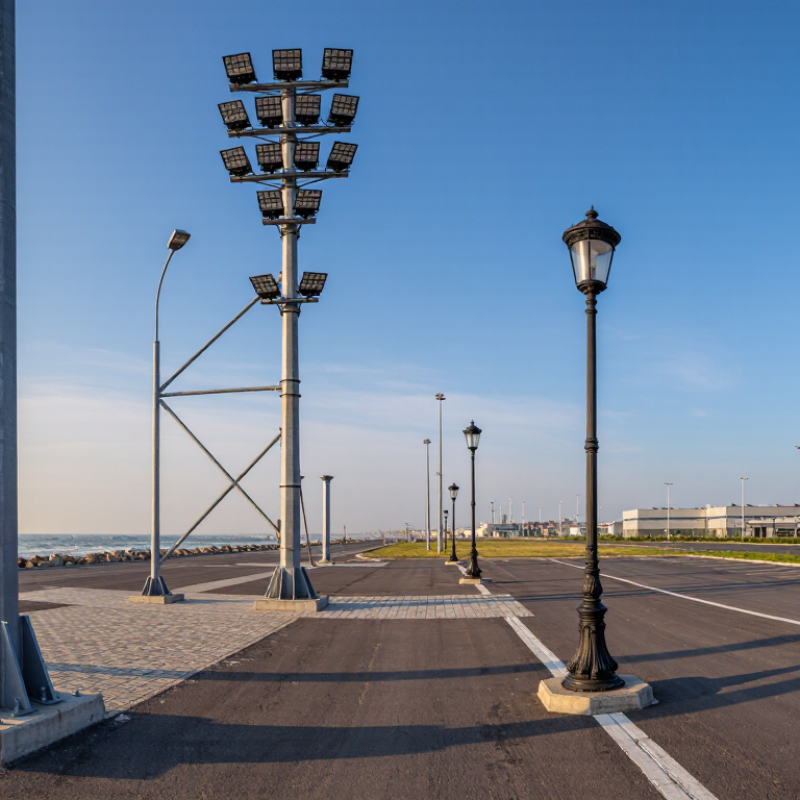
Choosing a steel light pole is not simply a question of height or price. The right design must suit the site, the lighting equipment, and local weather conditions. A coastal road may need stronger corrosion protection than a sheltered parking area. An open industrial yard may require a taller pole with carefully checked wind loads. Details matter.
This guide introduces common options for global buyers, including tapered, octagonal, high-mast, decorative, and solar-ready poles. Each type serves different needs, and names or standard features can vary between suppliers. Buyers should compare pole dimensions, steel grade, protective coating, base plate, anchor bolts, and luminaire mounting details. Ask for drawings and load information, not just a catalog image. A polished specification is not always a complete one.
There is no single best steel light pole for every project. Local engineering requirements, transport limits, installation access, and maintenance plans can change the decision. Confirm applicable standards with qualified project professionals, since requirements differ by location and application. This overview is a starting point, not a substitute for project-specific design review. Some choices look obvious on paper, then prove awkward during installation. Careful comparison helps buyers spot those gaps before ordering and select a solution that is practical, durable, and suited to its intended use.
Steel light poles are not one standard shape with different labels. Their geometry affects stiffness, appearance, fabrication, and installation. Tapered poles narrow toward the top, reducing visual bulk while keeping a clean roadside profile. They suit many conventional luminaires, but base plates and anchor-bolt layouts must match project drawings. Details matter.
Octagonal poles have eight flat faces, which can provide practical surfaces for brackets and access features. Buyers should compare wall thickness, section length, weld quality, and coating specifications rather than judging strength by shape alone.
High-mast poles illuminate broad areas such as ports, interchanges, and sports grounds. Their tall shafts may use lowering systems, so maintenance access, wind loads, foundations, and servicing need early review. Plan early.
Decorative steel poles bring lighting into streets, plazas, and heritage-style developments through shaped shafts, arms, bases, or ornamental details. These features can make cleaning and recoating harder, especially around joints and trim. Request dimensional drawings, material and coating records, load assumptions, and inspection guidance. Match each pole to its luminaire, soil conditions, and site exposure, not just a catalogue image. The most attractive option may not be the easiest to maintain; that trade-off deserves discussion before purchase.