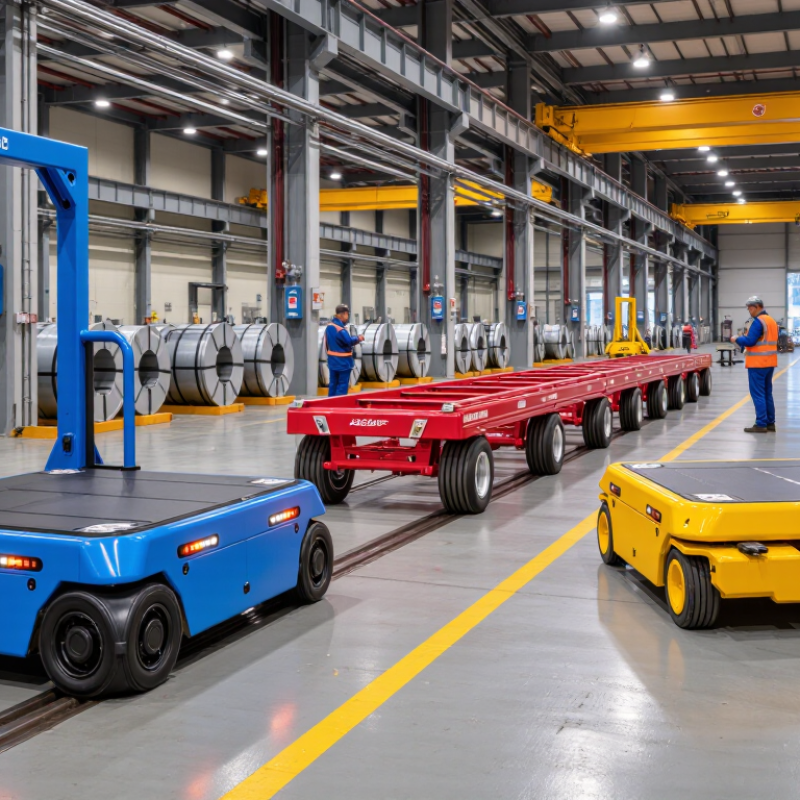
| Rail-Guided Steerable Transfer Cart | A powered cart that follows embedded or surface-mounted rails while its wheel assemblies maintain alignment through a guided steering or flange system. | Welded steel frame, load deck, four or more steel wheels, geared drive unit, guide wheels or flanged wheels, control cabinet, safety bumpers, and braking system. | Rechargeable battery, cable reel, or rail-side power supply. Battery systems are commonly selected where the route contains crossings or movable sections. | 10–500 tonnes, depending on frame, wheel load, rail design, and floor conditions. | Approximately 0.3–1.5 m/s under loaded operating conditions. | The drive motor applies torque to the wheels; the rails constrain the travel path and transfer horizontal guiding forces, while brakes stop and hold the cart. | Suitable for repeated, fixed routes and high loads. Requires rail installation, accurate alignment, drainage planning, and regular inspection of wheels and rails. |
| Trackless Steerable Transfer Cart | A rail-free industrial platform cart that changes direction through steerable wheel modules, differential wheel control, or an articulated steering axle. | Heavy-duty chassis, polyurethane or steel wheels, steering actuators, traction motors, battery pack, onboard controller, load platform, obstacle sensors, and emergency-stop devices. | Rechargeable lithium-ion or lead-acid battery with an onboard charger or automatic charging station. | 5–300 tonnes in common industrial configurations; higher capacities require detailed floor and wheel-load engineering. | Approximately 0.2–1.0 m/s, generally reduced in congested or pedestrian-access areas. | A controller coordinates wheel speed and steering angle using operator commands, programmed routes, sensors, or radio control. The cart turns within a defined minimum radius. | Useful where rails cannot be installed or routes change frequently. Requires a level, load-rated floor, accurate localization, and strict traffic-management procedures. |
| Battery-Powered Multi-Directional Cart | A steerable cart equipped with independently controlled wheel units that can travel forward, reverse, and laterally, including diagonal movement in some designs. | Low-profile structural frame, multi-directional wheel modules, traction drives, steering encoders, battery system, hydraulic or mechanical load supports, and safety scanning devices. | Rechargeable lithium-ion or lead-acid battery; charging method depends on duty cycle and operating shift pattern. | 10–200 tonnes for typical plant-transfer duties. | Approximately 0.2–0.8 m/s, depending on steering mode, payload, and floor quality. | Each wheel module receives coordinated speed and angle commands. The control system calculates wheel velocities to achieve the selected travel direction without rail guidance. | Effective in narrow bays, assembly halls, and areas requiring precise positioning. More complex controls and wheel calibration increase maintenance requirements. |
| Cable-Reel-Powered Steerable Cart | A cart supplied by a flexible trailing cable wound and unwound by a motorized or spring-assisted reel while the chassis follows a guided or controlled route. | Steel chassis, cable reel, power collector, geared drive system, steerable wheels, protective cable guides, electrical enclosure, and braking equipment. | External AC or DC supply through a cable reel; cable length and current rating are selected according to route and motor demand. | 20–500 tonnes, subject to the drive arrangement and floor or rail design. | Approximately 0.2–1.0 m/s. | Continuous electrical power is delivered through the reel. Steering and traction controls regulate the cart position while the reel maintains suitable cable tension. | Suitable for long shifts and high-energy applications. Cable protection, bend radius, reel tension, trip hazards, and route crossings require careful design. |
| Guided Automatic Steerable Cart | An automated cart that uses steering actuators and a navigation system to follow programmed routes without continuous manual driving. | Chassis, drive and steering modules, onboard computer, navigation sensors, safety scanners, communication unit, battery, load deck, and emergency circuits. | Battery power with automatic charging, opportunity charging, or battery exchange depending on operating hours. | 1–100 tonnes for common automated material-handling applications. | Approximately 0.3–1.5 m/s, subject to risk assessment and local operating rules. | The vehicle uses mapped paths, magnetic markers, reflectors, laser-based localization, camera guidance, or other navigation inputs to calculate steering and speed commands. | Appropriate for repeatable logistics flows. Requires verified routes, reliable localization, safety zones, traffic interfaces, and integration with production or warehouse controls. |
| Hydraulic-Lift Steerable Transfer Cart | A steerable cart with an integrated lifting platform that raises or lowers loads for transfer, alignment, docking, or direct handover. | Reinforced chassis, hydraulic cylinders, pump unit, lifting deck or forks, steerable drive wheels, load-holding valves, control system, and mechanical safety locks. | Battery-electric hydraulic power pack or electric-hydraulic system. | 5–100 tonnes, depending on lift height, center of gravity, and deck dimensions. | Approximately 0.1–0.6 m/s during travel; lifting speed is normally controlled separately. | The traction system moves and steers the cart, while hydraulic pressure extends the cylinders. Load-holding components help prevent unintended platform descent. | Useful for loading docks, machining lines, assembly stations, and height-mismatched transfer points. Stability, load distribution, hydraulic leakage prevention, and safety locking are critical. |
| Heavy-Duty Industrial Steerable Cart | A high-capacity platform vehicle designed for oversized or concentrated loads, using reinforced steering assemblies and multiple load-bearing wheel sets. | Box-section steel frame, modular wheel bogies, multiple traction units, heavy-duty bearings, structural deck, load restraints, braking system, and high-capacity control cabinet. | Large battery pack, cable reel, or fixed electrical supply. The choice depends on route length, duty cycle, and required travel freedom. | 100–1,000 tonnes or more in specially engineered systems. | Approximately 0.1–0.6 m/s, with lower speeds often used for very high loads or tight maneuvering. | Multiple drive and steering units distribute traction and wheel loads. The control system synchronizes the modules to limit frame twist and maintain directional accuracy. | Designed for shipbuilding, steel processing, precast construction, power equipment, and large machinery. Floor bearing capacity, turning clearance, braking distance, and load center are essential design inputs. |
| Explosion-Risk-Area Steerable Cart | A steerable transfer vehicle adapted for locations where flammable gases, vapors, dust, or other hazardous atmospheres may be present. | Enclosed electrical components, protected traction motors, static-control provisions, sealed battery enclosure, steerable chassis, emergency-stop system, and risk-assessed safety devices. | Battery-electric power or another approved supply system selected according to the hazardous-area classification and applicable regulations. | Typically 1–100 tonnes, with capacity determined by the application and certified equipment configuration. | Approximately 0.1–0.6 m/s, subject to the site risk assessment. | Traction and steering are controlled as with other electric carts, but ignition-risk sources are minimized through certified component selection, enclosure design, grounding, and operational controls. | Used only after a formal hazardous-area assessment. Equipment classification, temperature limits, charging arrangements, inspection, and local legal compliance must be verified before purchase. |