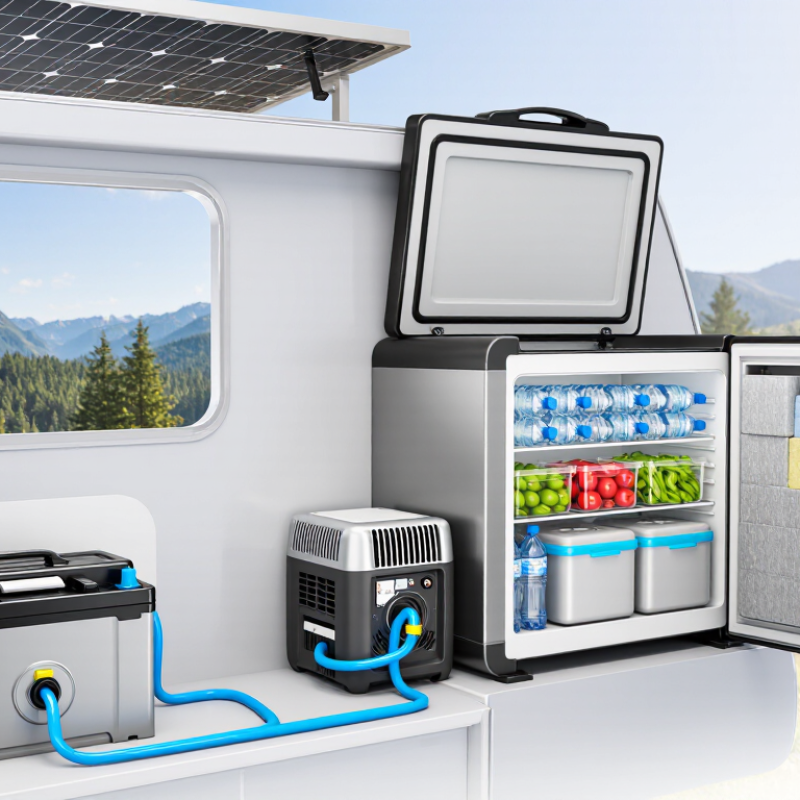
| 12V Compressor Refrigerator | A motor-driven compressor circulates refrigerant through a closed vapor-compression system to remove heat from the cabinet. | 30–200 L | 12V DC or 24V DC; many units also accept 100–240V AC through an adapter. | Approximately 0.3–1.2 kWh per 24 hours, depending on size, ambient temperature, insulation, and thermostat setting. | Usually reaches about 0°C to 10°C in the refrigerator compartment; freezer sections can commonly reach approximately −18°C. | Approximately 35–50 dB during compressor operation. | Fast cooling, efficient battery operation, reliable performance in warm weather, and the ability to freeze food. | Higher purchase cost than basic thermoelectric units; compressor start-up current must be supported by the wiring and battery system. | Best overall choice |
| 12V Compressor Portable Fridge | A compact compressor cooling circuit operates inside a portable insulated case, often with a digital thermostat. | 15–60 L | 12V DC or 24V DC; commonly supplied with a vehicle socket cable and an AC adapter. | Approximately 0.2–0.8 kWh per 24 hours, depending on capacity and ambient conditions. | Typically adjustable from around +10°C down to −20°C; actual freezer performance varies by design. | Approximately 35–48 dB. | Easy installation, low energy demand, strong cooling, and convenient portability. | Limited storage volume and less organized interior space than a built-in RV refrigerator. | Small RVs and camper vans |
| Absorption Refrigerator with 12V Controls | A heat source drives an ammonia-water absorption cycle. The 12V connection usually powers the control board and ignition rather than providing the main cooling energy. | 60–180 L | 12V DC for controls; commonly designed for LPG and/or 120V or 230V AC operation. | Electrical consumption varies widely; LPG use is commonly about 0.2–0.5 kg per 24 hours when operating on gas. | Normally maintains approximately 0°C to 8°C in the refrigerator compartment, but performance decreases in high ambient temperatures. | Very quiet because there is no continuously running compressor. | Can operate from LPG when shore power or sufficient battery capacity is unavailable. | Slower cooling, requires near-level installation, lower efficiency, and needs proper ventilation and gas safety measures. | Long off-grid trips with an approved LPG system |
| Thermoelectric Cooler | A Peltier module transfers heat from one side of the unit to the other when DC power passes through it. | 10–50 L | 12V DC; some models include an AC adapter. | Approximately 0.4–1.0 kWh per 24 hours because the cooling module may run continuously. | Often cools approximately 15–25°C below ambient temperature; it normally cannot maintain freezer temperatures. | Approximately 35–55 dB because of the cooling fan. | Simple construction, low initial cost, lightweight design, and no refrigerant compressor. | Weak performance in hot weather, continuous power demand, condensation, and limited food-storage capability. | Short trips and beverage cooling |
| Built-In Dual-Zone Compressor Refrigerator | One or two compressor-controlled compartments provide independent refrigerator and freezer temperature management. | 50–100 L | 12V DC or 24V DC; some models support AC through an external or integrated power supply. | Approximately 0.6–1.5 kWh per 24 hours, depending on compartment temperatures and ambient conditions. | Commonly provides a refrigerator zone near 0°C to 10°C and a freezer zone near −18°C. | Approximately 38–52 dB. | Separate temperature zones, practical food organization, and dependable freezing during extended travel. | Uses more space and power than a single-zone unit and generally costs more. | Family RVs and long journeys |