| Material density | Structural aluminum alloys | Approximately 2.70 g/cm³ | Aluminum is much lighter than carbon steel, which can simplify transport, assembly, and foundation preparation. | Useful for projects with limited access, manual installation, or lower shipping weight requirements. |
| Common frame alloy | 6063-T5/T6 extruded aluminum | Typical yield strength: about 110–215 MPa, depending on temper and section | Provides a practical balance of extrudability, surface finish, corrosion resistance, and structural capacity. | A suitable general-purpose choice when profiles are properly sized and engineered for local loads. |
| Higher-strength frame option | 6061-T6 aluminum used in selected structural parts | Typical yield strength: about 240–275 MPa | Can improve resistance to bending and connection stress where additional structural strength is required. | Check whether the alloy is used in the main load-bearing members rather than only in small fittings. |
| Corrosion protection | Exterior powder coating | Common dry-film thickness: approximately 60–120 μm | Adds a protective decorative layer and can improve resistance to weathering when surface preparation and curing are controlled. | For coastal or industrial locations, request a coating system tested for the intended exposure category. |
| Anodized finish | Anodized aluminum profiles | Common architectural anodic film thickness: approximately 10–25 μm | Creates an integral oxide layer with good abrasion resistance and a metallic appearance. | Color consistency and salt exposure performance should be verified through project samples and applicable specifications. |
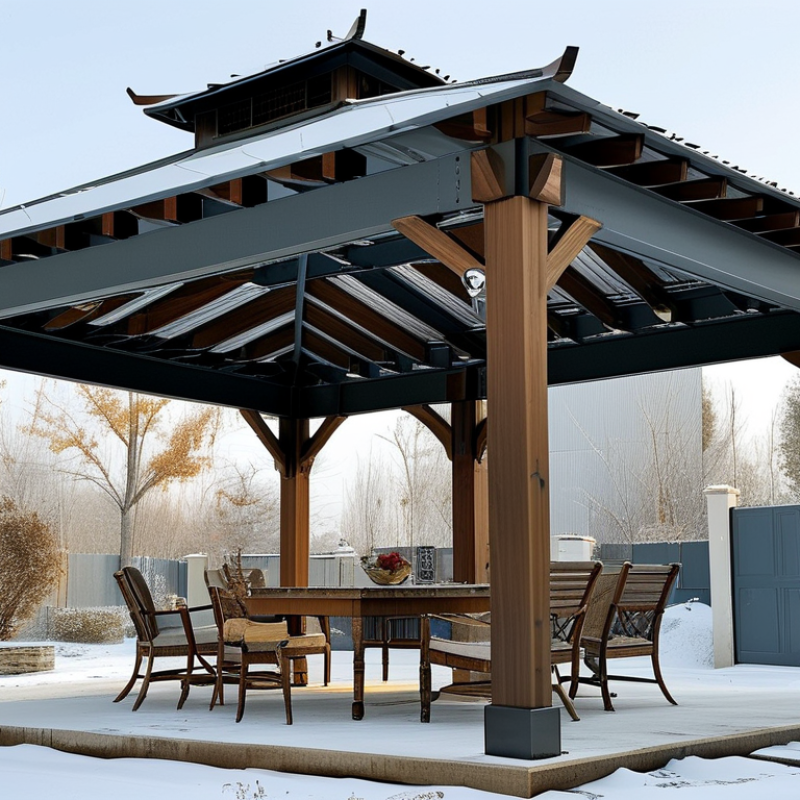
| Roof configuration | Fixed solid roof with drainage gutters | Typical roof pitch: approximately 5–15° | Improves rainwater runoff and can provide more consistent shade and weather protection than an open roof. | Confirm drainage outlets, snow-load design, waterproofing details, and compatibility with local rainfall conditions. |
| Adjustable roof design | Aluminum louvered roof | Louver rotation commonly approaches 90°, depending on mechanism design | Allows users to control sunlight and ventilation; closed louvers can direct rain toward integrated gutters. | Moving components require accurate installation, periodic inspection, and protection from ice or debris. |
| Thermal expansion | Aluminum frame and roof members | Coefficient of thermal expansion: approximately 23 × 10⁻⁶/K | Aluminum expands and contracts noticeably with temperature changes, so joints and fasteners need suitable movement tolerance. | Important in regions with large day-to-night or seasonal temperature differences. |
| Heat transfer | Uninsulated aluminum roof and frame | Thermal conductivity: roughly 150–235 W/m·K for common aluminum alloys | Aluminum transfers heat efficiently, so roof color, ventilation, insulation, and shading design strongly affect comfort. | For hot climates, consider ventilated louvers, insulated roof panels, light-colored finishes, and solar-control layouts. |
| Wind performance | Anchored frame with engineered bracing | Design wind pressure varies by location; many building standards use basic wind speeds of approximately 30–60 m/s for different regions | Post size, roof shape, bracing, anchors, and foundation connections usually influence wind resistance more than material name alone. | Require project-specific calculations or certification for typhoon, hurricane, cyclone, and exposed coastal areas. |
| Snow performance | Steep or reinforced roof with adequate drainage | Snow load must be calculated from the local ground and roof snow-load requirements | Beam span, roof shape, connections, and accumulated snow conditions determine structural safety. | Do not select a standard roof package for heavy-snow regions without local structural verification. |
| Connection quality | Stainless-steel fasteners with isolating washers or compatible hardware | Fastener grade, coating, and isolation detail depend on load and exposure conditions | Correct connections reduce loosening, galvanic corrosion, joint deformation, and water penetration. | In marine environments, specify compatible metals and prevent direct contact between dissimilar materials. |
| Expected service life | Engineered aluminum frame with maintained coating and drainage | Often designed for 10–25+ years, subject to environment, coating system, loads, and maintenance | Aluminum does not rust like carbon steel, but coating damage, galvanic corrosion, fastener failure, and water traps still require attention. | Request maintenance instructions, spare-part availability, warranty terms, and inspection intervals. |