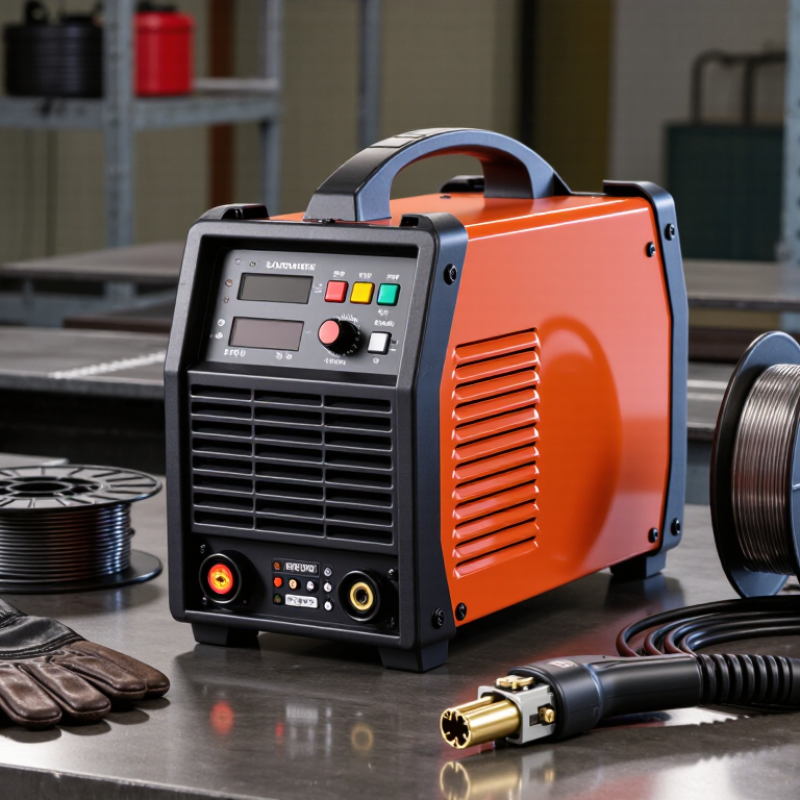
| Welding Process | Self-shielded FCAW | Uses flux-cored wire without an external shielding-gas cylinder. It is suitable for outdoor work where wind may disturb gas shielding. | Confirm that the machine supports the required polarity, usually electrode-negative or electrode-positive depending on the wire specification. Select wire according to the manufacturer’s welding procedure. |
| Welding Process | Gas-shielded FCAW | Uses flux-cored wire with shielding gas, commonly carbon dioxide or an argon/carbon-dioxide mixture. It generally requires better wind protection than self-shielded FCAW. | Check gas inlet fittings, regulator compatibility, flow-rate control, and the recommended gas composition for the selected wire. |
| Output Capacity | Rated welding current | Compact single-phase machines commonly cover approximately 120–200 A; heavier workshop units may provide approximately 200–300 A or more. | Match the rated current to the material thickness, wire diameter, and required duty cycle instead of relying only on the maximum advertised amperage. |
| Output Capacity | Duty cycle | Duty cycle is normally stated over a 10-minute period. For example, 60% at 180 A means about 6 minutes of welding followed by about 4 minutes of cooling within that test period. | Compare duty-cycle ratings at the same amperage and ambient-temperature test conditions. Provide additional cooling time when operating in hot environments. |
| Wire System | Compatible wire diameters | Common flux-cored wire diameters include 0.8 mm, 0.9 mm, 1.0 mm, 1.2 mm, and 1.6 mm. Availability depends on the welding process and application. | Verify that the supplied drive rolls, contact tips, liner, and wire spool holder match the intended wire diameter and spool size. |
| Wire System | Wire-feed speed control | A continuously adjustable wire-feed system provides better control of arc stability, deposition rate, and bead appearance than a limited stepped control. | Request the adjustment range, feed-roll type, motor specification, and a test video using the target wire diameter. |
| Input Power | Voltage and frequency | Equipment made for the Chinese domestic market commonly uses 220 V single-phase, 50 Hz power. Global destinations may require 110–120 V, 220–240 V, 50 Hz, or 60 Hz versions. | Specify the destination voltage, phase, and frequency before ordering. Do not assume that a plug adapter can correct an incompatible input voltage or frequency. |
| Input Power | Input current and protection | Actual input current depends on output current, efficiency, power factor, and supply voltage. A properly sized circuit breaker, cable, grounding conductor, and socket are required. | Obtain the technical datasheet showing maximum input current, recommended breaker rating, cable size, and grounding requirements. Installation should follow local electrical regulations. |
| Control Functions | Recommended operating controls | Useful controls may include voltage or arc-length adjustment, wire-feed speed, inductance or arc control, two-step/four-step trigger modes, and thermal overload protection. | Prioritize controls that correspond to the intended welding process. Avoid paying for functions that are not supported by the selected wire or power supply. |
| Material Range | Typical steel applications | FCAW is widely used for carbon-steel fabrication, repair, structural work, agricultural equipment, and outdoor maintenance. Actual thickness capability depends on current, joint design, and the wire procedure. | Request sample welds on the buyer’s actual base material and thickness. Evaluate penetration, fusion, spatter, slag removal, and bead profile. |
| Portability | Weight and mobility | Small inverter machines are generally easier to transport than transformer-based units. Actual portability depends on the enclosure, cable length, spool size, and carrying handle. | Confirm net weight, packed weight, carton dimensions, handle strength, wheel requirements, and cable storage before calculating shipping and handling costs. |
| Safety | Protection features | Important features include thermal overload protection, over-current protection, under-voltage or over-voltage tolerance, insulation protection, cooling-fan control, and a properly grounded enclosure. | Request test reports and conformity documents applicable to the destination market. Check that the rating label, user manual, warning labels, and wiring diagram are supplied in the required language. |
| Compliance | Export and destination requirements | Electrical welding equipment may be subject to destination-specific requirements covering electrical safety, electromagnetic compatibility, plug configuration, documentation, and labeling. | Confirm the correct product classification, customs documentation, country-of-origin information, commercial invoice, packing list, and transport insurance with the importer or customs broker. |
| Shipping | Packaging protection | A complete shipment should protect the machine from impact, moisture, abrasion, and movement. Common protections include inner cushioning, a strong export carton, and palletization for larger orders. | Specify drop protection, moisture-resistant packing, carton markings, serial-number records, spare-parts packing, and pre-shipment photographs. |
| Included Parts | Standard accessories | Typical accessories may include a torch, work clamp, electrode or work cable, gas hose for gas-shielded operation, contact tips, drive rolls, nozzle, and operating manual. | Use a signed packing list that identifies each accessory, quantity, specification, and replacement-part compatibility. Confirm whether the torch connection is a standard or proprietary type. |
| Quality Control | Pre-shipment inspection | A practical inspection can cover input-voltage operation, no-load voltage, wire-feed operation, output-current performance, thermal protection, fan operation, and visible workmanship. | Define acceptance criteria before payment. Record serial numbers, test results, photographs, welding samples, and any nonconformities in the inspection report. |
| Maintenance | After each use | Remove slag and spatter from the nozzle and work area, inspect the torch cable, check the work clamp, and store flux-cored wire in a dry, sealed condition. | Disconnect power before cleaning internal areas. Do not use damaged cables, loose connectors, cracked insulation, or a deformed contact tip. |
| Maintenance | Regular cleaning | Dust and metal particles can restrict cooling airflow and affect electrical reliability. Cleaning frequency depends on the workshop environment and operating hours. | Inspect air inlets, outlets, fans, and internal dust accumulation regularly. Use dry, clean compressed air only when permitted by the service instructions and safety procedures. |
| Maintenance | Wire-feed system | Drive-roll grooves, guide tubes, liners, and contact tips wear over time and can cause slipping, bird-nesting, inconsistent feeding, or unstable arcs. | Use the correct drive-roll profile and pressure. Replace worn contact tips and liners, and keep the wire path free from rust, dirt, and excessive friction. |
| Maintenance | Consumable storage | Moisture and contamination can increase porosity, spatter, and unstable welding performance. Flux-cored wire should be stored according to the wire manufacturer’s conditions. | Keep opened spools sealed and dry. Inspect wire for rust, surface contamination, crushed edges, or bird-nesting before installation. |
| Total Cost | Landed-cost calculation | The landed cost includes product price, accessories, export packing, inland transport, international freight, insurance, customs duties, taxes, brokerage, local delivery, and possible certification expenses. | Compare suppliers using the same Incoterm, voltage version, accessory list, packaging specification, warranty coverage, and destination charges. |
| Warranty | After-sales support | Effective support requires clear warranty duration, response time, exclusion terms, spare-parts availability, service documentation, and a defined method for handling transport damage. | Request a written warranty policy and a recommended spare-parts list, including contact tips, liners, drive rolls, fuses, fans, torch components, and control-related parts. |
| Best-Fit Decision | Final purchasing checklist | Correct process Correct voltage Adequate duty cycle Compatible wire Destination compliance Service support | Choose the unit that satisfies the actual welding procedure, electrical system, import requirements, operating environment, and long-term consumable and spare-parts plan—not simply the unit with the highest advertised amperage. |