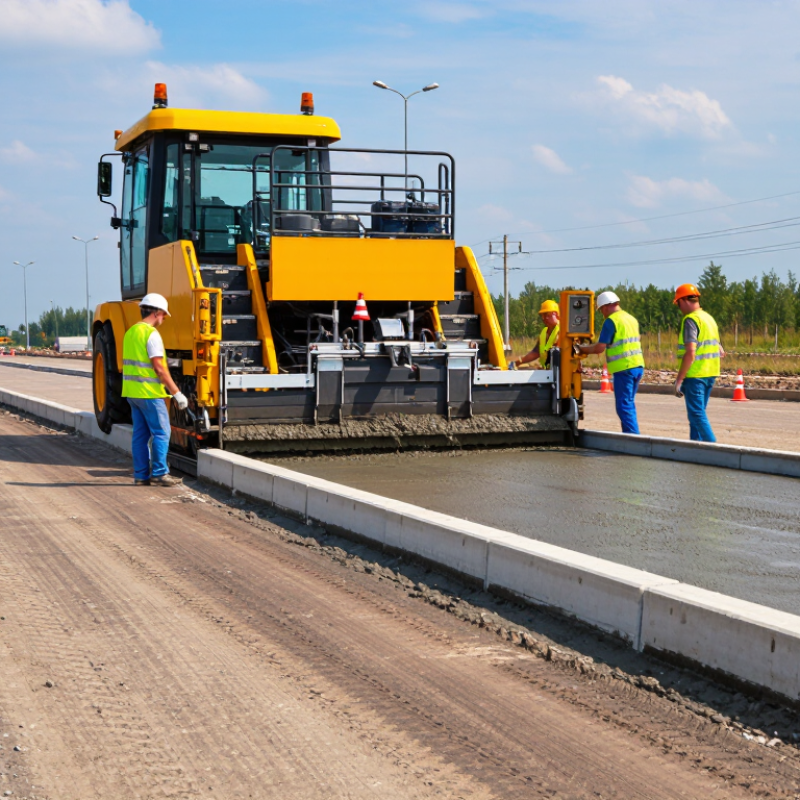
| Compact curb slipform paver | Smaller sites, urban streets, parking areas, and projects with limited working space. | Forms and extrudes concrete continuously along the curb line; the machine advances on its own tracks or wheels. | A compact footprint can make maneuvering and setup easier where access is restricted. | Smaller machines may have less capacity for large profiles or sustained high-volume work. Confirm the required profile and production rate. | Operating width, track or wheel configuration, mold availability, visibility, transport dimensions, and access to service. |
| Curb-and-gutter slipform paver | Roadway projects that require a combined curb and gutter profile. | Extrudes a continuous concrete section using a profile-specific mold, commonly following a prepared alignment. | Places the curb and gutter as one continuous section, which can reduce separate forming and placement steps. | Requires an appropriate mold, consistent concrete supply, and careful control of alignment, grade, and cross-slope. | Supported curb-and-gutter profiles, mold changeover process, grade and steering controls, and compatibility with project specifications. |
| Multi-purpose slipform paver with curb capability | Contractors handling varied paving work who need a machine configurable for curb applications. | Uses interchangeable or configurable paving equipment and molds to place different concrete profiles, depending on the machine setup. | Can support more than one type of paving task when the machine and attachments are designed for those applications. | Reconfiguration can require additional components, setup time, and trained operators; curb capability should be confirmed for the exact profile. | Available curb attachments, conversion time, control-system compatibility, transport requirements, and the cost of required components. |
| Fixed-form curb placement | Short runs, irregular layouts, repairs, or locations where a slipform setup is not practical. | Concrete is placed into positioned forms and finished after placement rather than continuously extruded by a curb slipform paver. | Forms can be adapted to short or irregular sections without setting up a continuous slipform operation. | Forming, finishing, and removal require labor and time; it is not a curb-paver machine configuration. | Compare as an alternative construction method when evaluating short runs, tight access, or non-standard geometry. |
| Selection note |
| There is no single best configuration for every project. Verify the required curb profile, site access, alignment and grade requirements, concrete supply, crew experience, transport needs, and local project specifications. Production depends on the machine, profile, concrete mix, site conditions, and material logistics; compare project-specific estimates rather than assuming a universal output rate. |