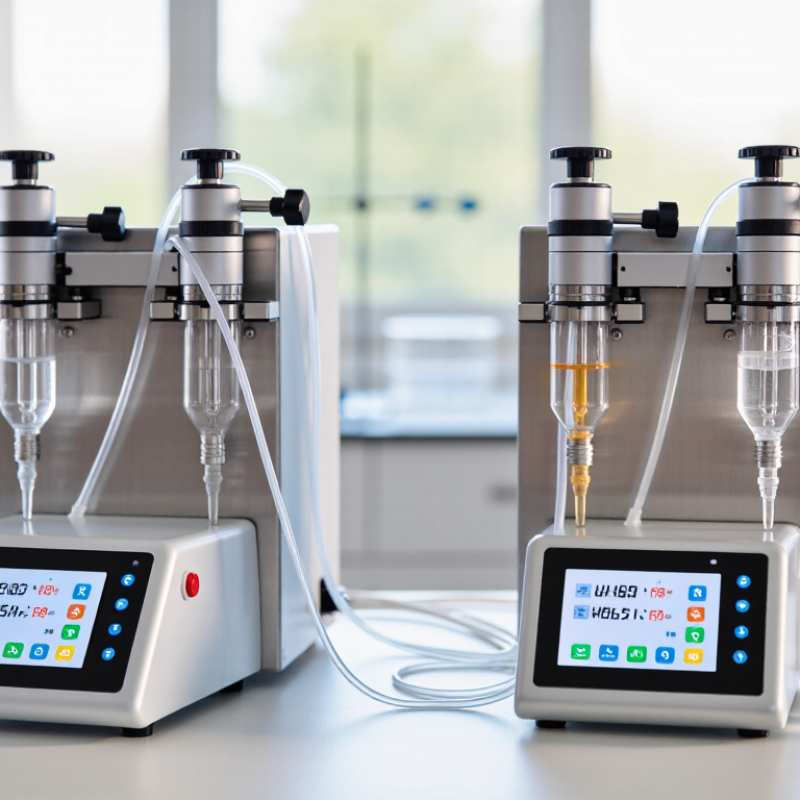
| General-purpose dual-channel pump | Routine laboratory infusion, reagent delivery, and two-stream experiments with moderate flow requirements. | Verify exact fit
Many pump families accept large-volume syringes, but supported sizes depend on the model and syringe geometry. | Verify exact fit
Do not assume a 60 mL syringe is supported just because a 50 mL syringe is listed. | Independent channel control, supported syringe-size list, flow-rate range, and a secure syringe-retention mechanism. | A flexible general-purpose setup may not provide the specialized controls needed for synchronized or tightly controlled protocols. |
| Large-syringe, low-flow configuration | Long-duration delivery where fewer syringe changes and steady low flow are priorities. | Often a candidate
Confirm the manufacturer’s supported syringe list and the specific syringe’s flange and plunger dimensions. | Check explicitly
Some systems distinguish nominal 50 mL and 60 mL syringe types; physical fit and calibration can differ. | Low-flow performance, drive resolution, occlusion or pressure monitoring, and the ability to set each channel independently. | Large syringes can require a compatible holder and may not be suitable for every low-volume or high-precision application. |
| Programmable dual-channel configuration | Protocols requiring timed steps, changing flow rates, alternating delivery, or coordinated channel operation. | Model-dependent
Check whether the selected syringe size is available in the pump’s configuration and setup menu. | Model-dependent
Confirm both physical compatibility and the correct syringe-size calibration option. | Program storage, independent channel programming, start/stop synchronization, alarms, and data or control interfaces. | More programming options can add setup complexity; validate the protocol before unattended operation. |
| Compact dual-channel configuration | Benchtop work where footprint and straightforward operation matter more than extended unattended runs. | Check holder limits
Confirm the pump can secure the chosen syringe’s barrel and plunger without interference. | May be limited
A compact frame may not accommodate every large syringe; check the supported-size specification. | Overall dimensions, channel spacing, mounting options, display readability, and ease of loading. | Smaller form factors can limit syringe size, accessory options, or available operating range. |
| Application-specific dual-channel configuration | Specialized setups such as infusion studies, microfluidic feeding, or delivery of sensitive fluids. | Application-dependent
Assess fit alongside tubing, connectors, fluid compatibility, and the required delivery range. | Application-dependent
Confirm the complete fluid path and syringe dimensions; nominal volume alone is not enough. | Compatible accessories, pressure limits, materials in contact with fluid, calibration guidance, and required compliance documentation. | Specialized configurations may be less adaptable to unrelated workflows. |