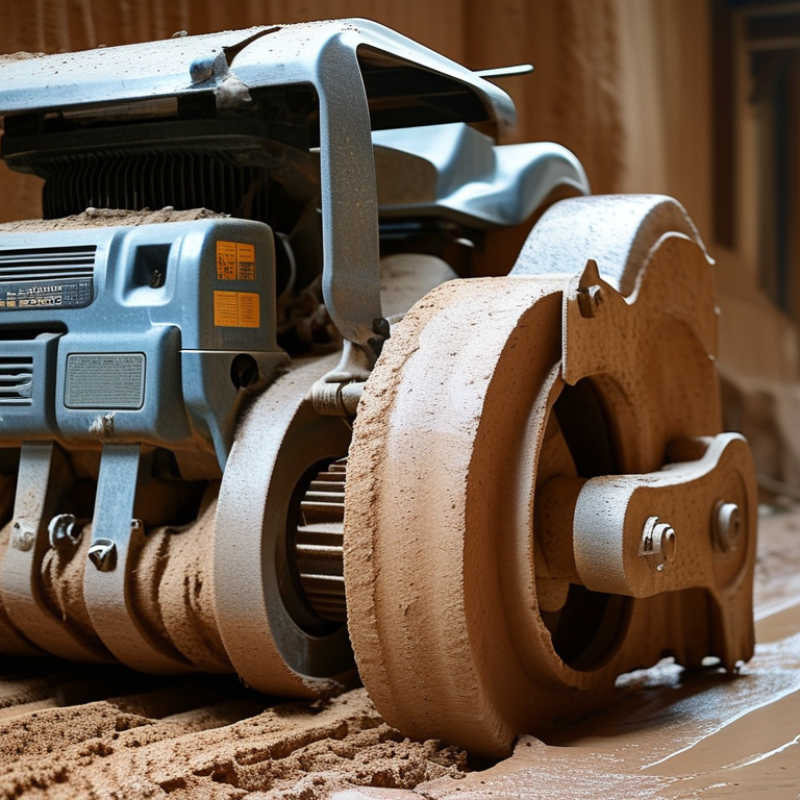
| Primary Purpose | Compaction of soil in narrow or confined areas | A reciprocating mechanism transfers repeated impact energy through a compact steel shoe into the ground. | Trenches, foundations, pipe backfill, road edges, and repair work | Confirm that the work area is too narrow or irregular for a vibratory Plate Compactor. |
| Suitable Soil Type | Most effective on cohesive and semi-cohesive soils, including clay, silt, and mixed backfill | The impact action kneads and rearranges soil particles, helping reduce air voids and increase density. | Clay-containing soil and utility-trench backfill | For clean, free-draining sand or granular aggregate, compare a vibratory plate compactor instead. |
| Operating Mass | Common professional units are approximately 50–80 kg, although lighter and heavier models exist. | The machine’s weight and impact mechanism work together to deliver concentrated compaction energy. | 50–65 kg: easier manual handling; 65–80 kg: greater force for demanding soil | Balance compaction performance with operator lifting, transport, and access requirements. |
| Impact Force | Many commonly used units deliver approximately 10–20 kN of rated impact force. | The crank, spring, and ram assembly repeatedly drives the shoe downward and then lifts it for the next stroke. | Higher force is useful for dense cohesive soil and deeper backfill layers. | Compare rated impact force using the same testing method; do not judge performance by engine power alone. |
| Compaction Shoe Width | Typical shoe widths are about 130–330 mm, depending on machine design. | The narrow shoe concentrates impact energy over a small surface area, allowing access to confined spaces. | Narrow shoes for trenches; wider shoes for more open backfill areas | Measure the trench width and allow sufficient clearance for safe operator control. |
| Impact Frequency | Many earth rammers operate within roughly 600–800 impacts per minute. | Repeated high-frequency impacts compact successive areas as the operator guides the machine forward. | General soil compaction where controlled, repeated impacts are required | A higher frequency is not automatically better; match frequency, force, and soil moisture to the application. |
| Power System | Gasoline engines commonly range from approximately 2–5 hp; electric versions are also available. | The engine or electric motor drives the clutch and crank mechanism that creates the vertical tamping motion. | Gasoline: outdoor mobility; electric: lower-emission areas with reliable power access | Check fuel consumption, electrical voltage, cable management, noise limits, and local emission rules. |
| Travel Speed | Typical forward travel speed is approximately 10–20 m/min, depending on soil and machine settings. | The operator guides the self-propelled rammer while the shoe impacts the surface continuously. | Short trench sections, repair zones, and small construction sites | Lower speed can provide more impacts per area; productivity also depends on layer thickness and soil condition. |
| Recommended Fill Layer | Backfill is generally compacted in multiple thin layers; the exact thickness depends on soil and equipment. | Each pass transmits energy into the current layer rather than effectively compacting an unlimited depth. | Utility trenches and foundation backfill placed in controlled lifts | Follow the project specification and verify density with an appropriate field compaction test. |
| Operator Comfort and Safety | Important features include vibration-reducing handles, balanced controls, emergency shutoff, and protective guards. | The handle allows directional control while isolating the operator from part of the machine’s vibration. | Frequent or extended compaction work | Review hand-arm vibration data, noise level, guarding, stability, and required personal protective equipment. |
| Maintenance Requirements | Routine service may include engine oil, air filter, spark plug, fuel system, clutch, springs, bolts, and shoe inspection. | The impact mechanism experiences repeated cyclic loading, making lubrication and fastener checks essential. | Construction fleets and rental operations requiring reliable uptime | Check spare-parts availability, service intervals, technical documentation, and warranty terms. |
| Best Overall Choice | The best earth rammer is the one whose force, shoe width, power system, safety features, and service support match the project. | Performance results from the combined effect of impact energy, frequency, operating mass, soil moisture, and operator technique. | Select by soil type, trench dimensions, required density, working environment, and expected utilization. | Request test data, inspect build quality, compare total ownership cost, and verify compliance with applicable safety standards. |