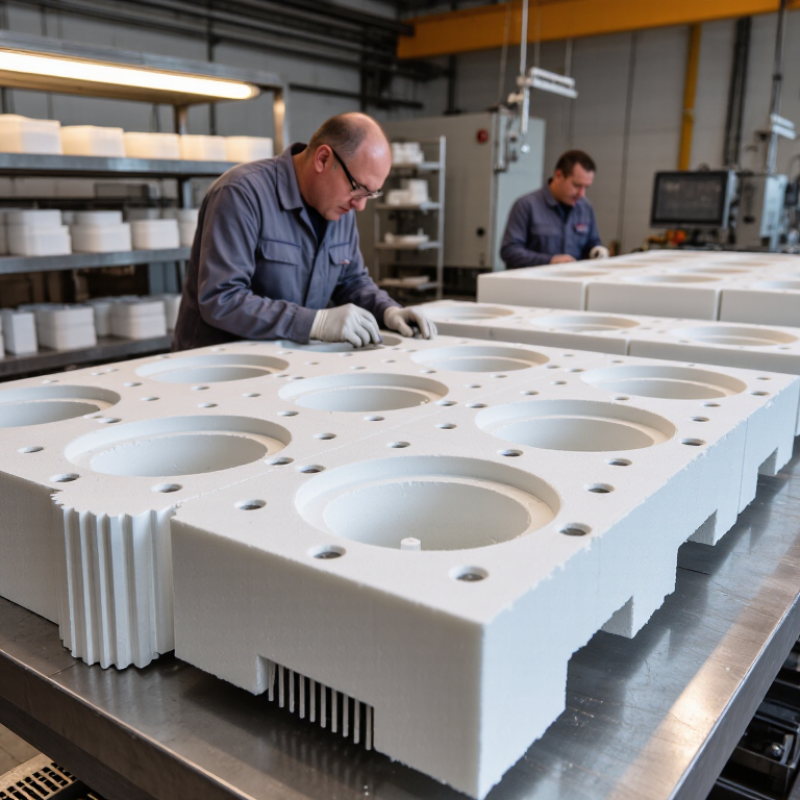
| CNC-machined EPS block pattern | Large or irregular castings; low-to-medium complexity; open surfaces; prototypes and engineering changes | Aluminum alloys, gray iron, ductile iron, carbon steel, low-alloy steel | 1–100 castings per design revision | Typically about ±0.5–1.5 mm, depending on part size, cutter, bead density, coating, and casting process control | Usually one-time or short-run use; the EPS pattern is consumed during pouring | Approximately 2–10 working days after approved CAD data | Low | Fast design changes, no permanent pattern mould, suitable for oversized parts, economical for prototypes | Machining marks may transfer to the casting; lower productivity for repeated small parts; dimensional drift can occur during storage | Best for prototypes, replacement parts, and large low-volume castings |
| Steam-chest moulded EPS pattern | Repeatable shapes with ribs, bosses, pockets, and moderate undercuts designed for controlled bead filling and ejection | Aluminum and magnesium alloys; gray and ductile iron; selected steel applications with suitable refractory systems | About 500–50,000 castings per year | Typically about ±0.3–0.8 mm for a well-controlled pattern process; final casting tolerance also depends on alloy and mold conditions | Commonly tens of thousands to hundreds of thousands of pattern cycles, depending on aluminum-tool design, steam, abrasion, and maintenance | Approximately 4–12 weeks, including tooling design, machining, trial shots, and correction | Medium to high | High repeatability, good surface definition, efficient cycle times, consistent bead density, and strong suitability for serial production | Higher initial investment; venting, ejection, bead filling, and shrinkage compensation must be engineered carefully | Best general-purpose choice for stable medium- to high-volume production |
| Hybrid moulded-and-machined EPS pattern | Complex production geometry requiring molded repeatability plus local machining for revisions, interfaces, or tight features | Aluminum alloys, ductile iron, gray iron, and selected steel castings | About 100–10,000 castings per year | Typically about ±0.3–0.8 mm before casting; tighter local features may require machining after casting | Generally tens of thousands of cycles for the permanent mould, with consumable EPS pattern inserts | Approximately 5–14 weeks | Medium | Balances repeatability and flexibility; useful when a family of related parts shares a common base geometry | More process coordination than either a fully machined or fully molded route; interface errors may arise between molded and machined areas | Best compromise for changing programs and medium-volume families |
| Segmented EPS mould with replaceable inserts | Large housings, manifolds, engine blocks, pump bodies, and parts with optional bosses or interchangeable features | Aluminum, iron, and steel alloys when the coating and gating system are matched to thermal demand | About 50–5,000 castings per year | Typically about ±0.5–1.0 mm before casting; joint alignment and insert location are critical | Permanent base tooling can support many thousands of cycles; replaceable inserts reduce full-tool replacement requirements | Approximately 6–16 weeks | Medium to high | Supports product variants, simplifies maintenance, reduces the cost of localized design changes, and suits large patterns | Parting lines, insert gaps, and assembly tolerances can affect surface quality and dimensional consistency | Best for modular product platforms and large variable castings |
| High-density EPS or bead-optimized moulded pattern | Fine ribs, thin walls, small radii, detailed lettering, and surfaces where pattern strength and finish are important | Aluminum, magnesium, gray iron, and ductile iron; steel requires carefully validated refractory and filling practice | About 1,000–100,000 castings per year | Typically about ±0.25–0.7 mm for the pattern, subject to bead fusion, density uniformity, and casting shrinkage | Often tens of thousands to hundreds of thousands of cycles for the permanent mould | Approximately 6–16 weeks | Medium to high | Improves pattern handling strength, edge retention, surface detail, and resistance to deformation during coating and handling | Higher material and processing cost; excessive density can slow gas evacuation and requires process validation | Best for detailed, thin-wall, and appearance-sensitive castings |
| Large-format additive or robotic EPS pattern | Very large components, topology-optimized forms, one-off tooling, complex cores, and geometries difficult to split conventionally | Aluminum and iron alloys; steel applications require thermal, coating, and gas-evolution validation | 1–50 castings per design | Typically about ±1.0–3.0 mm before finishing, depending on machine resolution, bead or pellet deposition, and post-machining | No durable production mould; the deposited pattern is generally consumed after one pour | Approximately 1–15 working days after model preparation | Low for low volume | Enables rapid production of very large or highly complex patterns with minimal hard tooling | Surface stepping, anisotropy, bead bonding, gas generation, and dimensional accuracy require careful control | Best for very large, highly customized, or rapidly iterated castings |
| Fine-detail EPS mould with integrated ceramic or polymer inserts | Local wear zones, thin sections, deep cavities, controlled interfaces, and features requiring additional dimensional stability | Aluminum, iron, and selected steel alloys; insert compatibility with pouring temperature must be verified | About 500–20,000 castings per year | Typically about ±0.3–0.8 mm in the pattern, with local accuracy governed by insert placement and thermal expansion | Permanent mould commonly supports tens of thousands of cycles; inserts may have shorter replacement intervals | Approximately 8–18 weeks | High | Protects critical details, improves local wear resistance, and can reduce machining allowance on selected surfaces | More expensive and complex to design; thermal compatibility, bonding, and gas permeability must be checked | Best when local detail or wear performance justifies additional tooling complexity |