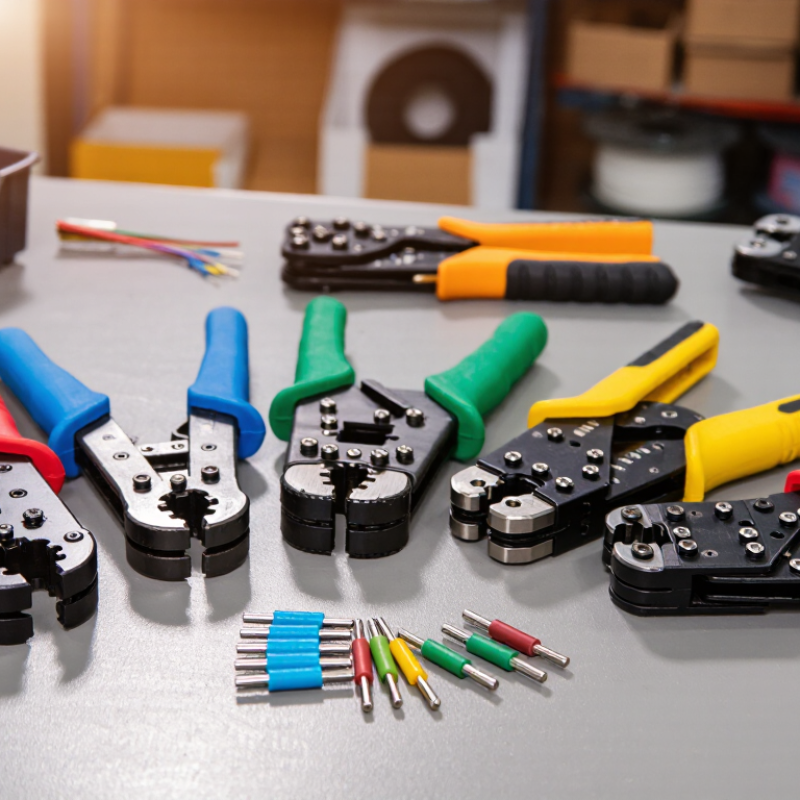
| 1 | Self-Adjusting Ratchet Crimper
Automatic die adjustment for common conductor sizes | 0.25–6 mm²
Approximately 23–10 AWG | Square or four-sided compression | Insulated and uninsulated bootlace ferrules conforming to common DIN 46228 sizes | Self-adjusting jaws, full-cycle ratchet, emergency release | Control panels, terminal blocks, industrial wiring, maintenance work | Fast size changes, consistent compression, low operator training requirement | Usually unsuitable for ferrules above 6 mm²; automatic mechanisms may need periodic cleaning | ★★★★★ |
| 2 | Adjustable Square-Profile Crimper
Manual die setting with a wider capacity range | 0.25–16 mm²
Approximately 23–5 AWG | Four-sided square compression | Single and twin bootlace ferrules, including larger tubular ferrules | Adjustable pressure or indexed die position; ratcheting handle | Power distribution panels, larger control conductors, machinery wiring | Broad size coverage and good terminal compatibility across multiple conductor sizes | Correct die adjustment is essential; incorrect settings can over-compress small ferrules | ★★★★★ |
| 3 | Hex-Profile Ratchet Crimper
Six-sided compression around the ferrule barrel | 0.25–6 mm²
Approximately 23–10 AWG | Hexagonal compression | Bootlace ferrules and selected tubular terminals designed for hex crimping | Fixed or indexed dies with a full-cycle ratchet | Compact control wiring, instrumentation, automotive harnesses, and terminal cabinets | Even radial compression and strong retention when matched to the correct ferrule | Hex geometry may not fit every spring-clamp or narrow terminal; not ideal for twin ferrules | ★★★★☆ |
| 4 | Compact Precision Crimper
Short-handle design for confined spaces | 0.14–4 mm²
Approximately 26–12 AWG | Square or trapezoidal compression | Small insulated and uninsulated ferrules for fine-stranded conductors | Manual ratchet with compact handles and controlled release | Electronics cabinets, laboratory equipment, small automation systems, and field service | Easy to carry, suitable for tight panels, and effective on small conductors | Limited leverage and capacity for large ferrules; less suitable for continuous high-volume work | ★★★★☆ |
| 5 | Twin-Ferrule Crimper
Designed for two conductors entering one terminal | 2 × 0.25–2 × 6 mm²
Combined cross-section depends on the die | Square or trapezoidal compression | Twin bootlace ferrules with a shared insulating collar | Dedicated twin-ferrule cavity or self-adjusting twin-ferrule jaws | PLC terminals, distribution blocks, relays, and compact control cabinets | Maintains two conductors in one ferrule and helps prevent loose strand escape | A standard single-ferrule crimper may not close the wider twin barrel correctly | ★★★★☆ |
| 6 | Hydraulic or High-Force Crimper
Intended for large conductor cross-sections | 10–50 mm²
Approximately 8–1 AWG | Hexagonal or deep-indent compression | Large tubular ferrules and heavy-duty cable-end ferrules specified for high-force crimping | Hydraulic pump or compound high-leverage mechanism; interchangeable dies may be used | High-current panels, battery systems, industrial power wiring, and large control conductors | Produces high compression force with less operator effort on large ferrules | Heavier, slower, and unnecessary for standard 0.25–6 mm² bootlace ferrules | ★★★☆☆ |
| 7 | Four-Indent Precision Crimper
Controlled indentation for specialized ferrules | 0.14–6 mm²
Approximately 26–10 AWG | Four-point indent compression | Precision tubular ferrules and selected thin-wall contact sleeves | Fixed precision cavity or interchangeable calibrated dies | Instrumentation, aerospace-style harnesses, test equipment, and vibration-sensitive wiring | Concentrated compression and repeatable results when the ferrule specification is exact | Ferrule and conductor dimensions must be matched carefully; less universal than square-profile tools | ★★★☆☆ |