| Light output | Measured luminous flux in lumens, preferably stated for each brightness mode | Choose output suited to the work area; compare tested lumen figures rather than LED count alone | More lumens can illuminate a larger area, but beam shape and usable runtime also affect performance |
| Beam pattern | Flood, spot, or adjustable beam; look for even illumination and controlled glare | A wide flood beam is useful for close-up tasks, while a focused beam helps illuminate a specific point | A well-matched beam can make work easier without requiring unnecessarily high brightness |
| Color quality | Color Rendering Index (CRI) and correlated color temperature (CCT), if specified | For color-sensitive inspection, consider a stated CRI of 80 or higher; neutral-white light around 4000–5000 K is a common general-purpose option | CRI describes how faithfully colors appear compared with a reference light source; CCT describes whether light appears warmer or cooler |
| Brightness control | Multiple output levels, a clearly accessible switch, and a low-output mode | Look for settings that let users balance illumination and battery life | Lower modes can reduce power consumption and limit glare during close work |
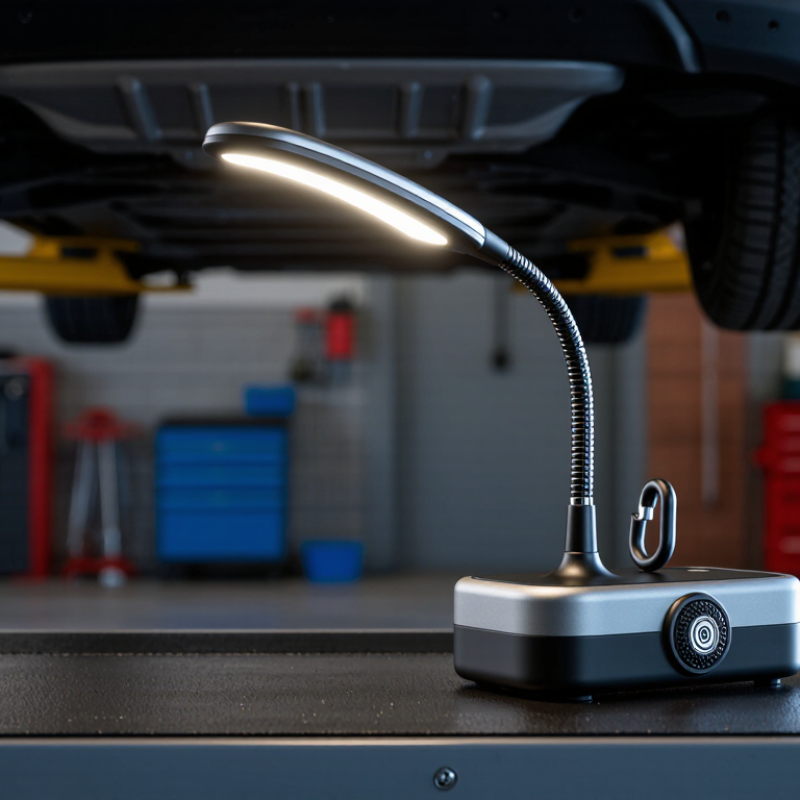
| Flexible positioning | Gooseneck or articulated section, stable base, and secure clamps or hooks | Check that the light holds its position under its own weight and can reach the intended work area | Secure positioning keeps both hands free and helps direct light into confined spaces |
| Flex-section durability | Reinforced joints, strain relief, smooth movement, and published bend-cycle test information | Ask how the flexible section was tested; avoid repeated sharp bends or twisting if the instructions prohibit it | Repeated movement can fatigue conductors and joints, so construction and correct use affect service life |
| Ingress protection | An IP rating tested to IEC 60529, with the rating applying to the assembled light | IP54 means dust-protected and protected against water splashes; IP65 means dust-tight and protected against water jets; IP67 includes temporary immersion under specified test conditions | The appropriate rating depends on exposure; an IP rating does not by itself indicate impact resistance |
| Impact resistance | Published IK rating, where relevant, and protection for the lens and housing | Under IEC 62262, IK07 corresponds to 2 J impact energy and IK08 to 5 J; confirm the tested rating for the complete product | Impact testing helps compare resistance to mechanical impacts, but does not guarantee survival of every drop or accident |
| Battery capacity and runtime | Battery voltage and amp-hour capacity, or watt-hours; runtime figures for each mode | Compare runtime at the same brightness setting. Watt-hours can be calculated as volts × amp-hours when both values are provided | Runtime varies with output, battery condition, temperature, and operating conditions; a single maximum-runtime figure may refer to a low mode |
| Charging and power options | Charging input, charging time, battery replacement options, and any wired operating mode | Check compatibility with the intended power source and whether charging can take place safely during use | Convenient charging and serviceable batteries can reduce downtime over the product’s working life |
| Thermal management | Heat-dissipating housing, output regulation, and stated operating-temperature limits | Review the manufacturer’s instructions for continuous operation and ambient-temperature limits | LED output and battery performance can be affected by heat; suitable thermal design supports consistent operation |
| Documentation and support | Clear specifications, test reports, safety instructions, warranty terms, and spare-part availability | Request documentation that identifies test standards and the exact model configuration | Verifiable specifications make it easier to assess quality and resolve service or compliance questions |