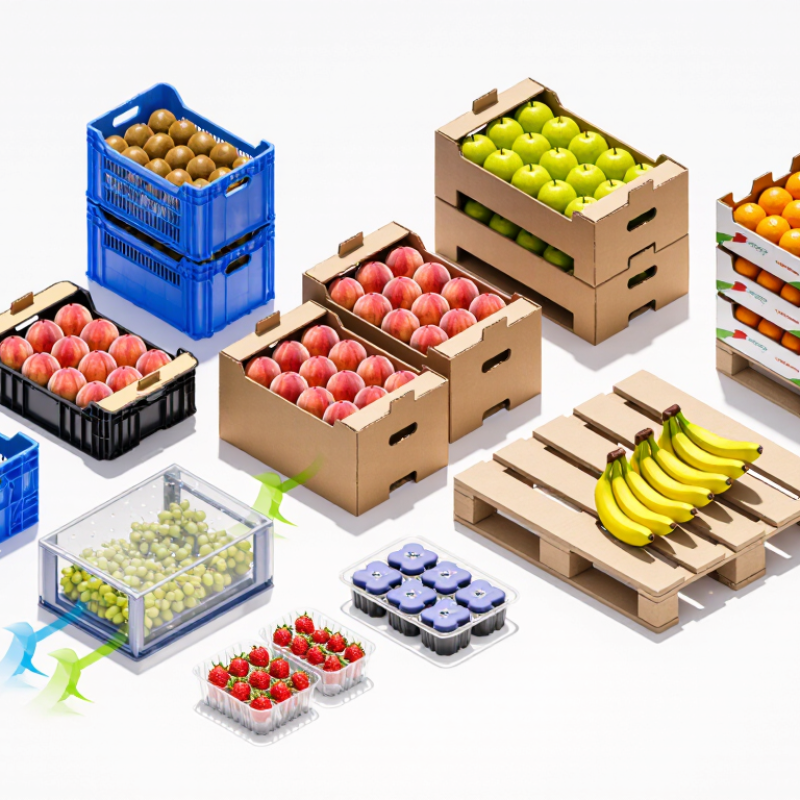
| 1 | Ventilated Corrugated Fiberboard Cartons | Berries, stone fruit, citrus, apples, and pears transported by pallet, truck, sea, or air. | Confirm food-contact suitability where direct contact occurs; test compression strength, edge-crush performance, moisture resistance, ventilation, and pallet stability. | Check recycled-fiber content, responsible fiber sourcing, recyclable design, water-based coatings, and the absence of unnecessary plastic laminates. | Verify destination-country labeling, net-weight declarations, traceability information, and any retailer packaging requirements. ISPM 15 does not apply to paperboard cartons. | Typical advantages: low tare weight, printable surface, efficient palletization, and adjustable ventilation for cooling and humidity control. |
| 2 | Reusable Plastic Crates | Hardy fruit such as citrus, apples, pears, and stone fruit in repeated domestic or regional distribution loops. | Use food-grade material declarations; inspect for cracks, sharp edges, contamination, drainage performance, and adequate ventilation. Validate cleaning and sanitation procedures. | Document expected reuse cycles, reverse logistics, washing-water management, repairability, and end-of-life recyclability. | Confirm hygiene records, import requirements, phytosanitary documentation for the fruit, and any rules governing returnable transport packaging. | Strong durability and ventilation; environmental performance improves when the crates achieve repeated trips and efficient backhauling. |
| 3 | Molded Fiber Punnets and Trays | Soft or delicate fruit, including berries and small stone fruit, requiring individual separation and cushioning. | Test wet strength, edge integrity, pulp cleanliness, odor transfer, dimensional stability, and compatibility with cold-chain condensation. | Prefer fiber-based designs that are recyclable through accepted local streams; verify recycled content and whether coatings or additives affect recyclability. | Confirm food-contact compliance, required origin and lot markings, and destination rules for fiber packaging and agricultural products. | Good cushioning-to-weight ratio; moisture resistance must be validated because excessive humidity can reduce strength. |
| 4 | Recyclable Plastic Clamshells | Berries, cherries, grapes, and other high-value fruit needing visibility, tamper evidence, and protection from crushing. | Verify food-contact compliance, hinge and closure durability, ventilation, sharp-edge control, seal integrity, and resistance to cracking at refrigerated temperatures. | Use a single polymer where possible, clearly identify the resin, minimize material weight, and confirm that the format is accepted by the target market’s recycling system. | Check labeling space, recycling claims, environmental-marking rules, extended producer responsibility obligations, and destination-country food-contact requirements. | High product visibility and good crush protection; ventilation openings must balance cooling with moisture retention. |
| 5 | Modified-Atmosphere Packaging Films | Berries, cut fruit, grapes, and other products where respiration control can help maintain quality during transit. | Validate oxygen and carbon-dioxide transmission rates, seal strength, puncture resistance, condensation behavior, and the package atmosphere for the specific fruit and temperature. | Reduce film thickness only after performance testing; assess recyclable mono-material structures, downgauging, and the risk of increasing food waste if the package fails. | Confirm food-contact declarations, migration testing where applicable, recycling claims, labeling rules, and cold-chain conditions required to maintain the validated atmosphere. | Can extend marketable life when correctly designed; it is not a substitute for rapid precooling and continuous temperature control. |
| 6 | Temperature-Controlled Insulated Shippers | High-value or temperature-sensitive fruit shipped by air, parcel service, or mixed-mode logistics. | Perform thermal mapping, transit simulation, drop testing, leak testing, and coolant compatibility checks. Avoid direct contact between refrigerants and food unless specifically approved. | Compare reusable versus single-use systems, recyclable insulation options, coolant recovery, package volume, and the emissions of return transport. | Review air-transport requirements, dangerous-goods rules for applicable refrigerants, customs documentation, and destination-specific food-contact and waste requirements. | Performance depends on starting product temperature, ambient profile, payload, insulation thickness, and opening frequency—not insulation alone. |
| 7 | Wooden Bins and Export Pallets | Bulk apples, pears, citrus, melons, and palletized shipments requiring high load capacity and mechanical protection. | Inspect for splinters, nails, mold, pests, odor, moisture, structural damage, and cleanable food-contact surfaces. Verify load capacity and stacking stability. | Use responsibly sourced timber, design for repair and reuse, avoid unnecessary treatments, and separate damaged wood for approved recovery or disposal. | Solid-wood packaging generally requires treatment and an official ISPM 15 mark when entering countries that enforce the standard. Confirm importing-country requirements before shipment. | High strength and stackability; heavier tare weight and moisture exposure should be included in freight and handling calculations. |