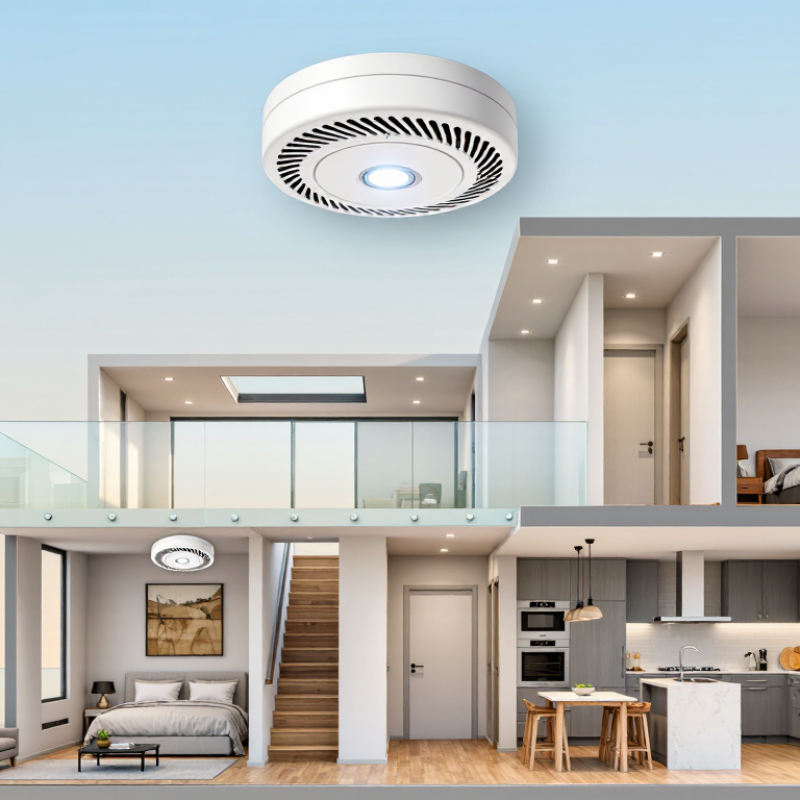
| Hardwired interconnected alarm | Building AC power, usually with a backup battery | Varies by unit; commonly photoelectric, ionization, or dual-sensor | Often connected through dedicated wiring; some systems also use wireless links | AC power reduces reliance on routine battery replacement. When correctly interconnected, one alarm sounding can activate the others. | Installation may require electrical work. Interconnected units must be compatible; wiring and backup-battery requirements vary. | Homes with existing alarm wiring, or new construction where a wired system can be installed. |
| Wireless interconnected battery alarm | Replaceable batteries or a sealed long-life battery, depending on the model | Varies by unit; check the product specifications | Radio-frequency communication between compatible alarms; internet is generally not required for local alarm-to-alarm signaling | Can link alarms without running interconnect wires, making it useful for retrofits and locations where wiring is impractical. | Wireless range, barriers, pairing procedures, and battery type differ. Check that every unit in the system is compatible. | Existing homes, additions, and spaces where new wiring would be difficult. |
| Dual-sensor interconnected alarm | Hardwired with backup battery or battery-powered, depending on the model | Combines photoelectric and ionization sensing technologies in one alarm | May use wired or wireless interconnection; confirm the specific configuration | Uses two sensing approaches. Photoelectric sensors are generally more responsive to smoldering fires, while ionization sensors are generally more responsive to fast-flaming fires. | Sensor combination alone does not confirm system compatibility or installation suitability. Follow the alarm’s instructions and applicable local requirements. | People who want two common smoke-sensing technologies in each alarm. |
| Photoelectric interconnected alarm | Available in hardwired and battery-powered versions | Photoelectric sensing, which detects smoke using a light-based chamber | Wired or wireless, depending on the model | Generally responds well to smoke from smoldering fires, which can produce significant smoke before visible flames develop. | Sensor type is only one factor in protection. Placement, maintenance, alarm age, and interconnection also matter. | Rooms or homes where photoelectric sensing is preferred; follow local guidance for placement. |
| Smart interconnected alarm | Hardwired with backup battery or battery-powered | Varies; may be photoelectric, ionization, or dual-sensor | May link locally to other alarms and send phone notifications through Wi-Fi or a compatible hub | Some models provide remote notifications, status information, or app-based alerts in addition to an audible alarm. | Remote features can depend on Wi-Fi, internet access, app support, and account setup. A phone alert is not a substitute for a local audible alarm. | People who want remote status or notifications, provided the local alarm functions independently. |
| Sealed long-life battery interconnected alarm | Factory-sealed battery designed for an extended service period; exact duration varies | Varies by model and may be photoelectric, ionization, or dual-sensor | Wireless interconnection is available on some models; not all sealed-battery alarms link to other units | Reduces the need for routine battery changes during the battery’s stated service life. | The entire alarm generally needs replacement when it reaches its end-of-life signal or expiration date; verify that the model supports interconnection if required. | Locations where reducing battery-change tasks is a priority. |