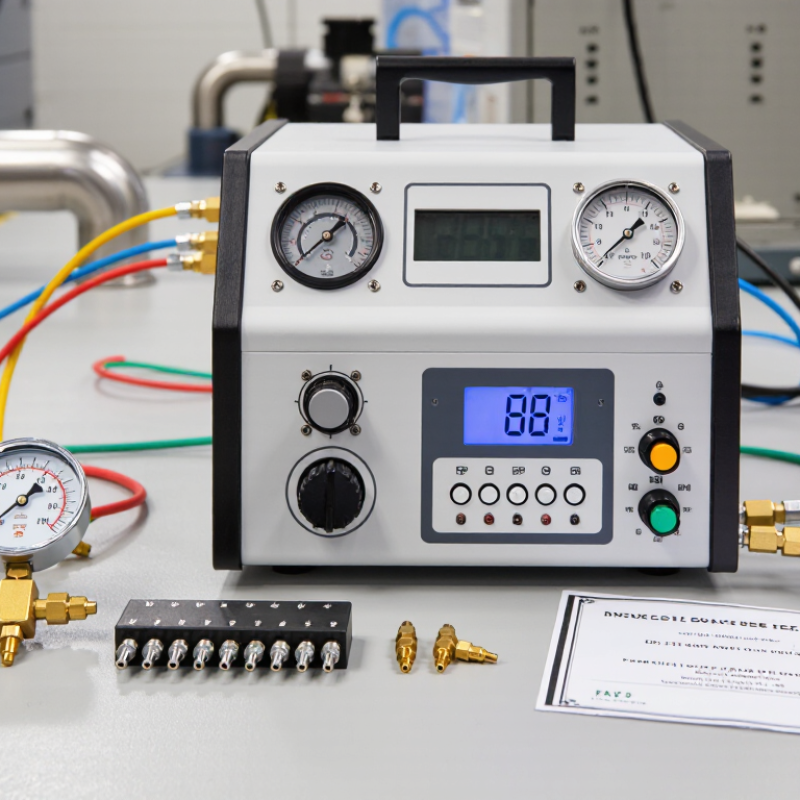
| Low-Pressure Pneumatic Hand Pump | Uses a manual pump and fine adjustment valve to create and stabilize low pressure or vacuum. | Approximately -1 to 1 bar, depending on configuration | Typically 0.1% to 0.25% of full scale when used with a suitable reference gauge | Clean, dry air or other compatible gas | Differential-pressure transmitters, air-handling equipment, laboratory instruments, and low-pressure switches | Portable, economical, and suitable for field testing | Manual operation; pressure stability and output depend on the operator |
| Pneumatic Pressure Hand Pump | Generates positive pressure through a piston or lever mechanism, with a bleed valve for fine control. | Approximately 0 to 40 bar for common field models | Typically 0.1% to 0.25% of full scale, depending on the reference instrument | Air or nitrogen | Pressure gauges, pressure switches, transmitters, and process instrumentation | Easy to carry and does not require electrical power | Not ideal for high-volume testing or applications requiring automatic control |
| High-Pressure Pneumatic Hand Pump | Uses a multi-stage pumping mechanism to generate higher pneumatic pressure for calibration checks. | Approximately 0 to 700 bar in specialized configurations | Typically 0.1% to 0.25% of full scale; the complete system accuracy is limited by the reference standard | Dry air or nitrogen where permitted by the equipment under test | High-pressure gauges, pressure transmitters, safety devices, and industrial test benches | Provides high pressure without a powered compressor | Requires more effort, careful connections, and appropriate pressure-rated components |
| Digital Pneumatic Pressure Calibrator | Combines a pneumatic pressure source with a digital reference sensor and electronic pressure display. | Commonly -1 to 40 bar, with wider ranges available | Typically 0.025% to 0.1% of full scale | Clean, dry air or nitrogen | Calibration of gauges, transmitters, switches, and pressure sensors | Improved readability, data recording, unit conversion, and portable operation | Requires battery maintenance and periodic sensor calibration |
| Automatic Pneumatic Pressure Calibrator | Uses a pressure controller, internal sensor, and control software to generate and maintain programmed test points. | Often from vacuum to 20 bar; the available range depends on the pressure controller | Typically 0.005% to 0.05% of full scale | Clean, dry air or nitrogen | Production testing, calibration laboratories, automated test systems, and multi-point verification | Fast, repeatable, programmable, and less dependent on operator technique | Higher purchase cost, greater system complexity, and a need for a stable gas supply |
| Pneumatic Temperature and Pressure Calibrator | Integrates a pneumatic pressure source with temperature simulation or measurement functions. | Pressure range commonly up to 20 to 40 bar; temperature range depends on the integrated module | Pressure accuracy commonly 0.025% to 0.1% of full scale; temperature accuracy varies by sensor type | Air or nitrogen for pressure generation | Combined testing of pressure transmitters, temperature transmitters, and Process Calibrators | Reduces the number of instruments needed for field service | More functions can increase setup time and calibration requirements |