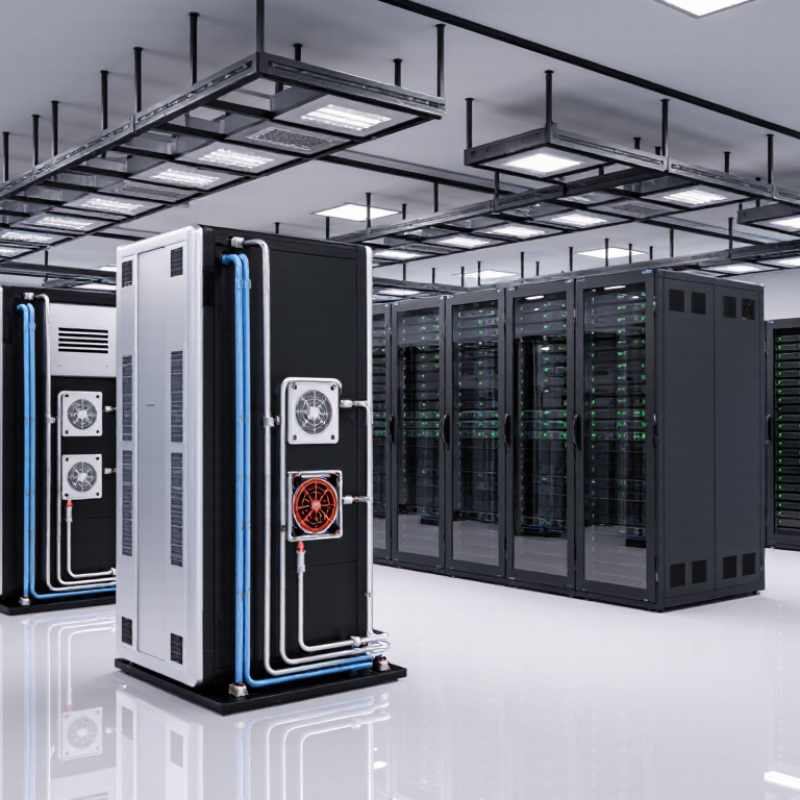
| Definition | Rack-mounted cooling | Cooling equipment is installed in, on, or immediately beside a server rack to remove heat close to the IT equipment. | Shortens the path between heat source and cooling unit and can provide more localized temperature control than room-level cooling alone. | Useful where rack heat loads vary significantly across a room or where a facility is adding higher-density equipment. | Sites that need cooling targeted to specific racks rather than uniform cooling across the entire room. |
| Air cooling | In-row cooling | Cooling units are placed in the server row and draw in hot exhaust air, cool it, and supply conditioned air near the rack fronts. | Can reduce mixing of hot and cold air and can be scaled by row as IT demand changes. | Requires careful aisle layout, airflow management, and coordination with the room’s cooling and electrical systems. | Medium- to higher-density rows that need more targeted air cooling than perimeter units provide. |
| Air cooling | In-rack cooling | A cooling unit is integrated into or attached to a rack and conditions air close to the servers. | Provides localized cooling and can help isolate a rack from room-wide temperature variations. | Check rack capacity, service access, airflow paths, noise, and the effect of the unit on available rack space. | Individual racks or small groups of racks with unusually high or uneven heat loads. |
| Liquid cooling | Rear-door heat exchanger | A liquid-cooled heat exchanger fitted to the rear of a rack removes heat from server exhaust air before it enters the room. | Captures heat at the rack and can reduce the amount of heat released into the data hall. | Needs compatible racks, a designed water or coolant loop, leak detection, and an operating plan for maintenance. | High-density racks where air cooling is becoming difficult to manage efficiently. |
| Liquid cooling | Direct-to-chip cooling | Coolant circulates through cold plates attached to heat-producing components, such as processors and accelerators. | Removes heat directly from components and can support equipment with concentrated thermal loads. | Requires compatible servers, coolant distribution, monitoring, trained maintenance, and a plan for residual air-cooled heat. | Compute-intensive deployments with supported liquid-cooled hardware and a suitable facility water loop. |
| Liquid cooling | Immersion cooling | IT components are placed in a tank of electrically non-conductive dielectric fluid, which absorbs heat from the equipment. | Provides direct heat transfer and can reduce dependence on conventional server-fan airflow. | Requires compatible equipment, fluid handling procedures, tank and facility design, and a maintenance approach suited to the deployment. | Purpose-designed, high-density deployments where the operator accepts a different equipment and service model. |
| Decision criteria | Cooling capacity and rack density | Compare the rack’s measured or planned heat load with the cooling unit’s capacity under the actual operating conditions. | Helps prevent undersizing and identifies whether cooling should be deployed per rack, row, or room. | Assess present and future IT loads rather than relying only on average room conditions. | All projects; especially important for mixed-density rooms and phased expansions. |
| Decision criteria | Energy, water, and climate | Evaluate cooling energy, water use, ambient conditions, and opportunities for economization over the full operating year. | Supports a design that balances efficiency, resilience, and operating cost. | China’s regional climates and local energy and water constraints differ; evaluate the specific site and applicable efficiency requirements. | New builds, major retrofits, and sites comparing air- and liquid-cooling options. |
| Decision criteria | Controls and monitoring | Use temperature, humidity, flow, pressure, and leak monitoring as appropriate, with alarms connected to facility operations. | Improves visibility of thermal conditions and helps operators respond to faults or changing IT loads. | Confirm integration with the site’s building and data-center management systems and define alarm-response procedures. | Any rack-mounted deployment, particularly liquid systems and unattended or highly automated facilities. |