7 Best Rectangular Fly Banners for Global Buyers
Fly Banners Rectangular give global buyers a portable way to make a brand visible at entrances, trade shows, storefronts, and outdoor events. Their broad, straight-edged print area suits logos, short offers, and high-contrast artwork. Simple, but details matter. Fabric weight, pole strength, base type, print quality, and packed dimensions can change how a banner performs in real conditions.
The Outdoor Advertising Association of America reported that U.S. out-of-home advertising revenue reached $9.1 billion in 2023, an 11.5% increase from 2022. That figure covers the wider OOH sector, not rectangular fly banners alone; it signals market activity, not guaranteed results for any one product. Advertising pioneer David Ogilvy wrote, “The more informative your advertising, the more persuasive it will be.” For banner buyers, that idea favors readable messages over crowded designs. A few clear words can work better than a wall of copy.
This guide compares seven rectangular options for international purchasing, focusing on practical factors such as materials, stability, customization, and ease of transport. A sunny product photo may hide weak stitching or a base that struggles on uneven ground. Check specifications. Ask for print proofs and packed-size details before ordering. One limitation remains: no banner suits every venue, and supplier claims deserve verification. That small pause can prevent an expensive mismatch.
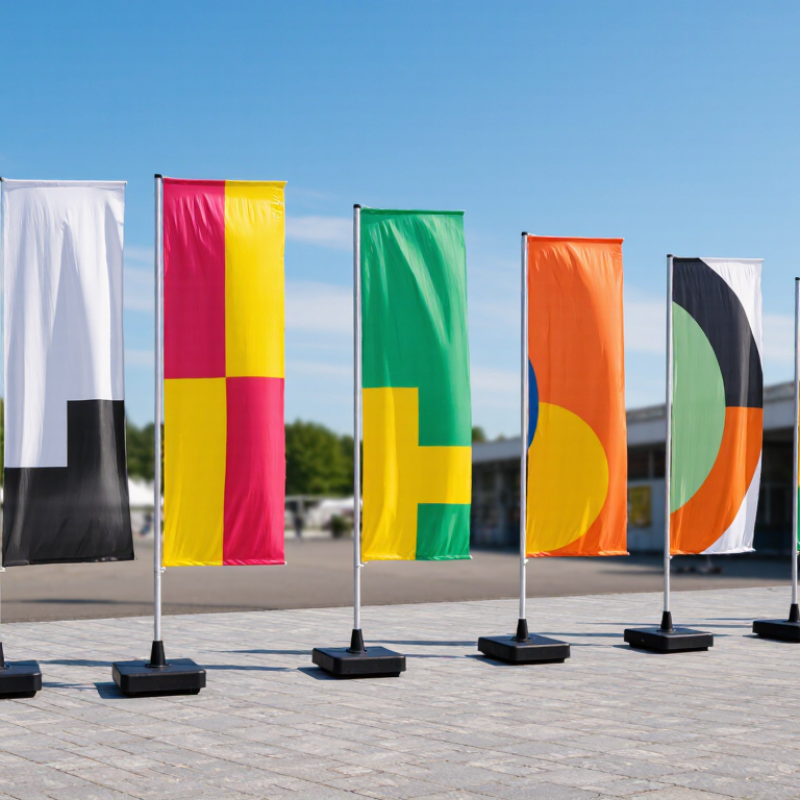
Rectangular Fly Banners: Common Formats, Fabrics, and Display Systems
Rectangular fly banners are often chosen for narrow entrances, pavement displays, and event booths. Common sizes range from compact formats near 2 by 5 feet to taller options around 3 by 10 feet, though dimensions vary by supplier. Check the finished graphic area, not just the pole height. A few inches can affect visibility beside a doorway.
Knitted polyester is lightweight and dries quickly after light rain. Woven polyester can feel sturdier, while mesh fabric may reduce wind resistance in exposed locations. Each option has trade-offs. Mesh can soften fine text, and heavier fabric may place more strain on a small pole. A sewn sleeve, reinforced corners, and clean hems help the banner hold its shape, but workmanship still varies.
Display systems usually include a flexible pole, a ground spike, or a cross base with a weight. Ground spikes suit soil; cross bases work better on flat floors, often with a water or sand weight. Small details matter. Measure the display area and consider nearby foot traffic before choosing a base. A banner that looks stable indoors may wobble outdoors. I would not assume one setup fits every venue.
Seven Banner Types Compared by Use Case, Portability, and Exposure
Rectangular fly banners work best when their shape, base, and print face suit the site. These seven configurations are useful comparisons, though some can overlap. A tabletop banner fits registration desks and narrow counters. A compact pole setup packs easily for short events. Standard-height banners suit entrances and market stalls. Tall versions rise above seated crowds, but need more room and a stable base. Single-sided printing keeps weight and cost down. Double-sided printing helps when people approach from both directions. A ground-ready setup uses either a spike for soft soil or a cross base for hard surfaces.
Portability changes with more than banner height. Check the packed pole length, fabric weight, and base weight before ordering for travel. A small case may still feel awkward on a crowded train. It happens. For indoor venues, a cross base is usually easier to place on flat floors, while a spike can anchor the banner in grass. Neither choice suits every site; loose gravel and strong gusts can make setup unreliable.
Exposure depends on sightlines and movement. A tall banner can be visible above a queue, while a compact one may disappear behind a table display. Double-sided graphics offer broader viewing, but can add fabric bulk. Ask for fabric and base specifications, then compare them with the actual venue conditions. A diagram helps, but it cannot show every obstacle on the day.
Fabric Performance: ISO 105-B02 Lightfastness and ISO 13934-1 Tensile Testing
Rectangular fly banners face long hours of direct sun, wind, and repeated handling. Fabric claims are more useful when backed by test results. ISO 105-B02:2014 evaluates colour fastness to artificial light using a xenon-arc source and blue-wool references graded from 1 to 8. Higher ratings indicate better resistance under the test conditions, not guaranteed outdoor life. Ask suppliers for the actual rating, fabric colour, and test date. A vivid red panel can fade differently from a pale background. Small details matter.
Strength needs its own evidence. ISO 13934-1:2013 uses a strip method to measure maximum tensile force and elongation, reported in newtons and percent. For a fly banner, check whether the fabric and seams were tested separately; a strong cloth can still tear around stitching or pole pockets. Wind exposure varies by site, so no single tensile figure predicts service life. A weakness in many comparisons is that buyers see a number without specimen details. Not just appearance. Request the laboratory report, including sample direction and conditioning notes. I would also compare several production samples, because one test result may not capture batch variation. That extra check can feel fussy, but it makes procurement more dependable.
7 Best Rectangular Fly Banners for Global Buyers - Fabric Performance: ISO 105-B02 Lightfastness and ISO 13934-1 Tensile Testing
Comparison of seven example rectangular banner configurations. Dimensions and fabric weights below are proposed specification examples, not independently measured product data.
| Configuration | Finished Banner Size (W × H) | Example Fabric | Example Fabric Weight | Typical Application | ISO 105-B02 Lightfastness | ISO 13934-1 Tensile Testing |
| Compact indoor | 0.60 × 1.50 m | Knitted polyester | Approx. 110 g/m² | Retail displays, indoor events, and short-term promotions | Request a test report; a buyer may specify a target of grade 6 or higher on the Blue Wool scale. | Request maximum-force results in newtons for both warp and weft directions, with specimen and conditioning details. |
| Standard event | 0.70 × 2.00 m | Knitted polyester | Approx. 115 g/m² | Trade shows, entrances, and general outdoor promotions | Request a test report; compare results only when the test conditions and fabric color are stated. | Request warp and weft results; ISO 13934-1 specifies a strip method and does not set one universal pass value. |
| Wide-format display | 0.90 × 2.50 m | Woven polyester | Approx. 120 g/m² | Large venues and locations where a broader graphic is desired | Request a report for the finished fabric and intended color; lightfastness can vary by dye and shade. | Request maximum force in both principal fabric directions and confirm whether the report covers finished or unprinted fabric. |
| Heavy-duty outdoor | 0.80 × 2.40 m | Woven polyester | Approx. 130 g/m² | Repeated outdoor use with suitable frame and installation conditions | Ask for an ISO 105-B02 result and the reported Blue Wool grade; exposure performance depends on the full material system. | Ask for ISO 13934-1 warp and weft results; assess them against the buyer’s documented load and use requirements. |
| Lightweight travel | 0.65 × 1.80 m | Lightweight knitted polyester | Approx. 100 g/m² | Portable displays and frequent transport | Request a test report rather than inferring lightfastness from fabric weight. | Request strip-method results in both directions; fabric weight alone does not establish tensile strength. |
| Double-sided graphic | 0.75 × 2.00 m | Polyester fabric assembly | Approx. 2 × 110 g/m² fabric layers, subject to construction | Displays intended to show graphics on both sides | Request results for the relevant printed fabric and color; separately confirm the complete assembly’s construction. | Request results for the fabric layers and clarify whether seams or the assembled banner have been tested separately. |
| Custom large-format | 1.00 × 3.00 m | Woven or knitted polyester, selected for the frame system | Approx. 120–150 g/m² | Large promotional areas; confirm wind exposure and support requirements before selection | Specify the required Blue Wool grade in the purchase specification and request the corresponding test report. | Request ISO 13934-1 maximum-force values in warp and weft; set acceptance limits based on the intended design and use. |
Outdoor Setup: Wind Exposure, Base Stability, and Manufacturer Load Ratings
For global buyers comparing the 7 best rectangular fly banners, outdoor exposure matters as much as print area. A banner can catch gusts like a small sail, especially when its broad face sits perpendicular to the wind. NOAA’s Beaufort wind scale describes 19–24 mph winds as strong enough to move large branches. That is a useful warning sign, not a safe operating limit. Conditions can change quickly around open lots, coastlines, and building corners.
Check the manufacturer’s load rating and ask what the figure covers: the pole, fabric, base, or complete setup. ASCE 7 provides a professional framework for calculating wind loads on structures, but its design values do not automatically certify a portable banner. A rating without test conditions is hard to compare. I would also check base weight, pole connections, and the recommended wind limit. On uneven pavement, a heavy base can still rock. Small detail. Big difference.
Tips: Match the base to the surface, orient the banner to reduce wind catch, and follow the stated shutdown limit. If gusts lift an edge or shift the base, lower the display. Ratings help, but real sites are messy. Don’t treat a calm test as a guarantee.
Wind Exposure and Reference Pressure for Rectangular Fly Banners
Estimated wind pressure rises rapidly with wind speed. Values are calculated using the standard approximation q = 0.613 × V², where wind speed (V) is in metres per second and pressure (q) is in pascals.
These figures describe reference wind pressure—not a banner’s actual load rating. Actual forces depend on banner area, shape, mounting, gusts, and other conditions. Check the manufacturer’s load ratings and use a base suited to the site and expected wind exposure.
Global Sourcing Checks: Print Quality, Compliance, Packaging, and Total Cost
For global buyers, a rectangular fly banner should be checked as a complete product, not just a printed panel. Ask for the fabric weight, pole material, base options, and finished dimensions in writing. Compare a physical sample against the approved artwork under daylight and indoor lighting. Fine text can blur. Check color consistency, straight hems, and whether the print shows through the reverse side more than expected.
Compliance needs vary by destination and use. Request material specifications and test documents relevant to the importing market, then confirm that names, claims, and safety markings match the product. Do not assume one certificate covers every component. Packaging matters too: a fitted carry bag, protected pole sections, and a clear assembly sheet can prevent damage and delays. Small details matter. Still, packaging that looks sturdy may not survive rough handling; ask how cartons are tested and packed.
Compare the total landed cost, not only the unit price. Include sample fees, printing setup, packaging, freight, duties, inspection, and likely replacement costs. A lower quote may omit a base or use thinner fabric, changing the final value. Request a carton size and gross weight before booking freight. Record agreed tolerances for color, dimensions, and defects, and keep the approved sample for comparison. Not always easy. Supplier replies can leave gaps, so clarify them before production rather than relying on assumptions.
