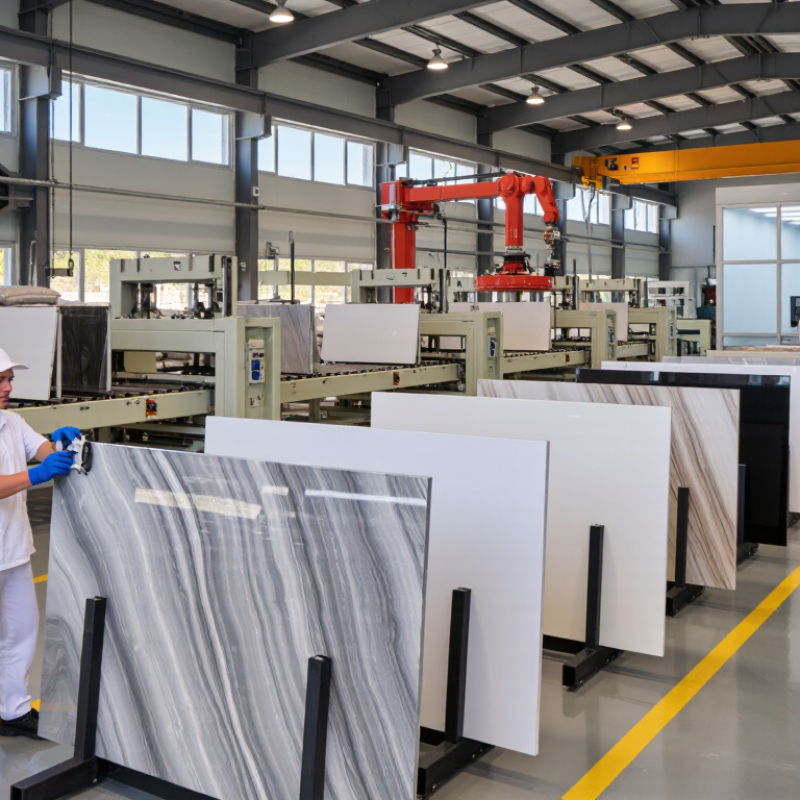
| Raw Material Composition | Refined natural minerals, including feldspar, silica, kaolin and other ceramic minerals; pigments may be added for color and veining. | A controlled mineral composition supports consistent color, density and mechanical performance. | Residential and commercial interior surfaces | Choose products with uniform slabs, stable color and complete technical documentation. |
| Manufacturing Process | Minerals are milled, mixed, pressed under high pressure, dried, digitally decorated when required, and fired at approximately 1,200–1,250°C. | High-pressure forming and high-temperature firing create a dense, low-porosity surface. | Projects requiring durable, low-maintenance surfaces | Confirm that the material is fully vitrified rather than only surface-coated. |
| Common Thicknesses | Approximately 3–6 mm for lightweight wall panels; 10–12 mm for countertops and furniture; 15–20 mm for heavy-duty or thicker applications. | Thickness affects weight, stiffness, edge strength, fabrication method and installation requirements. | Walls, countertops, vanities, tables and façades | Select thickness according to span, support structure, cut-outs and handling conditions. |
| Water Absorption | High-quality sintered ceramic surfaces typically achieve water absorption at or below 0.5%; exact results depend on the product standard and test method. | Low absorption helps resist staining, moisture penetration and freeze-thaw damage. | Kitchens, bathrooms, flooring and exterior areas | Request a laboratory test report for the exact slab series and production batch. |
| Surface Hardness | Typically around 6–7 on the Mohs mineral hardness scale, although the result varies with formulation and finish. | A hard surface provides good resistance to everyday scratching and abrasion. | Countertops, floors, public interiors and retail spaces | Use cutting boards and avoid dragging abrasive materials across polished finishes. |
| Heat Resistance | Non-combustible ceramic material with high resistance to normal household heat; brief contact with hot cookware is generally suitable when properly installed. | Heat resistance is important around cooktops, fireplaces and commercial food-service areas. | Kitchen worktops, splashbacks and fireplace surrounds | Follow installation instructions and avoid thermal shock from extreme temperature changes. |
| Stain and Chemical Resistance | Low-porosity surfaces generally resist common food, beverage and household stains. Strong acids, alkalis and abrasive cleaners may damage some finishes or coatings. | Good chemical resistance reduces maintenance and supports hygienic use. | Kitchens, laboratories, hospitals and hospitality interiors | Check resistance data for the intended chemicals and clean with pH-neutral products. |
| Flexural Strength | Dense porcelain-based slabs commonly provide flexural strength above 35 MPa; large-format products may have different certified values. | Flexural strength affects resistance to bending during transport, fabrication and use. | Large panels, counters, furniture and ventilated façades | Review the certified value together with support spacing and allowable overhang. |
| Finish Options | Polished, matte, natural, textured, satin and structured finishes are commonly available. | Finish influences appearance, slip performance, reflectivity, cleaning and scratch visibility. | Interior walls, floors, countertops and exterior cladding | For wet floors, prioritize tested slip resistance over appearance alone. |
| Slip Resistance | Performance varies substantially by surface texture and test standard; textured or matte finishes generally provide more grip than polished finishes. | Slip resistance is a safety factor in bathrooms, entrances, terraces and commercial floors. | Wet rooms, public floors, balconies and outdoor paving | Request the applicable slip-resistance classification for the project location and use. |
| Dimensional Stability | Very low moisture expansion compared with many natural materials; thermal and structural movement still require suitable joints. | Stable dimensions help maintain alignment and reduce movement-related failures. | Large-format wall panels, floors and façades | Use an approved substrate, movement joints and installation system for large slabs. |
| Maintenance Requirement | Usually does not require periodic sealing. Routine cleaning with water and a neutral detergent is generally sufficient. | Low maintenance reduces long-term operating cost and downtime. | Homes, hotels, restaurants, offices and healthcare facilities | Clean spills promptly and avoid unapproved abrasive or highly acidic cleaners. |
| Environmental and Health Profile | Inorganic, non-toxic ceramic composition; the finished surface does not normally emit volatile organic compounds. | A stable mineral surface is suitable for many indoor applications when installed correctly. | Residential, healthcare and food-related interiors | Evaluate recycled content, production energy, packaging and verified environmental documentation. |
| Fabrication Requirements | Requires diamond tools, controlled cutting, proper edge treatment and trained installers, especially for thin or large-format slabs. | Correct fabrication reduces chipping, breakage and installation waste. | Countertops, integrated sinks, furniture and complex wall layouts | Confirm fabricator experience, cutting equipment and replacement-slab availability. |
| Best Overall Choice | Application-dependent A dense, low-absorption slab with certified mechanical, thermal, chemical and slip-resistance data. | No single specification is best for every project; performance must match the intended use. | High-quality residential and commercial construction | Compare test reports, slab consistency, processing support, packaging quality and after-sales service rather than appearance alone. |