| 1 | Material Preparation | Receives pre-cut SMC slices or charge packages and positions them on the lower mold surface. | Typical SMC density: 1.7–2.0 g/cm³; common glass-fiber content: 20–30% by weight. | Keep the material clean, correctly weighed, and within the supplier’s recommended storage life. | A consistent charge that matches the required part mass and fiber layout. |
| 2 | Charge Layout | Places the SMC slices in a pattern that supports flow into ribs, corners, bosses, and other detailed areas. | Charge coverage is commonly designed at approximately 50–75% of the projected cavity area, depending on geometry. | Use balanced placement rather than relying only on a central charge. | More uniform filling, lower weld-line risk, and reduced fiber distortion. |
| 3 | Mold Closing | Closes the heated mold at a controlled speed until the cavity reaches the programmed compression position. | Typical mold temperature: 140–170°C; closing speed is adjusted to part geometry and air-release requirements. | Prevent premature locking, trapped air, and uncontrolled material displacement. | The SMC charge begins to soften and spread without excessive flash or air entrapment. |
| 4 | Heating and Flow | Transfers heat through the mold and compresses the softened SMC so it flows through the cavity. | Typical compression pressure: 5–15 MPa; actual force depends on projected area and cavity pressure. | Maintain even temperature across the mold and stable hydraulic pressure. | Complete filling of the cavity, including thin walls and reinforcing features. |
| 5 | Press Force Selection | Generates enough force to hold the mold closed against cavity pressure and prevent excessive flash. | Required force = projected area × design pressure. Example: 0.20 m² × 10 MPa = approximately 2,000 kN. | Select a press with reserve capacity; a practical design margin is commonly added above the calculated force. | Stable molding without mold opening, excessive flash, or hydraulic overload. |
| 6 | Curing | Maintains mold temperature and compression while the thermoset resin cross-links and hardens. | Typical cure time: approximately 30–120 seconds, depending on part thickness, resin system, and mold temperature. | Use cavity temperature and cure-time validation rather than time alone. | A rigid, dimensionally stable composite part with the required mechanical properties. |
| 7 | Pressure Release | Reduces pressure in a controlled manner after the cure cycle to minimize distortion and sticking. | Decompression speed should be adjustable; abrupt release can increase spring-back and dimensional variation. | Coordinate pressure release with mold-opening and ejection settings. | Lower risk of warpage, surface damage, and ejection defects. |
| 8 | Mold Opening | Separates the mold halves while maintaining a controlled opening profile. | Opening stroke and daylight must accommodate the part, mold height, inserts, and handling system. | Use synchronized motion and sufficient daylight for safe part removal. | Clean separation without tearing, deformation, or damage to molded details. |
| 9 | Part Ejection | Activates ejector pins, stripping plates, or an automated handling system to remove the cured part. | Ejection force depends on part geometry, draft angle, surface finish, and mold release behavior. | Apply balanced ejection force and avoid concentrated loading on thin sections. | Repeatable part removal with minimal marks and low breakage risk. |
| 10 | Inspection and Trimming | Supports removal of flash and inspection of dimensions, surface quality, fiber distribution, and defects. | Common checks include mass, thickness, dimensional tolerance, voids, short shots, and flash height. | Link inspection results to charge weight, mold temperature, pressure, and cure time. | A stable process window and consistent finished-part quality. |
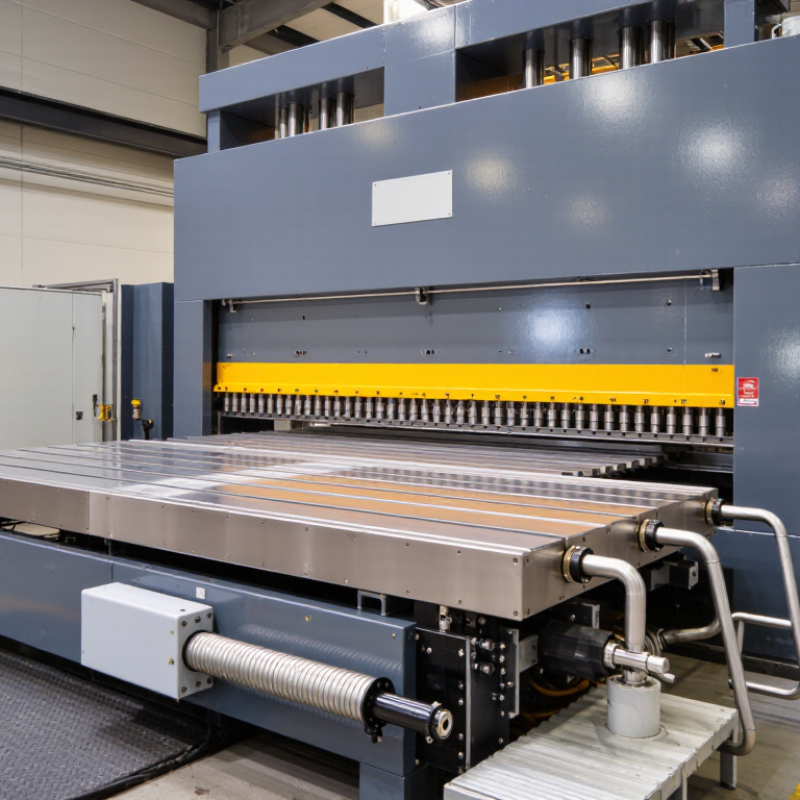
| 11 | Best Press Configuration for 2026 | Uses a programmable hydraulic compression press designed for repeatable SMC charge placement and molding. | Recommended capabilities: closed-loop force control, heated platens, multi-zone temperature control, adjustable speed, recipe storage, and automatic data logging. | Prioritize controllability, platen parallelism, repeatability, safety interlocks, and serviceability over maximum tonnage alone. | A press that delivers consistent filling, curing, dimensions, cycle time, and energy use across production runs. |