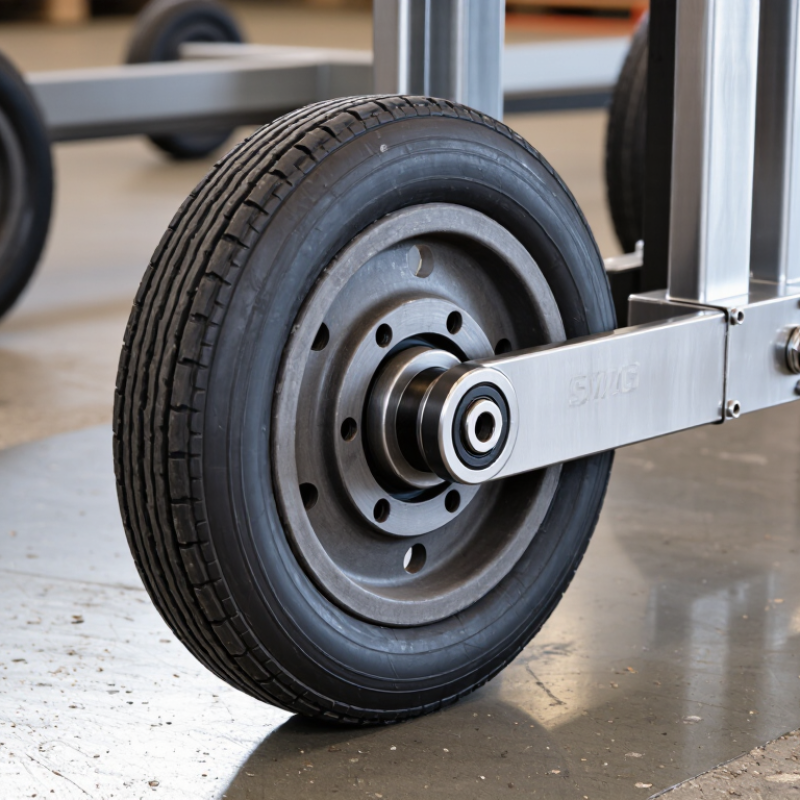
| General-purpose indoor use | Polyurethane tread on a metal core | Lower rolling resistance than solid rubber and quieter operation on smooth floors | Good resistance to abrasion, oils, and many common industrial fluids | Inspect for tread cuts, flat spots, and bearing play; keep the floor free from metal debris |
| Heavy static loads | Solid cast iron or steel wheel | High load-carrying capability and minimal elastic deformation | Highly resistant to compression and wear on hard industrial surfaces | Can damage concrete or tiled floors; use only where floor protection is acceptable |
| Uneven floors and thresholds | Elastic rubber or resilient polyurethane tread | Improved shock absorption and better passage over small joints and surface irregularities | More vulnerable to cuts, deformation, and wear than a rigid metal wheel | Check tread condition frequently and avoid exceeding the rated load at impact |
| Wet or wash-down environments | Corrosion-resistant wheel hardware with sealed bearings | Reduced risk of bearing contamination and corrosion-related resistance | Stainless or corrosion-resistant components generally provide better service life in moisture | Dry the assembly after washing; do not direct high-pressure water at seals unless approved |
| High-temperature service | Metal wheel with temperature-rated bearings and lubricant | Maintains dimensional stability where polymer treads may soften or degrade | Metal components tolerate heat better, but lubricant, seals, and mounting parts still have limits | Verify the complete temperature rating rather than judging the wheel material alone |
| Low-noise operation | Soft polyurethane or rubber tread | Reduces impact noise and vibration compared with bare metal wheels | Soft tread typically wears faster under abrasive loads or rough outdoor surfaces | Keep the wheel correctly aligned to prevent uneven wear and noise |
| Corrosive chemical exposure | Chemically compatible polymer tread and corrosion-resistant metal parts | Maintains rolling performance when materials are selected for the specific chemical | Chemical compatibility depends on concentration, temperature, exposure time, and material grade | Use a compatibility chart and replace components showing swelling, cracking, or discoloration |
| Manual handling efficiency | Larger wheel diameter with a precision bearing | Larger wheels generally roll more easily over small obstacles and require less starting force | A larger wheel may increase overall equipment height and require adequate clearance | Confirm axle size, mounting width, and total load before installation |
| Load selection | Select capacity using the actual total load and number of wheels that reliably carry it | Prevents excessive rolling resistance, deformation, and premature bearing failure | Impact, uneven floors, speed, and duty cycle can reduce practical capacity | Do not divide the load only by the nominal wheel count unless load distribution is guaranteed |
| Safety configuration | Wheel and mounting assembly rated for the application, with an appropriate brake where required | Improves directional control and reduces unintended movement during loading or parking | Overloading or side impacts can damage the wheel, axle, fork, or mounting plate | Check fasteners, brake function, wheel rotation, and structural cracks during routine inspections |