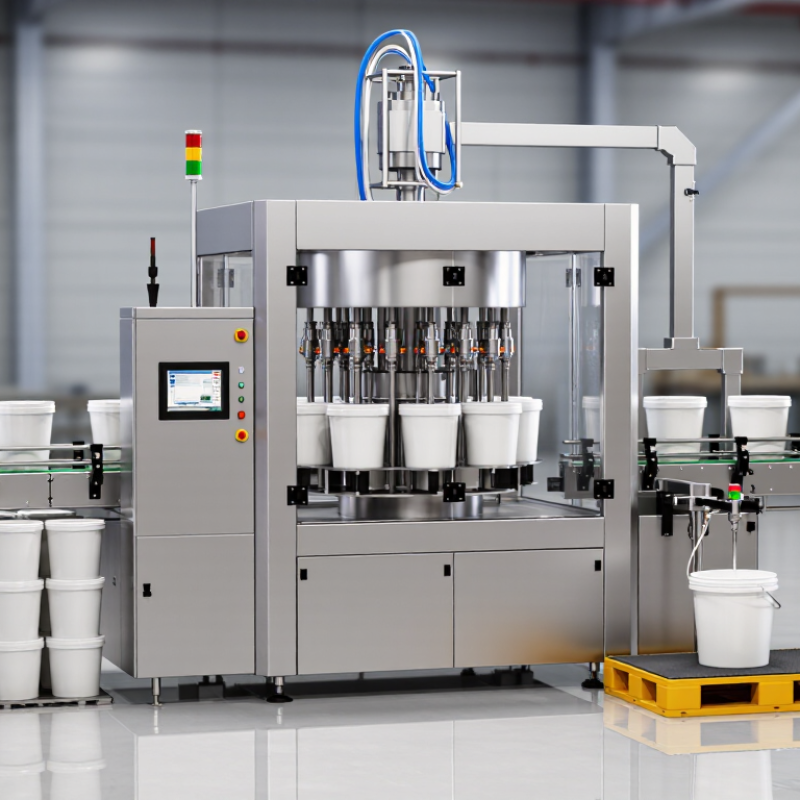
| What is a bucket filling machine? | An automated or semi-automated system that dispenses a measured quantity of product into buckets or pails. | It combines container positioning, product dosing, filling, and commonly discharge or conveying in one production process. |
| Typical products | Powders, granules, pellets, liquids, pastes, creams, and other free-flowing or semi-flowing materials. | The product’s density, flowability, viscosity, particle size, and tendency to foam determine the suitable filling method. |
| Common bucket sizes | Approximately 1–25 kg or about 1–25 L, depending on the container and product density. | The machine must be adjusted for bucket diameter, height, opening shape, target weight, and filling head clearance. |
| Typical output range | Approximately 10–60 buckets per minute. | Actual output depends on the dosing method, bucket size, product behavior, filling accuracy, operator loading, and the number of filling heads. |
| Manual or semi-automatic type | Typically about 5–20 buckets per minute, depending on operator handling and product flow. | An operator places the bucket under the filling nozzle, while the machine controls dosing and may stop automatically at the target quantity. |
| Automatic inline type | Typically about 10–40 buckets per minute. | Buckets are indexed or continuously conveyed through filling stations with limited operator intervention. |
| Automatic rotary type | Typically about 30–60 buckets per minute when using multiple filling positions. | Several buckets are processed around a rotating table, allowing filling, weighing, settling, and discharge to occur at different stations. |
| Net-weight filling | The product is dispensed into a bucket positioned on a weighing platform or load-cell assembly. | The controller stops or slows product flow when the measured net weight reaches the programmed target. |
| Gross-weight filling | The bucket and its contents are weighed together during filling. | The control system uses the total measured weight and compensates for the known empty-container weight. |
| Volumetric filling | A fixed volume is dispensed using a cup, piston, auger, or similar metering device. | It can provide high speed, but the delivered mass may vary when product density or compaction changes. |
| Auger filling | A rotating screw conveys a controlled volume of powder into the bucket. | It is commonly used for powders and can use coarse and fine dosing speeds to improve accuracy. |
| Gravimetric or linear weighing | Product is fed by a vibratory feeder, belt, gate, or similar device while the bucket is weighed. | This method is suitable for many dry products and can provide controlled bulk and dribble feeding. |
| Liquid filling | Liquid is delivered through a nozzle using time, flow measurement, piston displacement, or weight feedback. | Nozzle design and filling speed must account for viscosity, foaming, dripping, and the required fill level. |
| Bucket infeed | Buckets may be loaded manually or supplied automatically by a conveyor, denester, or container magazine. | Reliable infeed prevents empty positions, misalignment, and interruptions to the filling cycle. |
| Container positioning | Guides, clamps, indexing stops, or star wheels hold each bucket beneath the filling head. | Accurate positioning reduces spills and ensures that the product enters the container rather than the surrounding equipment. |
| Standard operating sequence | Feed bucket → detect position → tare or confirm container → bulk fill → fine fill → verify weight or level → release bucket. | Sensors and a programmable controller coordinate the sequence and can stop the machine when a fault is detected. |
| Typical accuracy | Often within approximately ±0.1% to ±1% of target weight, depending on the product and filling system. | The stated accuracy is application-dependent and should be confirmed through product trials and calibration. |
| Typical control components | Programmable controller, human-machine interface, photoelectric sensors, load cells, pneumatic valves, and variable-speed drives. | These components manage recipes, dosing, container detection, alarm conditions, speed, and production data. |
| Dust and spill control | Common features include dust extraction connections, enclosed filling zones, drip trays, cutoff valves, and anti-spill nozzles. | Control measures improve workplace cleanliness, product recovery, operator safety, and equipment reliability. |
| Downstream operations | Optional steps include vibration or settling, lid placement, lid pressing, sealing, labeling, check weighing, and palletizing. | Integrating downstream equipment can reduce manual handling and create a more continuous packaging line. |
| Main selection factors | Product characteristics, target weight, bucket dimensions, required speed, accuracy, hygiene needs, dust level, and available floor space. | A machine selected around the complete application is more likely to meet production, quality, cleaning, and maintenance requirements. |