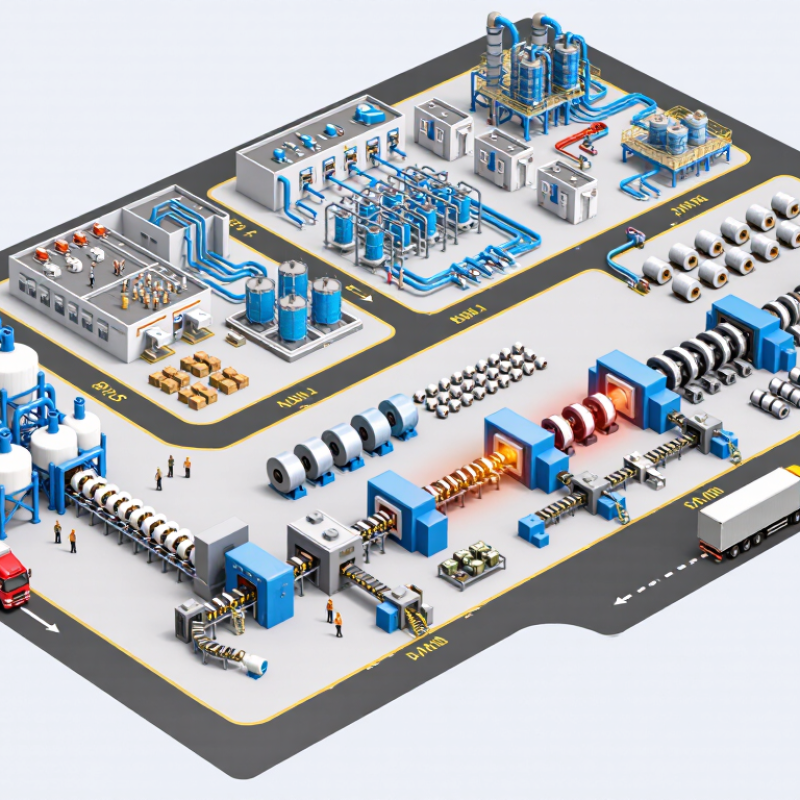
| 1. Production Definition and Output |
| Annual finished carbon fiber output | 0.1–0.5 kilotonnes/year | 0.5–1.5 kilotonnes/year | 2–5 kilotonnes/year | 5–10 kilotonnes/year |
| Typical operating schedule | 5–6 days/week; campaign production | 6 days/week; 7,000–8,000 operating hours/year | Continuous operation; 8,000–8,400 operating hours/year | Continuous operation; 8,000–8,400 operating hours/year |
| Typical product form | Research-grade continuous filament tow | Industrial-grade continuous filament tow | Industrial-grade tow for composite applications | High-volume industrial-grade tow |
| Typical tow size | 1K–12K filaments | 12K–24K filaments | 24K–50K filaments | 24K–50K filaments |
| Approximate PAN precursor demand | 0.20–1.00 kt/year | 1.00–3.00 kt/year | 4.00–10.00 kt/year | 10.00–20.00 kt/year |
| 2. Process Scope Included in the Estimate |
| PAN tow pay-off and tension control | Included | Included | Included | Included |
| Stabilization or oxidation ovens | 1 process train | 1 process train | 1–2 process trains | 2–4 process trains |
| Low-temperature carbonization | Included | Included | Included | Included |
| High-temperature carbonization | Optional or limited capacity | Included | Included | Included |
| Surface treatment and electrochemical oxidation | Included | Included | Included | Included |
| Washing, drying, and sizing application | Included | Included | Included | Included |
| Winding, packaging, and finished-goods handling | Included | Included | Included | Included |
| Process-control system and data acquisition | Basic monitoring and manual intervention | Distributed control with recipe management | Integrated distributed control system | Redundant integrated control system |
| Quality-control laboratory | Basic tensile, density, and sizing tests | Routine mechanical and chemical testing | Full production and failure-analysis laboratory | Full laboratory with production-development capability |
| 3. Indicative Capital Cost by Category (USD million) |
| Core process equipment | $3.0–6.0M | $7.0–14.0M | $18.0–35.0M | $35.0–70.0M |
| Thermal systems, furnaces, and exhaust treatment | $1.5–3.0M | $4.0–8.0M | $10.0–20.0M | $20.0–40.0M |
| Utilities and environmental systems | $1.0–2.0M | $2.5–5.0M | $6.0–12.0M | $12.0–25.0M |
| Building fit-out, clean areas, and material handling | $1.0–2.5M | $3.0–6.0M | $7.0–15.0M | $15.0–30.0M |
| Engineering, installation, commissioning, and training | $2.0–4.0M | $5.0–10.0M | $12.0–25.0M | $25.0–50.0M |
| Estimated installed capital cost | $8.5–17.5M | $21.5–43.0M | $53.0–107.0M | $107.0–215.0M |
| 4. Utility and Operating Planning Parameters |
| Electricity demand for the process line | 1.5–3.0 GWh/year | 5–12 GWh/year | 18–40 GWh/year | 40–85 GWh/year |
| Natural gas or equivalent thermal energy | 3–8 GWh/year | 12–30 GWh/year | 45–100 GWh/year | 100–220 GWh/year |
| Process and cooling water | 5–20 m³/day | 20–60 m³/day | 60–180 m³/day | 150–400 m³/day |
| Compressed air and inert-gas systems | Small packaged systems | Centralized plant systems | Centralized systems with standby capacity | Redundant centralized systems |
| Direct production labor | 15–30 employees | 30–60 employees | 60–120 employees | 120–220 employees |
| 5. Cost Drivers Used to Refine the Budget |
| Product performance target | Development and repeatability | Standard industrial performance | Tighter strength, modulus, and sizing tolerances | High consistency across multiple production trains |
| Line redundancy | Low; single-point downtime is acceptable | Limited spare capacity | Partial redundancy for critical utilities | Redundant utilities and parallel process trains |
| Expected commissioning period | 12–18 months | 18–24 months | 24–36 months | 30–48 months |
| Recommended contingency allowance | 15–25% of installed cost | 15–20% of installed cost | 10–20% of installed cost | 10–15% of installed cost |
| Excluded cost items | PAN precursor plant, land, financing, taxes, import duties, long-term inventory, customer qualification costs, and major off-site infrastructure. |
| Planning note: The installed capital cost should be calculated as core equipment plus utilities, buildings, engineering, installation, commissioning, and contingency. Actual costs vary materially with output specification, energy prices, local construction rates, environmental requirements, furnace configuration, automation level, and whether the PAN precursor is purchased or produced on site. |