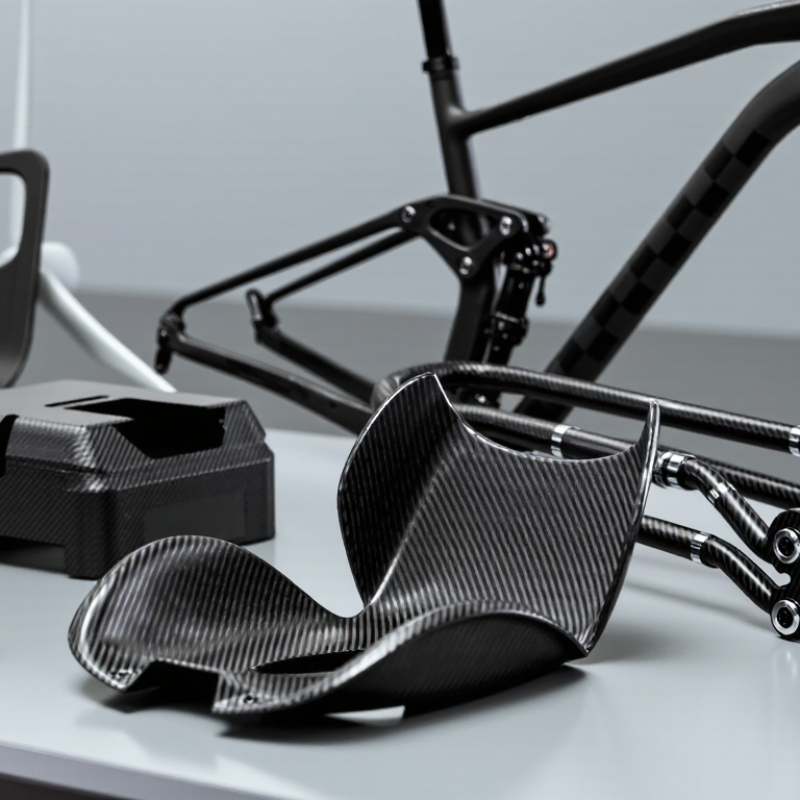
| Lightweight Structural Parts | Aircraft panels, vehicle body structures, bicycle frames, robotic arms, and sporting equipment | Carbon fiber composites commonly have a density of approximately 1.5–1.6 g/cm³, compared with about 2.7 g/cm³ for aluminum and about 7.8 g/cm³ for steel. | Reduces component mass while maintaining useful structural performance | Final weight and performance depend on fiber orientation, resin type, laminate design, and manufacturing method |
| High Specific Strength | Load-bearing frames, pressure vessels, automotive reinforcement parts, and aerospace structures | Carbon fiber has a high strength-to-weight ratio; the tensile strength of commercial fibers often falls within approximately 3–7 GPa, depending on grade. | Enables strong structures without adding unnecessary mass | Strength is directional in a composite and is lower across poorly aligned or unsupported directions |
| High Specific Stiffness | Aircraft wings, satellite structures, precision machine components, and high-performance frames | The tensile modulus of common carbon fibers is roughly 230–600 GPa, while composite laminate stiffness depends strongly on fiber alignment. | Limits bending and deflection in applications where dimensional stability matters | Very stiff laminates can be less tolerant of impact damage and may require carefully designed joints |
| Fatigue Resistance | Wind turbine blades, vehicle suspension components, sporting goods, and continuously loaded structures | Carbon fiber composites generally retain a high proportion of their static strength under repeated loading when properly designed and protected. | Supports long service life under cyclic mechanical loads | Fatigue performance can be reduced by impact damage, moisture, poor bonding, manufacturing defects, or stress concentrations |
| Low Thermal Expansion | Optical benches, precision instruments, antenna supports, and dimensional-control structures | Carbon fiber has a very low or even negative coefficient of thermal expansion along the fiber direction, while the composite value varies by laminate construction. | Helps maintain dimensional accuracy during temperature changes | Different expansion rates between carbon fiber parts and attached metals can create joint stresses |
| Vibration Damping | Vehicle panels, machine covers, musical instrument components, and aerospace equipment | The polymer matrix in a carbon fiber composite provides more damping than many metals, although damping depends on the resin, layup, and part geometry. | Can reduce resonant vibration and improve perceived smoothness or acoustic behavior | Carbon fiber is not always the best choice when maximum impact absorption or high inherent damping is required |
| Corrosion Resistance | Marine structures, chemical-processing equipment, bridges, pipes, and outdoor infrastructure | Carbon fiber itself does not rust, and many resin systems provide resistance to moisture and chemicals. | Can lower maintenance requirements compared with unprotected steel in suitable environments | Carbon fiber can cause galvanic corrosion when it contacts certain metals, so electrical isolation may be necessary |
| Electrical Conductivity | Electrostatic discharge paths, electromagnetic shielding, heating elements, and electrically conductive structures | Carbon fibers are electrically conductive, but the conductivity of a finished composite varies with fiber content, orientation, resin, and contact design. | Allows some components to provide conductive or shielding functions in addition to structural support | Electrical conductivity is anisotropic and generally differs from that of metals; insulation may be required near sensitive equipment |
| Pressure and Energy Storage Structures | Compressed-gas cylinders, hydrogen storage vessels, flywheel systems, and accumulator components | The high specific strength of carbon fiber makes it suitable for filament-wound pressure vessels and rotating structures. | Provides efficient structural reinforcement for high-pressure or high-speed applications | Requires strict control of winding patterns, resin quality, impact damage, inspection, and service limits |
| Wear and Surface Components | Protective panels, fairings, tooling, covers, and low-friction components when combined with suitable materials | Carbon fiber composites can provide a hard, stable surface, but wear resistance is primarily determined by the resin, coating, and counter-surface. | Offers low mass and good dimensional stability for protective or semi-structural parts | Uncoated carbon fiber composites may suffer surface wear, fiber exposure, or damage from abrasive contact |
| Temperature Performance | Engine-adjacent structures, industrial tooling, brake-related components, and high-temperature fixtures | The carbon fibers tolerate very high temperatures, but the polymer matrix typically limits continuous-use temperature; many standard epoxy systems are used below approximately 120–180°C unless specially formulated. | Maintains useful stiffness at moderate temperatures and can be tailored with high-temperature matrices | Resin selection, thermal cycling, fire performance, and heat transfer must be evaluated for the service environment |
| Manufacturing Flexibility | Complex shells, custom brackets, sandwich panels, molded housings, and integrated structural parts | Components can be produced using processes such as prepreg molding, resin transfer molding, compression molding, filament winding, and pultrusion. | Allows fiber placement and laminate thickness to be tailored to specific load paths | Tooling cost, production volume, cure control, repairability, and quality inspection affect total project cost |