| Electrical power supply | Provides controlled current to the semiconductor pump diode. Stable drive current helps maintain consistent pump output. | Current and voltage depend on the diode array and system design. | Supplies the energy that starts the optical amplification process. |
| Semiconductor pump diode | Converts electrical energy into light at a wavelength chosen to be absorbed by the solid-state gain medium. | Common pump wavelengths include approximately 808 nm for neodymium-doped media and approximately 940 or 969 nm for ytterbium-doped YAG. | Efficiently transfers energy into the gain medium when the pump wavelength and absorption band are suitably matched. |
| Solid-state gain medium | A doped crystal or glass absorbs pump light. Energy stored in the active ions can create population inversion, enabling optical amplification. | Examples include Nd:YAG, Nd:YVO₄, Yb:YAG, Er:YAG, and Tm:YAG. | The material determines the laser’s principal emission wavelength and influences efficiency, thermal behavior, and operating modes. |
| Population inversion and stimulated emission | When enough active ions are in excited states, photons passing through the medium can stimulate the emission of additional photons with matching properties. | Nd:YAG commonly emits near 1064 nm; Yb:YAG commonly emits near 1030 nm. | Builds coherent light at wavelengths characteristic of the selected gain medium. |
| Optical resonator | Mirrors form a cavity that sends light through the gain medium repeatedly, allowing amplification. One mirror partially transmits light as the output coupler. | Mirror reflectivity, cavity length, and alignment are selected for the intended design. | Provides optical feedback and determines how laser energy is extracted from the cavity. |
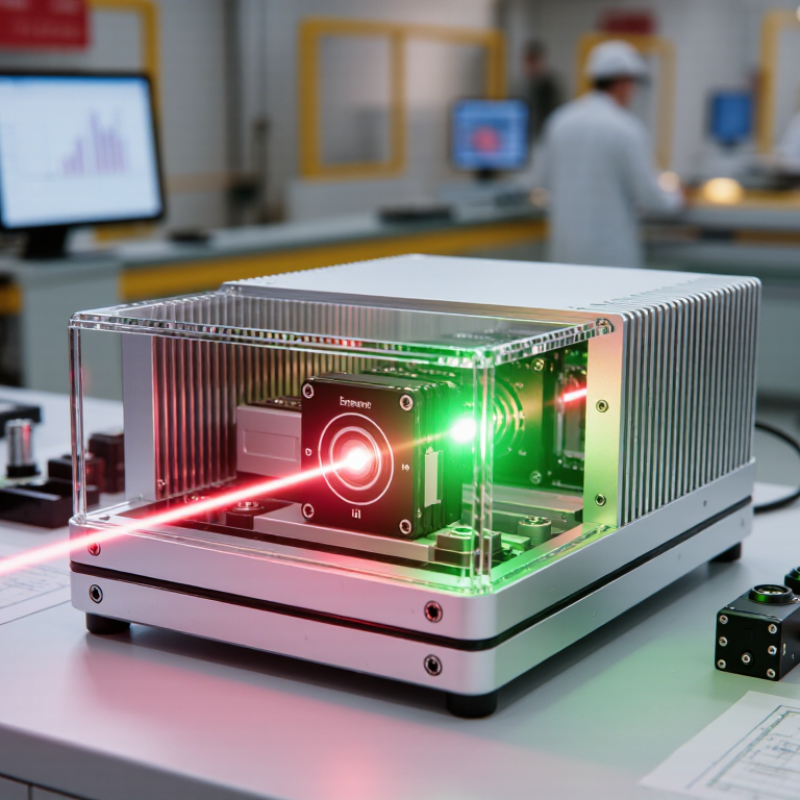
| Wavelength conversion (optional) | A nonlinear optical crystal can convert the fundamental output to a shorter wavelength, typically by frequency doubling. | Frequency-doubled Nd:YAG or Nd:YVO₄ can produce green light near 532 nm from infrared light near 1064 nm. | Enables output at wavelengths not directly emitted by the gain medium, with conversion efficiency dependent on the design and operating conditions. |
| Thermal management | Heat sinks, conduction cooling, or liquid cooling remove heat produced during pumping and laser operation. | Cooling requirements vary with output power, duty cycle, and system construction. | Helps limit temperature-related wavelength shifts, efficiency loss, and thermal stress. |
| Output beam | The laser delivers continuous-wave or pulsed light, depending on the gain medium, cavity, and control method. | Nd:YAG systems may operate near 1064 nm or, with frequency doubling, near 532 nm. Actual power and pulse characteristics vary by configuration. | Beam wavelength, power, pulse duration, repetition rate, and beam quality are design-dependent specifications. |