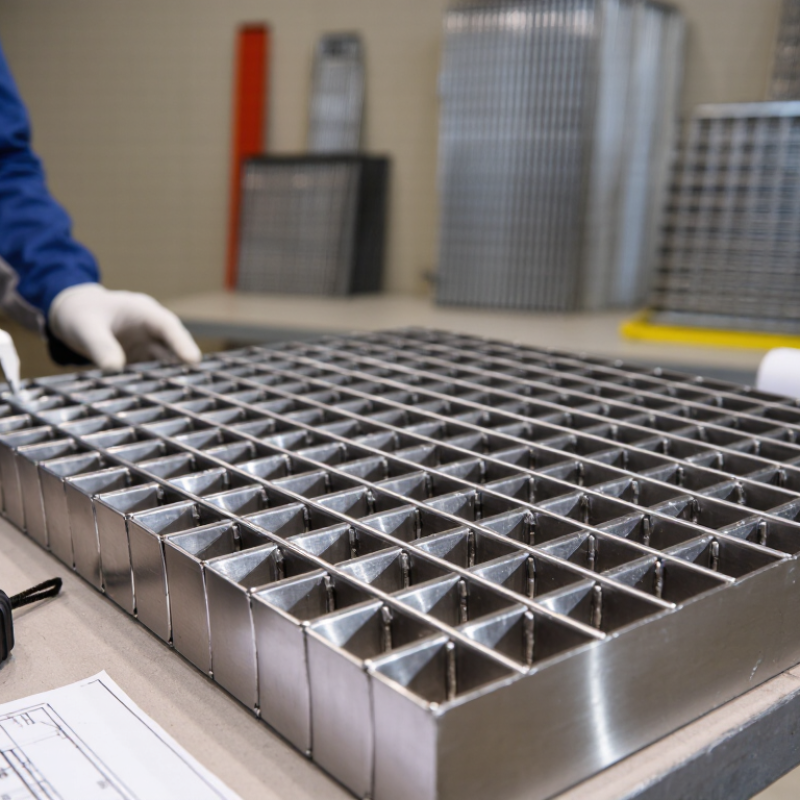
| What stainless wire grates are | Open-grid panels made from stainless steel wires or rods joined by welding, weaving, or other fabrication methods. | The open structure provides a supporting surface while allowing air, water, light, or debris to pass through. |
| Common stainless steel grades | Type 304 is widely used for general indoor and outdoor applications. Type 316 contains molybdenum and is often selected for greater resistance to chlorides and many corrosive environments. | Grade selection should reflect the specific chemicals, salts, temperature, cleaning practices, and exposure conditions. No grade is suitable for every environment. |
| Typical construction | A grate may use load-bearing wires or bars, cross wires, a perimeter frame, and attachment points. Wire diameter, spacing, panel dimensions, and edge treatment vary by design. | The load-bearing elements transfer applied loads to the supporting frame or structure; cross members help maintain the grid and distribute loads. |
| How the open grid functions | Openings between wires create a permeable surface rather than a solid sheet. | Airflow and drainage can pass through the openings, while the wire framework supports objects within the limits of its design and installation. |
| Load capacity | Capacity depends on wire or bar size, grid spacing, span, support conditions, material properties, and how the load is applied. | A load rating should be established for the specific grate design and installation. Do not infer safe capacity from appearance alone. |
| Common applications | Examples include drainage covers, equipment guards, shelving, baskets, ventilation panels, walkways, and food-service or processing equipment. | The suitable design depends on whether the main need is load support, drainage, airflow, visibility, containment, or cleanability. |
| Surface finish and cleaning | Finishes can include an as-fabricated surface or a specified polished finish. Smooth, accessible surfaces are generally easier to inspect and clean. | Cleaning requirements and exposure to food residues, chemicals, or abrasive methods should be considered when specifying the finish and maintenance routine. |
| Corrosion considerations | Stainless steel forms a chromium-rich passive surface film, but contamination, deposits, unsuitable chemicals, or severe conditions can still cause corrosion. | Appropriate grade selection, fabrication practices, cleaning, and exposure control help preserve service life; performance depends on the environment. |
| Important specification details | Specify stainless steel grade, panel dimensions, wire or bar diameter, opening size, edge/frame details, finish, tolerances, supports, and expected loads. | Clear specifications help ensure the grate fits its opening and performs as intended in its operating environment. |
| Inspection and maintenance | Check for loose connections, deformation, damaged welds, blocked openings, surface contamination, and signs of corrosion. | Regular inspection helps identify installation or service issues early. Maintenance frequency should match the application and environment. |