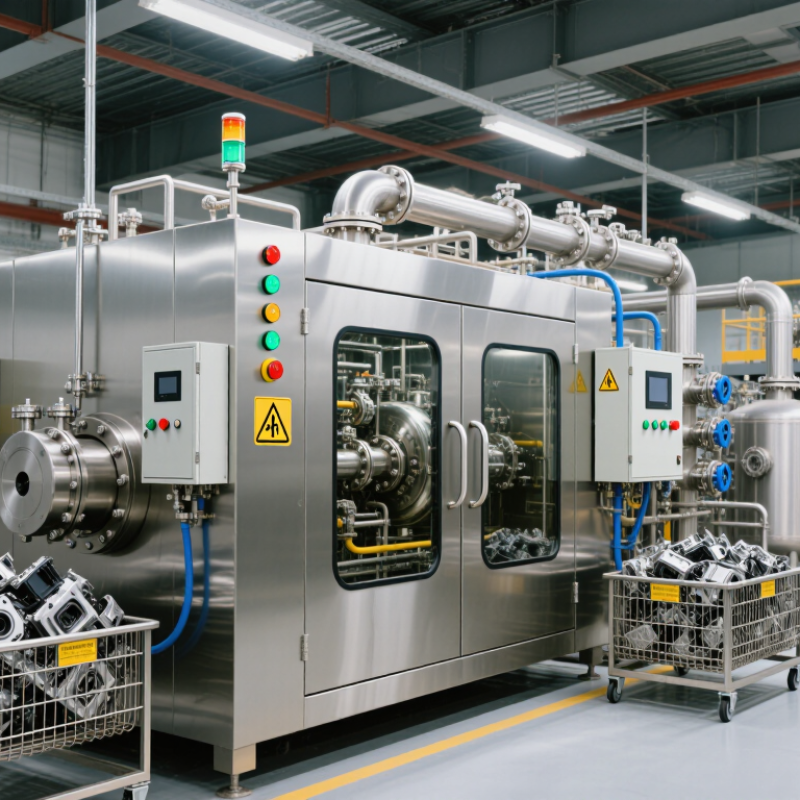
| Cleaning process and application fit | Confirm the machine’s process stages, such as solvent immersion, spray, vacuum cleaning, rinsing, and drying, against the part geometry and contamination type. | Process description, equipment layout, cycle sequence, and trial-cleaning report using representative parts and soils. | Cleaning results depend on the solvent, temperature, pressure, part design, and contamination; a machine specification alone does not establish cleaning performance. | Agree on measurable acceptance criteria, such as residual contamination, particle limits, or visual cleanliness, before ordering. |
| Solvent compatibility | Check compatibility of the proposed hydrocarbon solvent with seals, hoses, pumps, filters, coatings, and the materials being cleaned. | Solvent technical data sheet (TDS), safety data sheet (SDS), compatibility information, and a list of wetted machine materials. | Flash point, vapor pressure, exposure limits, and fire classification vary by solvent formulation. Review the SDS for the exact solvent to be used. | Confirm the solvent grade, operating temperature range, and any restrictions with the solvent supplier and the machine supplier. |
| Vacuum and drying performance | Review the operating vacuum range, leak detection approach, drying cycle, and provisions for recovering solvent vapor. | Vacuum-system specifications, cycle data from a representative load, and details of vapor condensation or recovery equipment. | Vacuum operation can assist drying and reduce vapor release, but it does not by itself eliminate flammable-atmosphere or exposure hazards. | Request test results under the expected load conditions and verify that the proposed cycle meets production and dryness requirements. |
| Machine capacity and throughput | Compare usable chamber dimensions, basket or fixture capacity, load weight, and total cycle time with actual production needs. | Dimensioned drawings, rated load limits, recommended loading patterns, and cycle-time assumptions. | Overloading or obstructing circulation can affect cleaning, drying, and safe operation. | Validate throughput using the planned parts, fixtures, batch size, and operating schedule rather than relying on an unloaded cycle time. |
| Flammable-liquid and fire-risk controls | Check how the design manages solvent inventory, ignition sources, abnormal temperatures, leaks, and emergency shutdowns. | Hazard analysis, electrical documentation, alarm and interlock list, emergency-stop details, and fire-protection design information. | Applicable requirements depend on the site and jurisdiction. In the United States, OSHA 29 CFR 1910.106 and relevant NFPA standards may apply; confirm applicability with qualified safety professionals and local authorities. | Have the installation design and site risk assessment reviewed before purchase and commissioning. |
| Electrical and hazardous-area suitability | Determine whether any equipment is intended for a classified hazardous area and whether its electrical design matches the site classification. | Electrical schematics, component ratings, hazardous-area certificates where applicable, and the equipment’s intended area classification. | ATEX and IECEx-related requirements may be relevant in some markets; U.S. installations may use different hazardous-location rules. Certification scope and jurisdiction must be checked. | Ask the site electrical engineer or authority having jurisdiction to confirm the required classification and documentation. |
| Emissions and workplace exposure | Review enclosure integrity, exhaust or vapor recovery provisions, access-door interlocks, and maintenance procedures that may expose workers to solvent. | Emission-control description, ventilation requirements, exposure-control guidance, and maintenance instructions. | Vacuum cleaning does not replace workplace ventilation or exposure controls. Applicable occupational exposure requirements vary by solvent and jurisdiction. | Assess the installation location and worker exposure controls with an industrial hygienist or competent safety professional where needed. |
| Solvent recovery and waste handling | Check filtration, distillation or recovery options, water separation where relevant, and the handling of spent solvent and residues. | Recovery-system flow diagram, maintenance intervals, consumables list, and guidance for managing process residues. | Recovered solvent quality and waste classification depend on the process and local environmental rules; waste must be characterized and managed accordingly. | Estimate solvent consumption and waste streams using the expected operating hours, soil load, and recovery method. |
| Quality control and process monitoring | Review monitoring of temperature, pressure, vacuum, cycle time, and other process variables relevant to repeatable cleaning. | Instrument list, calibration requirements, alarm limits, data-logging options, and sample cycle records. | Monitoring and recordkeeping needs may be set by the buyer’s quality system, customer requirements, or regulated application. | Define which parameters must be recorded, retained, and traceable to each production batch. |
| Machine guarding and operator access | Inspect access doors, interlocks, pinch-point protection, loading aids, maintenance access, and lockout provisions. | Risk assessment, operator manual, maintenance manual, and descriptions of safety-related controls. | Safety requirements depend on the machine configuration and applicable local machinery and workplace rules. | Include operator and maintenance personnel in a design review before finalizing the machine layout. |
| Supplier qualification and factory acceptance | Evaluate the supplier’s experience with comparable applications, engineering support, documentation quality, and production controls. | References for comparable installations, quality-system documentation, inspection records, and a factory acceptance test (FAT) plan. | Certificates and declarations should identify their scope, issuing body where applicable, equipment model, and applicable market; do not assume a certificate covers the full installation. | Specify FAT criteria, test instruments, acceptance tolerances, documentation, and corrective-action procedures in the purchase contract. |
| Installation, service, and lifecycle cost | Account for utilities, ventilation, foundations, solvent supply, commissioning, training, spare parts, and planned maintenance. | Utility schedule, installation requirements, recommended spare-parts list, service response terms, and training plan. | Site preparation and operation may require permits, ventilation reviews, fire-protection measures, or other local approvals. | Compare total cost of ownership, including solvent, energy, filters, waste disposal, maintenance, and production downtime. |