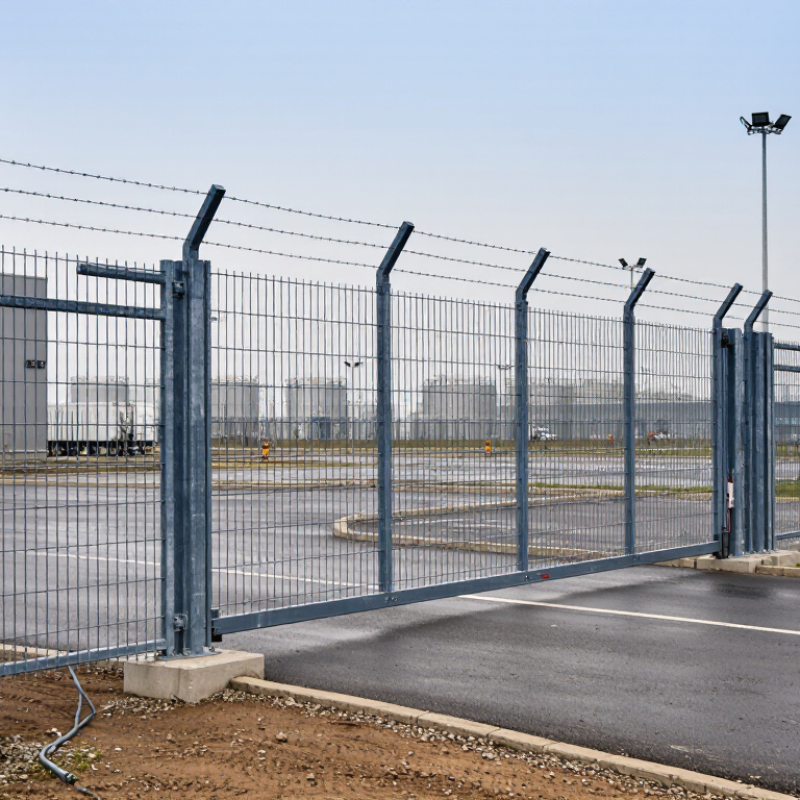
| Mesh Opening | 76.2 mm × 12.7 mm (3 in × 0.5 in) | The narrow aperture makes it difficult to insert fingers, footholds, cutting tools, or other objects through the panel. | Choose the standard narrow aperture when climbing resistance and reduced tool access are key priorities. |
| Horizontal and Vertical Wires | Commonly arranged with 76.2 mm horizontal spacing and 12.7 mm vertical spacing | The dense wire arrangement limits hand and foot purchase while maintaining visibility through the fence. | Confirm the actual wire layout on technical drawings before approval, especially for customized panels. |
| Wire Diameter | Commonly 4.0 mm; heavier options may be available | A larger wire diameter increases rigidity and makes manual deformation and cutting more difficult. | Use a heavier wire specification for high-risk sites, but verify the additional weight against post and foundation capacity. |
| Panel Height | Often selected from approximately 1.8 m to 3.0 m or higher | Greater height increases the effort required to climb over the barrier and can improve perimeter separation. | Select height according to risk level, local planning rules, emergency access requirements, and site visibility. |
| Panel Width | Frequently about 2.0 m to 2.5 m per panel | A suitable panel width reduces the number of joints while keeping handling, transport, and installation practical. | Choose a width compatible with the site layout, lifting equipment, post spacing, and terrain conditions. |
| Panel Stiffness | Reinforced by dense mesh and correctly formed panel edges | Rigid panels are harder to bend away from the posts and provide a more stable barrier under physical pressure. | Inspect panel flatness, edge quality, weld consistency, and the proposed fixing arrangement. |
| Weld Quality | Continuous, uniform resistance-welded intersections | Secure welds help prevent wires from being separated and preserve the intended mesh geometry. | Request quality-control records or sample inspection results for weld strength and panel dimensions. |
| Post Profile | Commonly rectangular, square, or specialized hollow steel sections | Strong posts transfer loads from the panel to the foundation and reduce opportunities to force the fence sideways. | Match post size, wall thickness, spacing, and embedment depth to panel height, wind exposure, and soil conditions. |
| Anti-Tamper Fixings | Security bolts, shear-head nuts, or protected fixing systems | Tamper-resistant hardware makes it more difficult to remove panels with ordinary hand tools. | Use fixings that cannot be easily accessed from the public side and include secure nuts or protective covers where appropriate. |
| Surface Protection | Hot-dip galvanized steel, zinc-coated steel, or galvanized steel with a powder-coated finish | Corrosion protection preserves wire strength, weld integrity, and appearance throughout the service life. | Specify coating requirements according to humidity, pollution, salinity, and expected maintenance conditions. |
| Finish Color | Commonly dark green, black, or other project-approved colors | Color does not replace physical security, but a suitable finish can reduce visual distraction and blend with the surroundings. | Prioritize coating performance and repairability before selecting the color. |
| Visibility and Surveillance | High visual transparency through the narrow mesh | The open design supports camera observation, lighting coverage, and inspection of the perimeter without creating a solid visual screen. | Position cameras and lights to avoid blind spots created by corners, gates, landscaping, or nearby structures. |
| Climb Resistance | High when combined with narrow mesh, adequate height, and secure fixings | The small openings provide very limited footholds and handholds compared with conventional larger-mesh fencing. | For elevated risk, consider additional measures such as an outward overhang, monitored gates, lighting, and intrusion detection. |
| Cut Resistance | Improved compared with larger-aperture wire mesh; not completely cut-proof | The dense mesh makes it difficult to create a usable opening quickly, although determined attackers may still use powered tools. | Combine the fence with alarms, patrol procedures, controlled access, and suitable response arrangements. |
| Gate Integration | Matching mesh gates with reinforced frames and controlled locking hardware | A weak gate can undermine a strong perimeter because gates are common access and attack points. | Specify gate frames, hinges, locks, clearances, and automation as part of the complete security system. |
| Foundation and Ground Conditions | Concrete footings designed for local soil, wind, height, and loading conditions | A secure panel cannot perform properly if posts can be loosened, pulled out, or undermined. | Obtain a site-specific structural assessment for exposed, unstable, sloping, or heavily trafficked locations. |
| Inspection and Maintenance | Periodic checks of welds, fixings, coatings, posts, gates, and ground stability | Regular inspection helps identify corrosion, loose hardware, impact damage, and attempts to compromise the perimeter. | Establish an inspection schedule and repair damaged sections promptly to prevent security gaps. |