| Sizing Scenarios — Calculated, Not Manufacturer Ratings |
| Compact flow scenario | Displacement: 4 cm³/rev
Reference speed: 1,500 rpm
Theoretical flow: 6.0 L/min
Estimated flow at 90% volumetric efficiency: 5.4 L/min | Theoretical flow = displacement × speed ÷ 1,000. Estimated flow applies an explicitly assumed 90% volumetric efficiency; actual efficiency changes with pressure, speed, temperature, and wear. | Obtain the pump’s flow-versus-speed and flow-versus-pressure curves, with the test fluid, temperature, and measurement method stated. |
| Mid-range flow scenario | Displacement: 8 cm³/rev
Reference speed: 1,500 rpm
Theoretical flow: 12.0 L/min
Estimated flow at 90% volumetric efficiency: 10.8 L/min | Compare estimated delivery with required actuator flow in both rotation directions. Confirm that the selected speed is within the pump’s documented operating range. | Request a dimensioned drawing, displacement tolerance, recommended speed range, and performance data for both flow directions. |
| Higher flow scenario | Displacement: 16 cm³/rev
Reference speed: 1,500 rpm
Theoretical flow: 24.0 L/min
Estimated flow at 90% volumetric efficiency: 21.6 L/min | Check inlet-line sizing, fluid velocity, available inlet pressure, and the drive’s power capacity. Higher flow can increase inlet losses and heat generation. | Verify inlet-pressure limits, allowable fluid viscosity range, port sizes, and any published cavitation or noise test conditions. |
| Illustrative shaft torque | At an assumed 160 bar differential pressure:
4 cm³/rev: approximately 10.2 N·m
8 cm³/rev: approximately 20.4 N·m
16 cm³/rev: approximately 40.7 N·m | Ideal torque = differential pressure × displacement ÷ (2π). These figures exclude mechanical losses and do not establish a safe operating pressure or shaft rating. | Confirm the pump’s rated pressure, peak-pressure duration, mechanical efficiency, shaft torque limit, and drive-coupling capacity from the applicable datasheet. |
| Specification, Supplier Data, and Test Verification |
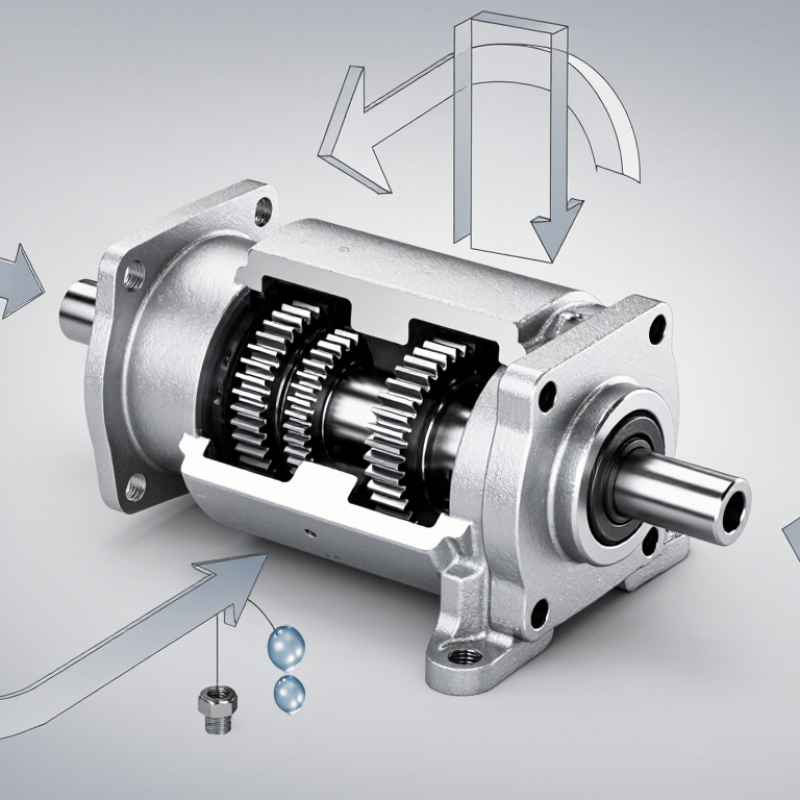
| Bidirectional operation | Confirm intended rotation and flow direction for clockwise and counterclockwise operation. | Check whether both directions are permitted continuously and whether porting, case drain, or pressure-balancing arrangements change the installation requirements. | Request a port and rotation diagram, installation instructions, and test records covering both directions where required. |
| Aluminum construction | Verify housing alloy, surface treatment, and compatibility of internal components and seals with the application fluid. | Do not assume that “aluminum” alone specifies alloy, corrosion resistance, or fluid compatibility. | Request a bill of materials or material declaration, seal-material identification, and any applicable corrosion or compatibility documentation. |
| Pressure and speed limits | Compare continuous, intermittent, and peak limits separately; verify minimum and maximum operating speed. | Use the limits for the exact displacement and configuration. Pressure capability may depend on speed, fluid viscosity, temperature, and duty cycle. | Check the current revision of the datasheet and obtain written confirmation of the intended duty cycle and operating envelope. |
| Efficiency, leakage, and temperature | Review volumetric and mechanical efficiency, external leakage, and oil-temperature limits at representative operating points. | Compare results only when pressure, speed, fluid, viscosity, and temperature are equivalent. | Request test curves or reports that identify the test conditions, instrument accuracy, acceptance limits, and sample configuration. |
| Production test results | Check whether each delivered unit is tested or sampled, and identify the tests performed. | Relevant checks may include pressure integrity, leakage, flow, rotation, and noise. Acceptance values should be agreed for the application rather than assumed. | Request a dated inspection or test report traceable to the delivered batch or serial number, with measured values and pass criteria. |
| Document control and traceability | Match the pump configuration, drawings, and test records to the quotation and purchase specification. | Confirm revision dates and ensure that any substitutions or changes are disclosed before approval. | Verify drawing revision, datasheet revision, material records, change-control process, and batch or serial-number traceability. |