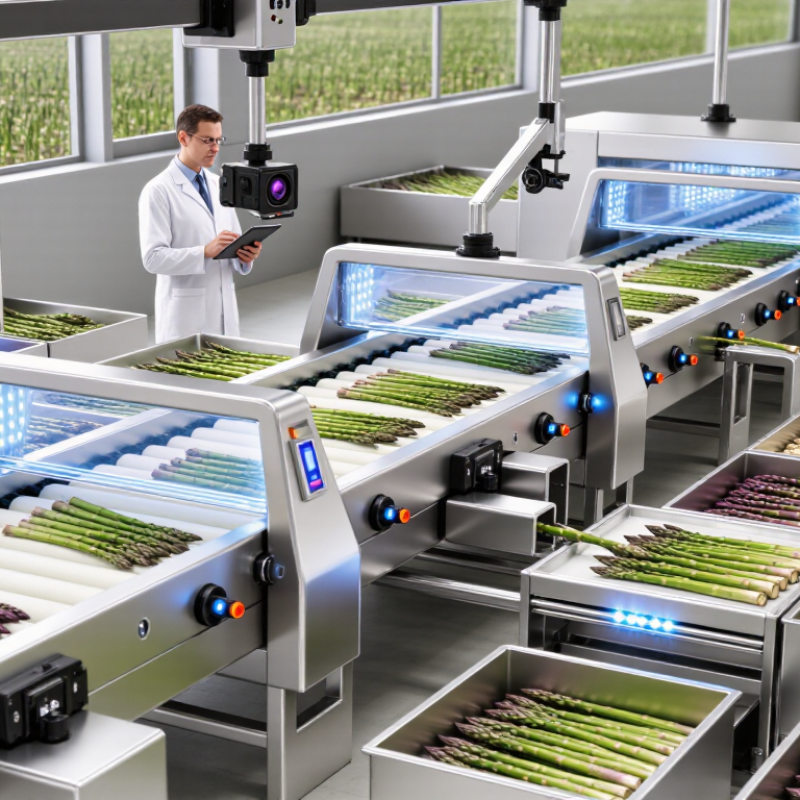
| RGB Area-Scan Imaging | Visible light, approximately 400–700 nm | Surface color, shape, contour, visible texture, and image-based dimensions | Yellowing, browning, discoloration, open or damaged tips, surface blemishes, broken spears, and mixed color grades | Provides intuitive color images; suitable for appearance grading; comparatively simple to integrate with controlled LED illumination | Limited ability to detect hidden or internal defects; performance can be affected by shadows, condensation, dirt on the camera window, and changing illumination | Very high for surface appearance |
| Near-Infrared Imaging | Approximately 700–1,000 nm; some industrial systems extend beyond 1,000 nm | Differences in reflectance related to water, organic material, and chemical composition | Moisture-related variation, some bruising or tissue changes, and material differences that are difficult to separate using visible color alone | Can add material-sensitive information to RGB inspection; less dependent on visible color differences | Detection performance depends strongly on wavelength selection, calibration, product freshness, and defect depth; it does not automatically reveal every internal defect | High when material information is required |
| Short-Wave Infrared Imaging | Approximately 1,000–2,500 nm | More detailed spectral differences associated with water and organic compounds | Selected moisture variation, tissue damage, foreign material, and composition differences that may be weak in visible and near-infrared images | Offers stronger material discrimination than visible imaging for some applications; useful when product composition or moisture is a key concern | Higher equipment cost; requires suitable detectors, optics, and illumination; atmospheric moisture and surface condition can influence measurements | High for advanced material inspection |
| Multispectral Imaging | Several discrete bands selected from visible, near-infrared, or short-wave infrared ranges | Reflectance values at predefined wavelengths | Color grade, surface damage, moisture-related differences, and selected defect categories defined during system development | Balances information content, processing speed, and system complexity; targeted wavelengths can be chosen for specific asparagus defects | Only measures the installed wavelength bands; performance may decline when a defect is outside the selected spectral signatures | Very high for targeted sorting programs |
| Hyperspectral Imaging | Many contiguous spectral bands across a defined visible, NIR, or SWIR range | A complete spectral signature for each measured pixel or product region | Research or advanced production classification of subtle surface and material differences, including quality variation not reliably separated by RGB alone | Provides the richest spectral dataset; supports development of new defect models and detailed quality classification | More data-intensive and complex; generally requires stronger computing, calibration, model development, and process control than standard multispectral systems | High for development and specialized inspection |
| 3D Laser or Structured-Light Measurement | Geometric measurement using projected light and camera triangulation; no single universal wavelength applies | Height profile, diameter, curvature, shape, and three-dimensional position | Abnormal curvature, misshapen spears, height differences, uneven presentation, and dimensional grading | Adds shape information that 2D color cameras cannot provide; can improve product positioning and dimensional classification | Does not directly identify many color or chemical defects; shiny, wet, overlapping, or rapidly moving products may reduce measurement quality | High for shape and dimensional grading |
| Polarized Visible-Light Imaging | Visible light with controlled polarization, approximately 400–700 nm | Surface-reflection behavior and visible appearance with reduced glare | Surface scarring, wet-surface variation, glare-obscured blemishes, and some texture differences | Can reduce specular reflection from wet or smooth asparagus surfaces; improves image consistency in selected applications | Usually complements RGB imaging rather than replacing it; polarization cannot compensate for poor product separation or insufficient illumination | Medium to high as an RGB enhancement |
| Fluorescence Imaging | Excitation commonly uses ultraviolet or blue light; emitted response is measured at longer wavelengths | Fluorescence response from selected surface compounds or contamination indicators | Specific surface contamination or biological-surface indicators when a validated fluorescence signature exists | Can reveal certain surface conditions that are difficult to distinguish under ordinary white light | Requires application-specific validation; not a general-purpose replacement for RGB, NIR, or SWIR sorting | Specialized and application-dependent |
| Combined RGB + NIR or Multispectral System | Two or more coordinated spectral ranges, commonly visible plus NIR or SWIR bands | Surface appearance together with material-sensitive reflectance information | Color defects, surface damage, moisture-related variation, foreign material, and selected quality classes | Combines complementary information and can reduce dependence on a single visual feature; often a practical choice for demanding commercial sorting | Higher integration, calibration, software, and maintenance requirements than a single-camera system | Very high for multi-defect inspection |
| Air-Jet Ejection with Optical Detection | Not a sensing spectrum; pneumatic separation is triggered by optical classification | Fast physical removal of classified products from the product stream | Removal of defective, discolored, undersized, oversized, foreign, or incorrectly graded spears after optical detection | Non-contact separation; suitable for high-speed handling when air pressure, nozzle timing, and product spacing are correctly controlled | Requires accurate timing and stable compressed air; overlapping products can reduce ejection precision; excessive air can damage delicate products or disturb neighboring spears | Essential for many continuous sorting lines |