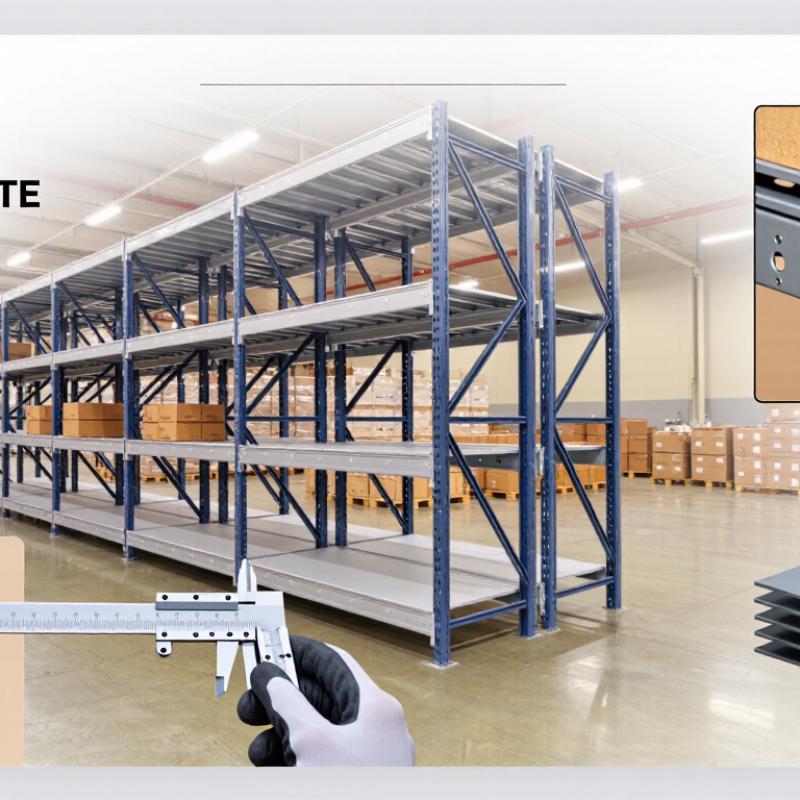
| Upright Frame Material | Cold-formed carbon steel | Common thickness: approximately 1.5–2.5 mm, depending on rack height and rated load | Uprights carry the vertical load and resist bending and sway. Thicker steel is generally suitable for taller or heavier-duty configurations. | Confirm steel grade, thickness measured after coating, upright profile, hole spacing, and the manufacturer’s tested load rating. |
| Beam Material | Roll-formed carbon steel with reinforced profile | Common thickness: approximately 1.2–2.0 mm for light- to medium-duty boltless racks | Beam strength affects shelf capacity, deflection, and the stability of the complete bay. | Check beam length, beam profile, connector engagement, weld quality, and whether the rating applies to an evenly distributed load. |
| Shelf Material | Steel panels, wire decking, or wood-based panels | Typical shelf thickness: approximately 0.6–1.2 mm for steel panels; wood panels vary by construction and thickness | The shelf surface must support the actual load without excessive deflection or local damage. | Verify panel thickness, reinforcement ribs, corrosion protection, edge treatment, and compatibility with the beam system. |
| Surface Finish | Powder coating or galvanized steel | Powder coating is common for dry indoor areas; galvanizing is more suitable for humid or corrosive environments | A suitable finish helps reduce corrosion and extends service life. | Look for uniform coverage, good adhesion, no exposed steel, and a finish appropriate for the storage environment. |
| Typical Rack Width | Choose according to load length and available space | Common widths: approximately 900, 1200, 1500, and 1800 mm | Longer beams usually experience greater bending under the same load, so beam length must be considered together with capacity. | Measure the longest stored item, required clearance, aisle width, and distance from walls or doors. |
| Typical Rack Depth | Choose according to product depth and access requirements | Common depths: approximately 300, 400, 450, 600, and 900 mm | Depth affects storage volume, accessibility, stability, and the amount of usable floor space. | Allow clearance for handling. Avoid storing items so far back that they cannot be safely retrieved. |
| Typical Rack Height | Select a height that matches the room and safe manual access | Common heights: approximately 1200–2400 mm; taller systems may require additional stability controls | Higher racks increase storage density but also increase the importance of leveling, anchoring, and safe loading. | Measure ceiling height, sprinkler clearance, door access, floor levelness, and the need for ladders or lifting equipment. |
| Shelf Load Capacity | Use the manufacturer’s tested rating for the exact configuration | Typical light- to medium-duty range: approximately 100–500 kg per shelf with evenly distributed loading | Load capacity depends on beam length, shelf depth, steel thickness, shelf reinforcement, number of levels, and rack height. | Confirm whether the rating is per shelf or per bay, and whether it assumes evenly distributed rather than point loading. |
| Total Bay Capacity | Calculate from the complete rack configuration | Example: 4 shelves × 250 kg per shelf = 1000 kg theoretical shelf-load total, subject to the complete rack rating | The total capacity may be limited by the uprights, connectors, bracing, floor condition, or stability rather than the shelves alone. | Request a load chart for the selected width, depth, height, shelf count, and shelf spacing. |
| Load Distribution | Distribute weight evenly across the shelf surface | Heavy items should be stored on lower levels; avoid concentrated loads unless specifically approved | Uneven or point loading can cause local deformation and may reduce the safe working capacity. | Check the location of heavy cartons, the support span, shelf deflection, and whether additional decking is required. |
| Rivet Connection | Fully engaged, tight-fitting rivet beams and uprights | Connections should seat completely with no visible gap or looseness after assembly | Correctly engaged rivets transfer load between beams and uprights and help prevent accidental disengagement. | Inspect connector fit, locking tabs, assembly tolerances, and whether a rubber mallet is required for proper seating. |
| Bracing and Stability | Use back or side bracing when required by height, load, or site conditions | Bracing requirements vary with rack geometry, floor conditions, and local safety rules | Bracing reduces sway and improves resistance to racking forces during loading and use. | Ask for stability guidance, anti-tip options, wall or floor anchoring details, and the recommended maximum height-to-depth ratio. |
| Floor Requirements | Level, firm, and capable of supporting the rack and stored goods | The required floor capacity depends on the total loaded weight and contact area of the feet | An uneven or weak floor can cause instability, uneven loading, or premature deformation. | Check floor levelness, concrete condition, moisture exposure, footplate size, and whether shims or anchors are allowed. |
| Safety Clearance | Maintain practical clearance around shelves and access routes | Clearance should be based on product size, handling method, aisle equipment, and local regulations | Adequate clearance reduces collision risk and makes loading and retrieval safer. | Plan aisle width, shelf overhang, sprinkler clearance, emergency exits, and pedestrian or equipment traffic paths. |
| Best Use Case | Manual storage of cartons, tools, spare parts, archives, and small components | Most suitable for organized indoor storage with regular inspection and controlled loading | Boltless rivet racks are quick to assemble and flexible, but they are not automatically suitable for every heavy-industrial application. | Choose a heavier-duty system or professional engineering review for pallets, forklifts, impact-prone areas, or very high loads. |
| Quality Documentation | Obtain configuration-specific technical documents | Useful documents include assembly instructions, load charts, material specifications, and inspection guidance | Documentation allows the buyer to verify that the quoted capacity matches the exact rack being supplied. | Ensure drawings and load ratings show dimensions, shelf count, spacing, material thickness, and loading conditions. |
| Important: The capacities and dimensions above are typical industry ranges for evaluation purposes, not universal guarantees. Always use the supplier’s tested rating for the exact rack configuration and comply with applicable local storage and workplace-safety requirements. |