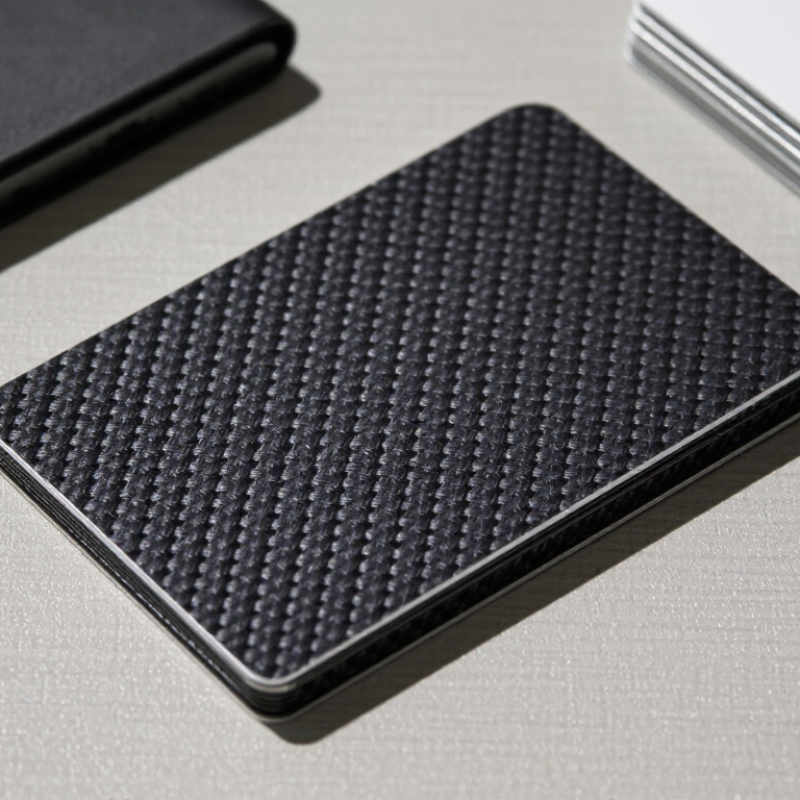
| Card size | For a standard ID-1 card, check for 85.60 × 53.98 mm dimensions. The nominal thickness for this format is 0.76 mm under ISO/IEC 7810. | The card fits the intended wallet, holder, or reader slot without forcing or excessive movement. | Access, transit, and specialty cards may use different dimensions or thicknesses. Confirm the requirements of the specific reader or holder. |
| Chip and contact compatibility | Check whether the card uses a contact chip, a contactless interface, or both, and confirm that the intended terminal supports it. | The card is tested with the actual reader or payment terminal it will be used with. | A carbon-fiber exterior alone does not establish chip or terminal compatibility. Do not assume all card readers use the same interface. |
| Contactless performance | For contactless use, confirm the card’s supported technology and test tap performance. Many contactless systems operate at 13.56 MHz, including systems based on ISO/IEC 14443. | The card reads reliably at the expected distance and orientation on compatible readers. | Carbon-fiber composites can be electrically conductive, depending on their construction, and may affect radio-frequency performance. A decorative carbon-fiber layer does not guarantee contactless function. |
| Material construction | Ask whether the card is solid carbon-fiber composite, a carbon-fiber laminate, or a conventional card with a carbon-pattern finish. | The construction and materials are clearly described, including the core, surface layers, and any embedded components. | A carbon-fiber appearance does not prove that the card is made from structural carbon-fiber composite. |
| Flex and impact resistance | Look for documented testing of the complete card, not just general claims about carbon fiber. Check the stated conditions and test method. | The seller provides specific test information or a clear warranty for cracking, delamination, or everyday wear. | Durability depends on the resin, lay-up, thickness, edges, and bonding. Carbon-fiber material by itself does not establish how a finished card will withstand bending or impact. |
| Surface and edge wear | Inspect the finish, printed details, corners, and edges for coating quality and signs of peeling or exposed layers. | Edges are smooth, markings are legible, and the finish has a stated care and warranty policy. | Abrasion, heat, solvents, and repeated contact with hard objects can wear finishes. Avoid relying on appearance alone as a durability test. |
| RFID shielding claims | If shielding is important, check for independent test results identifying the frequency range, test setup, and measured outcome. | The claim is supported by test details and the card is tested with the relevant contactless technology. | “RFID blocking” is not a universal guarantee. Shielding can also prevent the card from working while covered or positioned near shielding material. |
| Data and account security | Confirm whether the card is a payment card, access credential, or non-electronic card, and review the issuer’s security and replacement process. | Sensitive information is handled through the issuer’s approved systems, and loss can be reported promptly. | A carbon-fiber body does not itself protect account data, prevent cloning, or replace issuer security features. Never share a PIN or one-time code when evaluating a card. |
| Final selection | Prioritize confirmed fit and reader compatibility, then compare documented durability, warranty coverage, and any verified security claims. | The card works in the intended setup, has transparent material and warranty details, and meets the user’s actual needs. | Avoid choosing solely by weight, appearance, or unverified claims such as “unbreakable,” “universal,” or “complete protection.” |