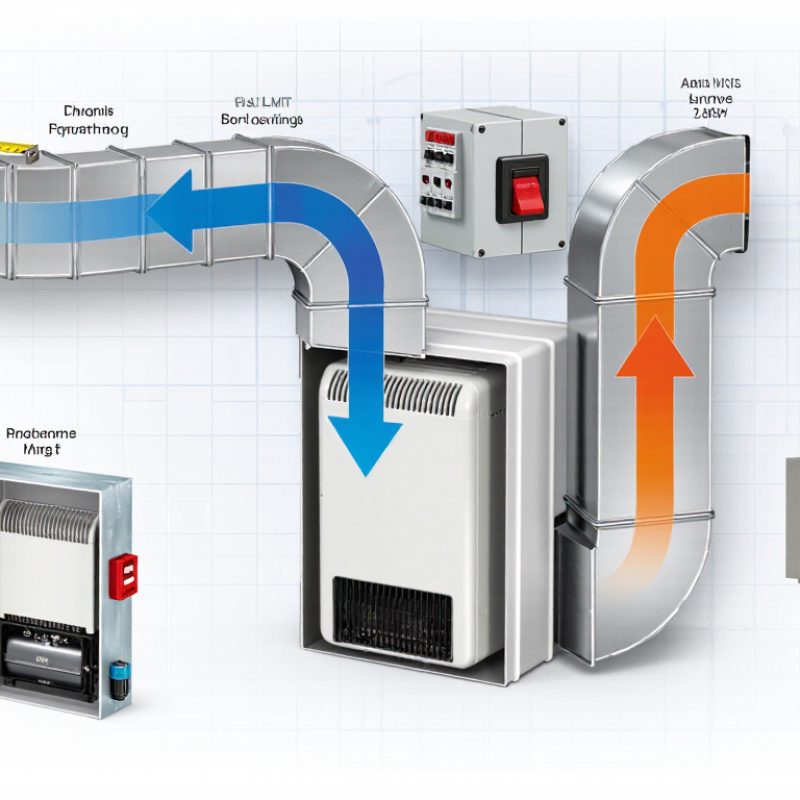
| Electric Resistance | Supplemental heat, reheat coils, packaged air-handling units, and small or medium commercial zones | Converts nearly all electrical input into heat at the point of use; operating cost depends mainly on wattage, runtime, and electricity rates | Airflow proving switch, high-temperature limit, automatic reset limit, manual-reset limit, grounded metal casing, and staged elements | On/off thermostat, staged contactors, SCR or electronic modulation, BACnet or other building-management-system interface | Confirm voltage, phase, amperage, duct airflow, heating capacity, minimum airflow, and available electrical service |
| Hydronic Hot-Water Coil | Central HVAC systems with an existing boiler or hot-water heating loop | Heating efficiency depends on boiler efficiency, water temperature, pump energy, pipe insulation, and control strategy | Freeze protection, low-temperature alarm, coil access for inspection, air venting, isolation valves, and condensate protection where applicable | Two-way or three-way valve, modulating valve actuator, supply-air sensor, outdoor-air reset, and building-management-system control | Verify water flow, entering-water temperature, pressure drop, coil face area, freeze protection, and boiler capacity |
| Steam Coil | Large commercial or industrial air-handling systems with an available steam distribution system | Can deliver high heat output in a compact coil; total energy use is affected by boiler performance, steam pressure, and condensate return | Steam trap, vacuum breaker, pressure control, condensate drainage, freeze protection, and appropriate relief and isolation devices | Modulating control valve, discharge-air temperature sensor, pressure regulator, and central supervisory control | Check steam pressure, condensate removal, coil orientation, valve sizing, freeze risk, and maintenance access |
| Gas-Fired Duct Heater | High-volume commercial or industrial ventilation systems where gas service and combustion-air provisions are available | Combustion efficiency varies by equipment design; requires combustion-air supply, venting, and regular burner maintenance | Flame safeguard, gas pressure supervision, blocked-vent or airflow protection, high-limit control, automatic shutoff valves, and flame-failure lockout | Single-stage, two-stage, or modulating gas control, discharge-air sensor, room thermostat, and building-management-system interface | Confirm fuel type, input capacity, ventilation airflow, clearances, venting, combustion air, local code compliance, and service access |
| Heat-Pump or Refrigerant Reheat | Energy-conscious systems that can recover or move heat instead of using resistance heat as the primary source | Can use less electrical energy than resistance heating under suitable operating conditions; performance varies with outdoor temperature and system design | High- and low-pressure protection, refrigerant monitoring, compressor protection, airflow proving, temperature limits, and condensate management | Variable-capacity compressor, electronic expansion valve, supply-air sensor, room thermostat, and integrated system controller | Evaluate heating capacity at design conditions, defrost behavior, refrigerant circuit compatibility, airflow, and backup heat requirements |