How to Choose the Right Electric Stacker Lift?
Choosing an Electric Stacker Lift is not a catalog exercise. It is a decision about the loads, travel paths, and people moving through your facility every day. MHI’s 2024 Annual Industry Report describes ongoing pressure from labor constraints, customer expectations, and technology investment. That context matters: a lift that saves space but slows replenishment may not be the right fit. Small details count. Measure the narrowest aisle, check pallet entry clearance, and record the heaviest load—not just the average one.
Warehouse researcher Dr. René de Koster is a leading expert on warehouse operations. A useful principle from his field is that equipment and warehouse processes must be evaluated together. Apply that thinking before comparing lift capacities or battery options. How high must the load travel? Will operators use the stacker for occasional put-away or repeated shifts? What floor conditions and turning space will it face? The answers shape stability, visibility, and operator comfort. They also affect total cost, which a purchase price alone cannot show.
There is no universal best model. A compact pedestrian stacker may suit a tight stockroom, while a ride-on unit may better serve longer routes. Even a careful shortlist can miss a constraint; recheck measurements with operators on site. This guide explains how to compare capacity, lift height, power, controls, and service support, so your choice fits the work—not just the specification sheet.
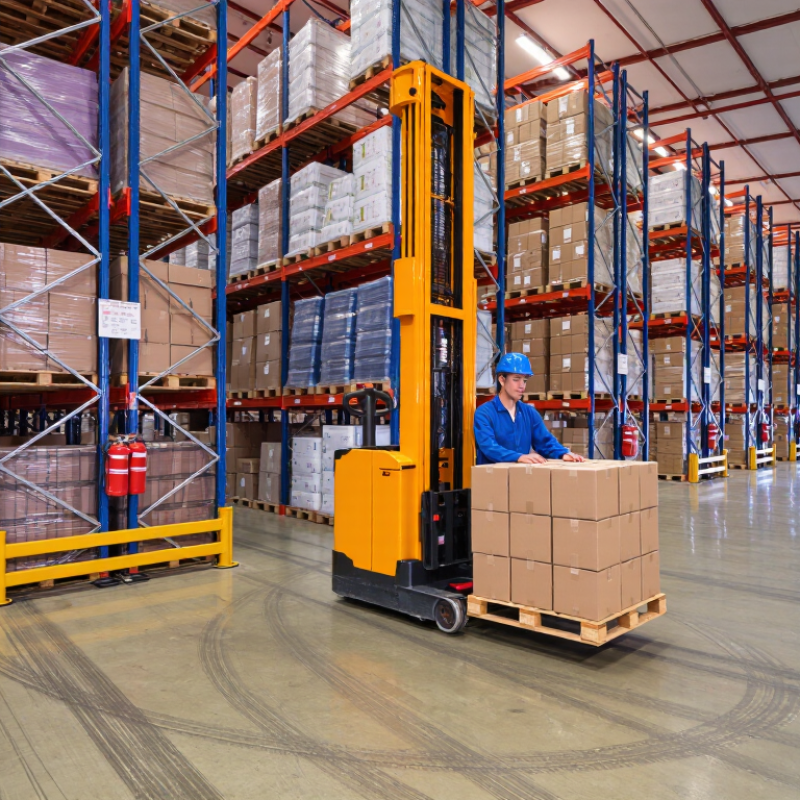
Identify the Loads, Tasks, and Operating Environment
Start with the heaviest load, not the average one. Record its weight, dimensions, and load center, then check these against the stacker’s rated capacity at your intended lift height. Tall or uneven pallets can shift the center of gravity and reduce safe capacity. Measure the highest shelf and the lowest doorway. Measure the aisle, too.
Next, match the machine to the work cycle. Short trips and frequent pallet transfers may favor compact equipment, while longer runs demand attention to travel speed, battery capacity, and charging access. Consider floor quality, gradients, turning space, and pedestrian traffic. OSHA’s Powered Industrial Trucks guidance cites about 85 forklift-related workplace deaths and 34,900 serious injuries annually in the United States. Those figures make capacity checks and clear visibility practical priorities, not paperwork. Still, a specification sheet cannot capture every awkward corner or poorly placed pallet.
Tips: Measure the narrowest aisle with the load raised only as needed. Confirm floor condition and turning clearance during a site walk. Ask operators to test typical loads, including the awkward ones. Leave charging space near the work area. It is easy to over-specify equipment; I would verify the daily task mix before choosing extra lift height or capacity.
How to Choose the Right Electric Stacker Lift
Electric stackers commonly come in rated-capacity classes around 1,000, 1,500, and 2,000 kg. Match the truck to the heaviest load and required lift height, and check the capacity chart for the specific load center and configuration. Aisle width, floor conditions, travel distance, and duty cycle also affect the right choice.
Match Stacker Type and Capacity to Your Requirements
Choose an electric stacker by matching its type and rated capacity to the loads, travel routes, and lift height you actually use. Start with the heaviest pallet, not the average one. Check its weight and dimensions, then compare them with the stacker’s capacity at the required lift height and load center. Capacity can decrease as the forks rise, so the headline rating alone may not tell the whole story. Small detail, big difference.
Next, match the operating style to your space and work rhythm. A walk-behind model can suit short trips and narrow aisles, while a ride-on version may help when operators travel longer distances or handle frequent moves. Measure aisle width, doorway clearance, and the height of the lowest beam or sprinkler before choosing a mast. Also consider floor condition, shift length, charging access, and how often loads are lifted. These details are easy to overlook during a quick warehouse visit. A marked floor and a tape measure can reveal awkward turns that a layout drawing misses. If possible, trial the stacker with a representative pallet; the right choice should feel controlled, not merely powerful.
How to Choose the Right Electric Stacker Lift? — Match Stacker Type and Capacity to Your Requirements
Use these typical ranges as an initial guide only. Actual capacity, lift height, aisle requirements, and performance vary by model and load configuration; confirm them against the equipment data plate and manufacturer specifications.
| Stacker Type | Typical Rated Capacity | Typical Lift Height | Best-Fit Application | Key Selection Considerations |
| Walk-behind / pedestrian stacker | About 1,000–1,500 kg | About 1.6–3.5 m | Short travel distances, light-to-moderate stacking, and loading or replenishing shelves in smaller work areas. | Check operator travel distance, floor condition, turning space, and whether the required lift height is available at the intended load weight. |
| Straddle-leg stacker | About 1,000–2,000 kg | About 1.6–5.5 m | Handling common pallet sizes where the legs can pass around the pallet. | Measure pallet width and overall load dimensions. Straddle legs may not suit closed-bottom pallets, some skids, or loads that must be picked up close to the floor. |
| Counterbalance stacker | About 1,000–2,000 kg | About 1.6–4.5 m | Handling pallets that cannot accommodate straddle legs, including certain closed-bottom pallets, in compact indoor spaces. | Confirm the load center and capacity at height. The counterweight affects machine size and turning space, so check aisle width and maneuverability. |
| Ride-on or platform stacker | About 1,200–2,000 kg | About 2.0–5.5 m | Frequent pallet movement over longer indoor travel routes and regular stacking tasks. | Consider travel distance, operating speed, braking, visibility, pedestrian separation, and whether the platform configuration fits the site’s safety procedures. |
| High-lift stacker | Often about 1,000–1,500 kg; capacity may decrease at greater lift heights | Often about 3.0–5.5 m | Placing loads on higher storage levels where vertical reach is a primary requirement. | Check the residual capacity chart at the required lift height and load center. Confirm ceiling clearance, mast height, and stability on the actual floor. |
| Initial-lift stacker | About 1,000–1,600 kg, depending on model | Model-dependent; the initial lift raises the support legs for uneven thresholds or limited ramps | Sites with small floor transitions or tasks that require moving loads across modest, approved inclines. | Verify the permitted gradient and load conditions in the manual. Initial lift does not make every ramp or uneven surface safe for operation. |
| Requirement to Check | How to Match the Stacker |
| Maximum load weight | Choose a rated capacity that covers the heaviest complete load, including pallet or attachment weight. Check the capacity at the intended lift height and load center, not just the headline rating. |
| Load dimensions and pallet type | Compare pallet entry, fork dimensions, leg arrangement, and load overhang with the stacker design. Confirm compatibility for closed-bottom pallets, skids, and nonstandard loads. |
| Required storage height | Allow for the highest shelf level, pallet height, and clearance needed to place or retrieve the load. Verify mast height and residual capacity at that lift height. |
| Aisle and turning space | Measure the narrowest working aisle and turning area with the actual pallet or load. Compare these measurements with the selected machine’s turning radius and aisle guidance. |
| Travel frequency and distance | For short, occasional moves, a walk-behind configuration may be suitable. For frequent or longer routes, consider a ride-on or platform model and evaluate battery runtime and charging access. |
| Floor and operating environment | Check floor smoothness, gradients, thresholds, doorway clearances, and indoor or outdoor exposure. Use equipment only on surfaces and gradients approved for that model. |
| Battery and charging needs | Match battery capacity and charging method to expected duty cycles, shift length, and available charging facilities. Follow the equipment and battery manufacturer’s charging instructions. |
Check Lift Height, Load Dimensions, and Aisle Space
Before selecting an electric stacker, measure the highest shelf and the lowest overhead obstruction, including lights, pipes, and door tracks. Check both maximum lift height and lowered mast height; a machine that reaches the rack may still fail to pass through a doorway. Measure the actual load, too. A pallet’s length, width, and overhang affect the load centre and stability, so compare these dimensions with the capacity chart at the required lift height. A tidy specification sheet can still mislead.
Aisle width needs a real-site check. Use the stacker’s turning data and the longest load to assess the required working aisle, then allow room for steering and pedestrian separation. Mark the aisle on the floor and test the route at corners, rack ends, and charging areas. Tight spaces matter.
OSHA’s powered industrial truck safety materials cite estimates of about 85 forklift-related fatalities and 34,900 serious injuries each year. Those figures cover a broad range of trucks, not stackers alone, but they underline why clearance and stable load handling deserve careful checks.
Re-measure after racks or loads change; I would not assume yesterday’s layout still fits.
Review Maintenance, Warranty, and Total Ownership Costs
Maintenance costs depend on how hard and how often the electric stacker works. A unit moving pallets through a busy warehouse will need different care from one used for occasional deliveries. Ask a qualified technician about service intervals, common wear items, and local labor rates. Check whether inspections, travel, parts, and battery testing are included in quoted service plans. Small omissions matter. Battery care also affects costs: charging habits, storage conditions, and replacement timing can change the ownership budget. Keep a simple log of operating hours, repairs, and charging issues. It gives you better evidence than a rough estimate.
Read the warranty closely before comparing prices. Confirm its duration and whether the battery, charger, labor, and replacement parts are covered. Coverage may require documented maintenance or exclude damage linked to poor charging. Ask how quickly repairs are typically handled; a low-cost lift can become expensive if it sits idle. Then estimate total ownership costs over the period you expect to use it: purchase price, scheduled maintenance, electricity, likely battery replacement, and downtime. Include resale value only as a cautious estimate. A spreadsheet can look precise and still miss real usage patterns. Review the assumptions with the people who will operate and maintain the lift.
