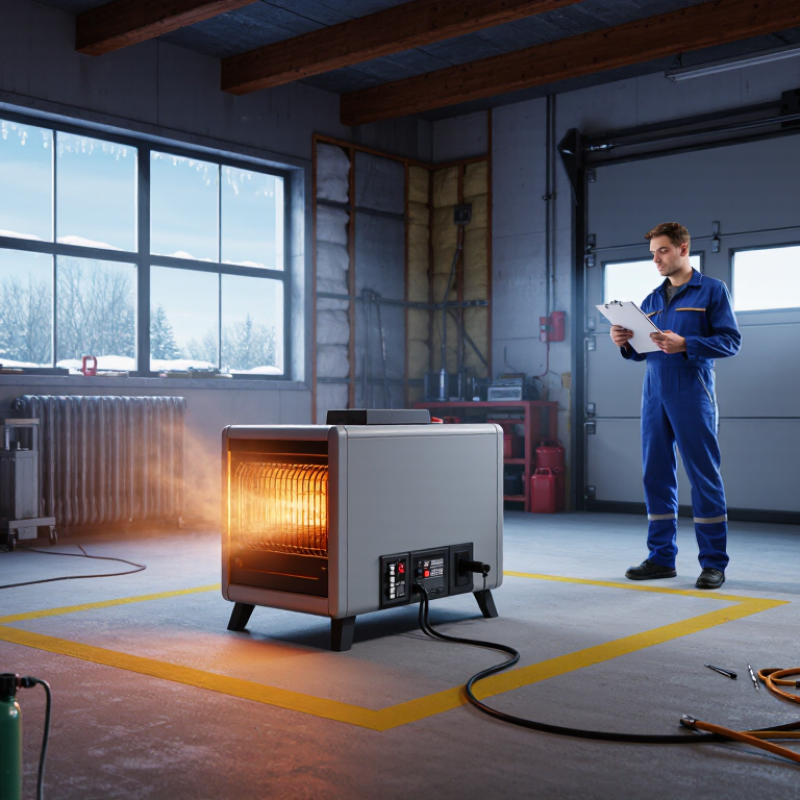
| Direct-Fired Forced-Air Heater | Approximately 20–400 kW, depending on model | A fan distributes heated combustion air directly into the space | Construction sites, workshops, agricultural buildings, warehouses, and temporary heating | High ventilation is required because combustion products enter the heated area | Rapid warm-up, high mobility, simple installation, and nearly all fuel energy becomes useful heat indoors | Not suitable for occupied areas with limited ventilation or where clean air is essential; adds moisture and exhaust gases |
| Indirect-Fired Forced-Air Heater | Approximately 20–350 kW, depending on model | A heat exchanger separates combustion gases from the heated air | Event spaces, commercial buildings, occupied workshops, warehouses, and enclosed work areas | Requires a flue or exhaust duct to discharge combustion gases outdoors | Provides cleaner, drier heated air and is more appropriate for occupied spaces | More expensive and less energy-efficient than direct-fired units because heat leaves through the flue; installation is more complex |
| Oil-Fired Hydronic Heater | Commonly about 15–300 kW for building heating systems | Burns fuel oil to heat water or another approved heat-transfer fluid for radiators, fan coils, or underfloor systems | Homes, offices, schools, workshops, and buildings with existing hydronic distribution | Requires a properly sized flue, combustion-air supply, and a suitable mechanical room | Even heat distribution, quiet operation in occupied rooms, and compatibility with multiple heat emitters | Higher installation cost, slower response than direct air heaters, and regular boiler and water-system maintenance |
| Oil-Fired Warm-Air Furnace | Approximately 20–150 kW for many building applications | A burner heats a heat exchanger, and a blower distributes warm air through ducts | Residential and light-commercial buildings that already have ductwork | Requires a flue, combustion-air provisions, and adequate return-air and supply-air ducting | Fast response, centralized temperature control, and the ability to integrate filtration or ventilation equipment | Duct installation can be costly; airflow may create noise and distribute dust if filters are not maintained |
| Oil-Fired Cabinet or Unit Heater | Typically about 20–150 kW | A compact burner and heat exchanger deliver warm air directly or through a short duct system | Garages, workshops, small warehouses, service areas, and agricultural buildings | Usually needs a flue and dedicated combustion-air provisions; requirements vary by installation | Compact footprint, direct space heating, and relatively straightforward zoning for individual areas | Can cause temperature stratification, requires clearance from combustibles, and is not ideal for large multi-zone buildings without ducting |
| Oil-Fired Radiant Heater | Commonly about 10–100 kW | Radiant surfaces or tubes transfer infrared heat directly to people, floors, and objects | High-bay workshops, loading areas, partially open buildings, and zones with frequently open doors | Requires a flue or approved exhaust arrangement and adequate combustion air | Heats occupants and surfaces directly, reduces losses from air movement, and performs well in tall or drafty spaces | Uneven comfort may occur outside the radiation pattern; equipment placement and combustible-clearance rules are critical |
| Condensing Oil Boiler or Heater | Often about 15–100 kW in building heating applications | Recovers latent heat from water vapor in the flue gases by operating with sufficiently low return temperatures | Well-insulated buildings, low-temperature radiators, and underfloor heating systems | Requires a compatible flue system, condensate drainage, and treatment where required by local regulations | Can achieve higher seasonal efficiency than conventional non-condensing equipment when correctly designed and operated | Higher design complexity, acidic condensate management, and reduced condensation benefits at high water temperatures |