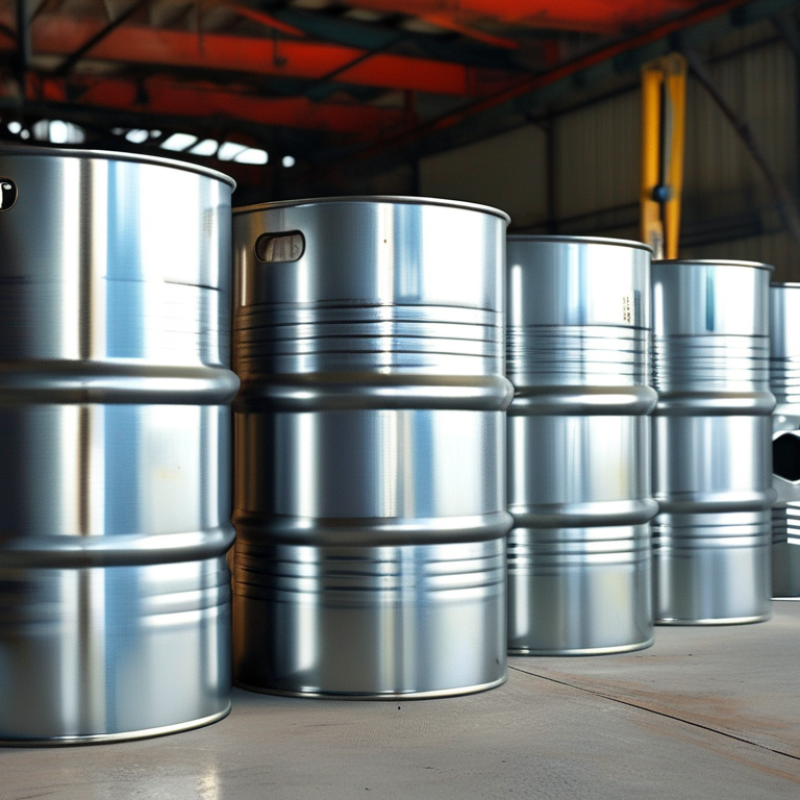
| Nominal Drum Capacity | Common sizes include 20 L, 30 L, 60 L, 120 L, and 208 L. A 208 L drum is commonly described as a 55 U.S. gallon drum. | Confirm the nominal capacity, usable fill volume, external dimensions, and required headspace from the product specification. | Correct sizing prevents overfilling, reduces handling stress, and allows sufficient space for thermal expansion where required. |
| Closed Head Construction | The top should be permanently seamed or securely attached, with designated openings for plugs, bungs, or fittings. | Inspect the top seam, plug threads, gasket seating area, and closure torque requirements. Check that openings are compatible with the intended liquid or material. | A sound closed head reduces leakage, contamination, and deformation during transport and storage. |
| Galvanizing Method | Typical steel-sheet galvanizing is applied before drum forming. Common coating designations for galvanized sheet include G60 and G90 under ASTM A653/A653M, when specified by the supplier. | Request the coating designation, coating type, and applicable standard. Verify whether the coating is hot-dip galvanized, electrogalvanized, or another treatment. | Coating type and mass affect resistance to atmospheric moisture, handling damage, and early red-rust formation. |
| Zinc Coating Mass | For ASTM A653/A653M sheet designations, G60 represents approximately 203 g/m² total coating on both sides, while G90 represents approximately 305 g/m² total coating on both sides. | Check the material certificate or coating report. When necessary, use a calibrated magnetic coating-thickness gauge at multiple locations. | A higher and more uniform zinc coating generally provides a longer protective barrier, especially in humid storage environments. |
| Coating Uniformity | The coating should be continuous and free from exposed bare steel, severe scratches, peeling, blistering, or concentrated uncoated areas. | Inspect the body, top, bottom, seams, rolling hoops, plug areas, and handling-contact points. Measure several positions rather than relying on one reading. | Localized bare spots can become corrosion initiation points and may reduce service life even when the average coating value is acceptable. |
| Steel Thickness | Common drum body gauges are approximately 0.6–1.2 mm, depending on capacity, contents, stacking requirements, and regulatory design. | Verify nominal thickness from the technical drawing or mill certificate. Use a calibrated ultrasonic thickness gauge when incoming inspection is required. | Thicker steel generally improves resistance to denting, buckling, puncture, and deformation during palletizing and transport. |
| Bottom and Top Thickness | The bottom and top may use different gauges or reinforcements from the cylindrical body to withstand stacking and impact loads. | Review thickness values separately for the body, top, bottom, rolling hoops, and seam areas instead of accepting one overall thickness figure. | Weak top or bottom panels can fail under stacking loads even when the cylindrical wall appears sufficiently strong. |
| Seam Quality | The longitudinal seam and circular chimes should be continuous, uniform, and free from cracks, sharp edges, excessive wrinkles, or visible pinholes. | Perform visual inspection and, where appropriate, leak testing. Pay particular attention to the side seam, top seam, bottom seam, and chime transitions. | Seams are high-stress areas and common potential leak paths during impact, vibration, or pressure changes. |
| Leakproofness | For regulated dangerous-goods service, select a drum with the required UN packaging marking and performance level for the specific substance. | Check the complete UN marking, closure instructions, gasket material, and test documentation. Do not rely only on a visual inspection. | Leakproofness is essential for preventing product loss, environmental release, and hazards caused by incompatible or flammable contents. |
| Drop Resistance | UN performance packaging may be subject to drop testing at specified heights according to the applicable packing group and packaging type. | Confirm that the test report applies to the same drum design, capacity, closure system, and packing group required for the intended shipment. | Drop-test performance indicates the drum’s ability to withstand accidental impacts during loading, unloading, and transportation. |
| Stacking Resistance | The drum should have a stable chime, reinforced top and bottom geometry, and a documented maximum stacking load or height. | Request the allowable stacking load and test method. Keep the load centered and follow the supplier’s stacking instructions. | Adequate stacking strength reduces buckling, closure damage, and loss of stability in warehouses and shipping containers. |
| Closure and Gasket Compatibility | Common closure components include threaded plugs, gaskets, and sealing washers made from materials selected for chemical compatibility. | Compare gasket and liner materials with the contents, temperature range, storage duration, and cleaning chemicals. Verify the specified tightening torque. | Even a strong drum can leak if the gasket swells, hardens, dissolves, or is incorrectly compressed. |
| Corrosion Environment | Galvanized steel is generally suited to dry or moderately humid atmospheric storage, but performance depends on exposure conditions and the stored material. | Assess humidity, salt spray, condensation, outdoor exposure, contact with acidic or alkaline substances, and possible galvanic contact with other metals. | Galvanizing is not a universal chemical barrier; aggressive environments may require an internal lining, different material, or additional protective coating. |
| Internal Lining Requirement | An internal lining may be necessary when the contents could react with zinc or steel, or when product purity must be maintained. | Review chemical compatibility data, immersion-test results, and the lining specification. Confirm that the lining is continuous and properly cured. | A suitable lining can reduce internal corrosion, contamination, odor transfer, and interaction between the contents and galvanized surface. |
| Dimensional Consistency | Drum height, diameter, bung spacing, chime profile, and pallet footprint should remain within the stated manufacturing tolerances. | Measure sample drums with calibrated tools and compare the results with the approved drawing or purchase specification. | Consistent dimensions improve pallet stability, automated handling, closure fit, warehouse utilization, and stacking safety. |
| Surface and Handling Safety | The exterior should be free from sharp burrs, loose zinc flakes, severe dents, unstable chimes, and damage that compromises handling. | Inspect the complete exterior, including rolling hoops, bottom rim, top rim, and plug openings. Segregate drums with structural dents or damaged closures. | Safe edges and stable geometry reduce worker injury risk and help prevent punctures, tipping, and secondary damage. |
| Documentation and Traceability | A robust specification should identify steel grade, nominal thickness, coating type, coating mass, capacity, closure details, test results, and production lot. | Request a certificate of conformity, material certificate, inspection records, and applicable UN test documentation before approval. | Traceability supports quality control, regulatory compliance, failure investigation, and consistent repeat purchasing. |
| Recommended Selection Priority | Select based on contents and regulations first, then evaluate coating, steel thickness, closures, leakproofness, drop resistance, and stacking performance. | Use a written acceptance checklist and compare identical test criteria across samples. Avoid choosing only by lowest purchase price or nominal capacity. | A balanced specification provides better lifecycle value and lowers the risk of leakage, corrosion, handling damage, and rejected shipments. |