How to Choose a Precision Drive in 2026?
Choosing a precision drive in 2026 is not simply a search for the smallest error figure. It is a practical decision about load, speed, stiffness, feedback, heat, and service conditions. A drive that performs beautifully in a laboratory may struggle beside dust, vibration, or a changing production schedule. The details matter.
Precision engineering authority Dr. Alexander Slocum has stated, “Precision is not a property of a machine; it is a relationship between a machine and its task.” This principle remains useful when comparing servo drives, direct-drive motors, linear stages, and integrated motion systems. The right precision drive should match the application’s real tolerance, duty cycle, acceleration profile, and control architecture. Higher resolution is not automatically better. Sometimes it adds cost without improving the finished part.
Begin with the motion profile, not the product brochure. Record the payload, travel distance, settling time, peak torque, continuous torque, and allowable backlash. Watch the machine during startup. Listen for resonance. Check whether the feedback scale sits close to the working point. A polished specification can hide a poor mechanical fit.
There is no perfect choice.
Experience also exposes uncertainty. Suppliers may report accuracy under controlled conditions, while your machine faces temperature changes and imperfect alignment. Ask how performance was measured, over what distance, and after how many operating hours. A reliable selection process leaves room for testing, recalibration, and honest doubt. In 2026, the best precision drive will be the one that delivers repeatable motion where production actually needs it.
What Is a Precision Drive and Why Does It Matter in 2026?
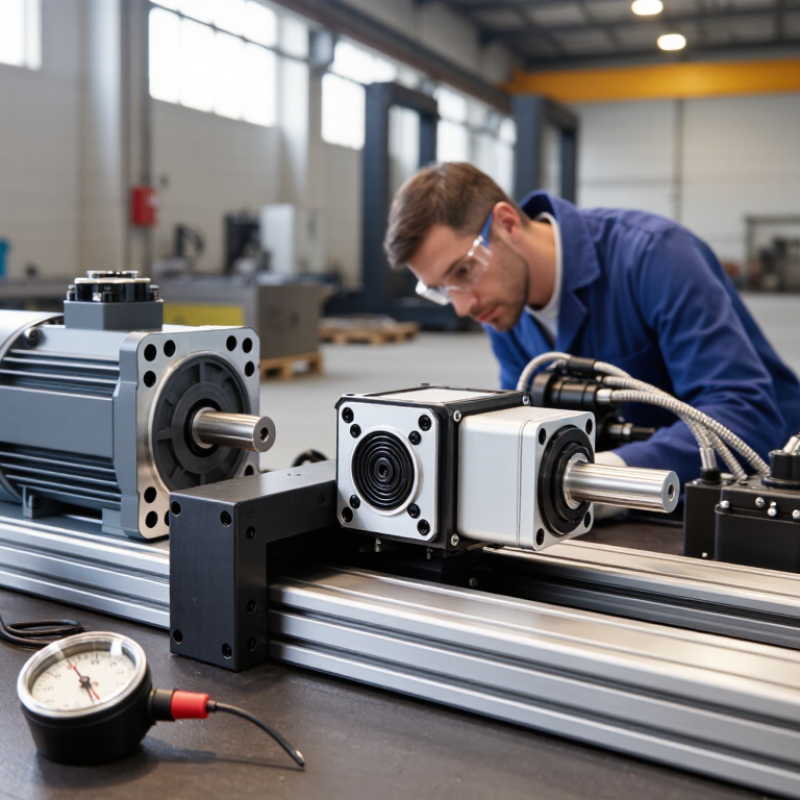
A precision drive is a coordinated system of motor, amplifier, controller, and feedback sensor. It regulates position, speed, and torque with far greater accuracy than an open-loop motor. In practice, the encoder is the drive’s eyes. The control algorithm decides how quickly the motor should respond. Small errors become visible at the machine’s tool tip.
This matters more in 2026 because automation is becoming denser and less forgiving. The International Federation of Robotics reported 541,302 industrial robot installations worldwide in 2023, a 10% annual increase. More robots mean more axes, tighter motion profiles, and greater demand for repeatable control. The International Energy Agency also estimates that motor-driven systems consume about 70% of industrial electricity. Efficient acceleration and regenerative control can therefore influence both output and operating costs.
Choosing a drive should begin with the application, not the catalog. Check continuous torque, peak torque, feedback resolution, thermal limits, bus voltage, and required communication protocols. A drive that looks powerful may still perform poorly under rapid reversals. Test the complete motor-drive-load combination. Include cable length, gearbox backlash, vibration, and emergency-stop behavior. No drive is perfect. Specifications can hide difficult tuning work, and a laboratory result may fail beside a hot, dusty production line. That weakness deserves attention.
How to Compare Control, Connectivity, Safety, and Energy Efficiency
How to Choose a Precision Drive in 2026?
Choosing a precision drive in 2026 starts with the machine’s motion profile, not a feature checklist. Control quality appears in settling time, overshoot, repeatability, and performance under changing loads. For a pick-and-place axis, a two-millisecond delay can create visible vibration at the tool. Ask for measured curves, not brochure adjectives. Test it.
Connectivity should reduce troubleshooting time, not add another isolated data island. Check support for open industrial communication standards, time synchronization, diagnostic access, and secure remote updates. A useful drive should report temperature, current, fault history, and load changes in readable formats. IEC 62443 provides a strong reference for industrial cybersecurity practices, although implementation quality still varies between systems.
Safety functions deserve direct verification. Review safe torque control, emergency response behavior, validation documents, and alignment with ISO 13849-1 and IEC 61800-5-2. Energy efficiency also needs measurement across the full duty cycle. The U.S. Department of Energy estimates motor systems may consume about 68% of industrial electricity, while the IEA reports motor-driven systems use roughly half of global electricity. Regenerative braking, correct sizing, sleep modes, and reduced mechanical losses can matter more than a small peak-efficiency claim. The uncomfortable part is this: a drive can be technically excellent yet waste energy through poor tuning. Leaving margin everywhere feels safe, but excessive oversizing often reduces efficiency and control precision.
How to Select, Validate, and Maintain the Right Precision Drive
How to choose a precision drive in 2026? Start with the motion, not the catalog. Define load, speed, acceleration, duty cycle, backlash, and thermal limits. A 0.01 mm positioning target means little without a stated measurement method. The International Federation of Robotics reported 541,302 industrial robot installations in 2023. That growth increases demand for repeatable motion, but higher speed can expose vibration, cable drag, and poor tuning. Select the drive and motor as one system. Check encoder resolution, continuous torque, peak torque, feedback compatibility, and safety functions against real operating conditions.
Tips:
Build a validation test using the actual payload, temperature, travel profile, and mounting structure. Record settling time, position error, noise, and heat after repeated cycles. ISO 230-2 offers a useful framework for testing positioning accuracy and repeatability. Do not trust a single factory number. It may describe ideal conditions.
Maintenance should begin before installation. Store baseline current, temperature, vibration, and error logs during commissioning. The U.S. Department of Energy’s Operations and Maintenance Best Practices guide reports that predictive maintenance can reduce maintenance costs by about 8–12%. Still, sensors do not replace judgment. A clean trend can hide loose couplings or gradual mechanical wear. Inspect fasteners, lubrication, cable routing, and backlash at defined intervals. I would also leave a small performance margin, even when the spreadsheet looks convincing. Real machines age unevenly. That part is easy to underestimate.