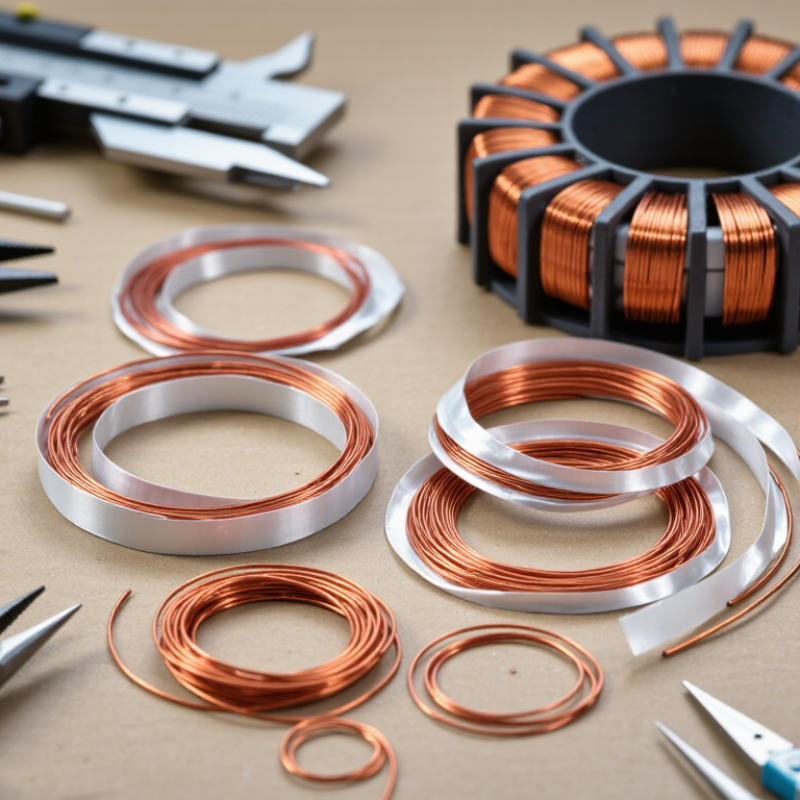
| Wire structure | Fine copper strands are individually insulated, assembled into a bundle, and covered with a textile yarn wrap. | The strand insulation and construction help manage high-frequency current effects; the textile covering holds the bundle together and provides a protective outer layer. | Confirm the strand insulation, lay or bunch construction, and covering material in the product specification. “Silk covered” alone does not define the electrical construction. |
| Operating frequency | The frequency range of the transformer, inductor, resonant circuit, or other application. | At higher frequencies, skin and proximity effects can increase AC resistance and losses in conductors. | Choose strand diameter and bundle construction for the operating frequency. The suitable design depends on the application’s waveform, magnetic field, and winding layout. |
| Strand diameter and count | Individual strand diameter, number of strands, and total copper cross-sectional area. | Strand dimensions affect high-frequency behavior, while total copper area is an important input for current capacity and DC resistance. | Compare the specified copper area and strand details—not just the overall covered diameter. Verify current and temperature limits for the actual installation. |
| Silk or textile covering | Covering material, number of wraps, coverage, and finished outside diameter. | The wrap can improve handling, bundle integrity, and separation between adjacent turns, but its properties vary with material and construction. | Check abrasion, temperature, and chemical requirements. Do not treat a textile covering as certified primary electrical insulation unless its rating and intended use are specified. |
| Current and temperature | RMS current, duty cycle, cooling conditions, allowable temperature rise, and ambient temperature. | Conductor losses produce heat; permissible current depends on the complete design and thermal environment, not wire size alone. | Use application-specific thermal calculations or testing. Check the temperature ratings of the strand insulation and covering, as well as any winding insulation system. |
| Flexibility and winding | Bend radius, coil shape, winding method, and available space in the magnetic component. | A flexible stranded bundle can be easier to wind than a solid conductor, while the finished wrap affects handling and packing density. | Check the finished outside diameter and minimum bend guidance, then test the wire with the intended winding process to avoid damaging strands or covering. |
| Termination and soldering | How strand insulation and textile covering are removed, and how the conductor ends are joined. | Unremoved strand insulation can prevent reliable electrical contact; excessive heat can damage nearby insulation or covering. | Confirm whether the strand insulation is solderable and follow the specified stripping and termination process. Validate the connection mechanically and electrically. |
| Application fit | Frequency, loss target, voltage requirements, winding space, environment, and applicable standards. | Silk-covered Litz wire is commonly considered for high-frequency windings where flexible, multi-strand conductors and a textile wrap are useful. | Request a specification covering strand construction, copper area, insulation, covering, dimensions, and ratings. Compare candidates against the complete electrical and mechanical requirements. |