| 1 | Estimate Daily Energy Consumption | Calculate the energy used by lighting, refrigeration, electronics, ventilation, water pumps, and other devices. Start with a load calculation | A small RV may use approximately 500–1,000 Wh per day, while a larger RV with more appliances may use 1,500–3,000 Wh or more. | List each appliance, its wattage, and daily operating hours. Multiply watts by hours, then add approximately 15–25% for system losses and usage variation. |
| 2 | Choose the Solar Panel Type | Select monocrystalline panels when roof space is limited; consider flexible panels when weight and curved surfaces are important. Efficiency versus weight | Rigid crystalline panels commonly provide about 18–23% module efficiency. Flexible panels are lighter but may have lower durability and heat performance depending on construction. | Use rigid panels for better ventilation, long-term durability, and easier maintenance. Use flexible panels only when their lower weight or installation shape provides a clear advantage. |
| 3 | Match Panel Capacity to Energy Needs | Size the array according to daily energy demand, available sunlight, and the amount of roof space. Avoid undersizing | A 400 W array may produce roughly 1,000–1,600 Wh per day under about 3–5 peak-sun-hours, before accounting for system losses and shading. | For light use, 200–400 W may be suitable. For regular off-grid use, 400–800 W is often more practical. Higher demand may require additional panels or another charging source. |
| 4 | Select the Battery Capacity | Choose a battery bank that can cover nighttime use and provide reserve energy during cloudy periods. Storage matters | A 100 Ah, 12.8 V lithium battery stores approximately 1,280 Wh nominally. A 100 Ah, 12 V lead-acid battery stores approximately 1,200 Wh nominally but generally offers less usable capacity. | Compare usable watt-hours rather than only amp-hours. For multi-day travel without reliable sunlight, increase storage or provide an alternative charging method. |
| 5 | Choose the Charge Controller | Use a controller that supports the battery chemistry and has sufficient voltage and current ratings. MPPT for better harvest | MPPT controllers can generally harvest more energy than PWM controllers when panel voltage is higher than battery voltage or when conditions are cool and variable. | Confirm the controller's maximum photovoltaic voltage, charging current, battery settings, and safety functions. Allow design headroom above the calculated array current. |
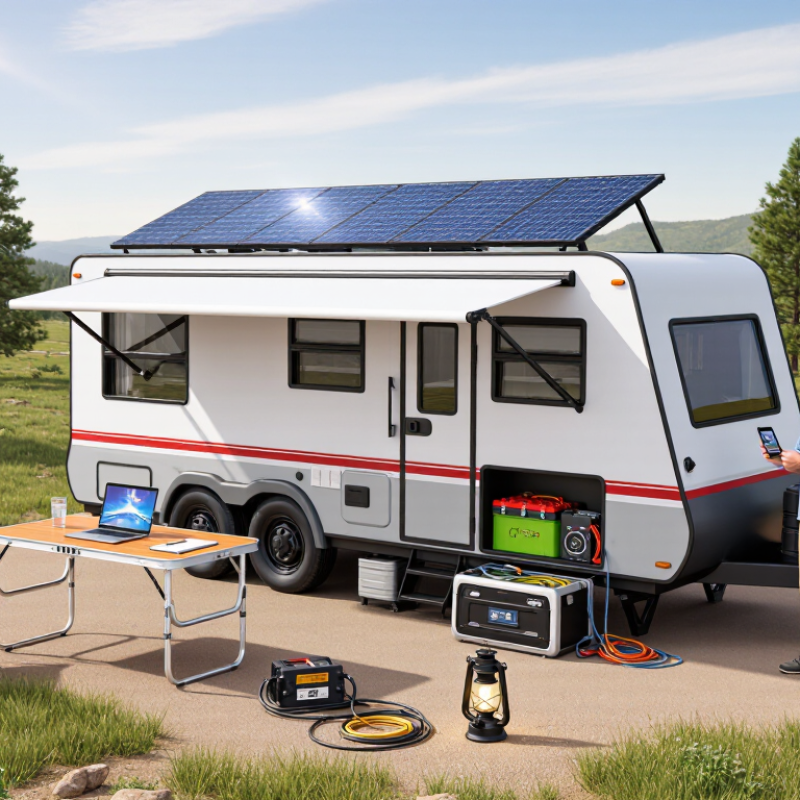
| 6 | Check Roof Area and Weight Limits | Measure usable roof space and verify the RV's roof-loading specifications before installation. Space and payload first | A typical rigid RV panel may occupy approximately 1.5–2.2 m² and weigh about 15–25 kg, depending on its power rating and construction. | Keep clearance from vents, air conditioners, roof edges, and service areas. Include the weight of mounting hardware, wiring, controller, and battery in the payload calculation. |
| 7 | Account for Shade and Parking Conditions | Plan for partial shade from trees, roof equipment, nearby vehicles, and low sun angles. Shade reduces output | A small shaded section can reduce the output of a panel string substantially, although bypass diodes and separate solar inputs may reduce the overall impact. | Use multiple panels or independent inputs when roof obstructions are unavoidable. Place the RV where panels receive unobstructed sunlight whenever possible. |
| 8 | Decide Between Fixed and Portable Panels | Combine roof-mounted panels for automatic charging with portable panels when additional output or flexible positioning is needed. Flexibility versus convenience | Fixed panels charge while driving or parked, whereas portable panels can be placed in direct sun when the RV is parked in shade. | Choose portable panels if campsite shade is common or roof space is limited. Consider storage, setup time, cable length, and theft protection. |
| 9 | Size the Inverter for AC Loads | Select an inverter based on both continuous power and short startup surges. Check surge demand | Common RV inverter sizes range from approximately 600 W for light electronics to 2,000 W or more for several higher-power appliances. | Add the running wattage of devices that may operate at the same time. Motors, compressors, and some heating appliances can require substantially higher startup or operating power. |
| 10 | Allow for Weather, Season, and System Losses | Include losses caused by temperature, dust, wiring, battery charging, controller conversion, and cloudy weather. Build in reserve | Real-world daily output is commonly lower than the panel's laboratory-rated capacity. A design factor of approximately 20–30% above the calculated minimum can provide useful operational reserve. | Increase panel capacity when traveling in winter, high latitudes, cloudy regions, or areas with frequent shading. Monitor actual battery state and energy production after installation. |