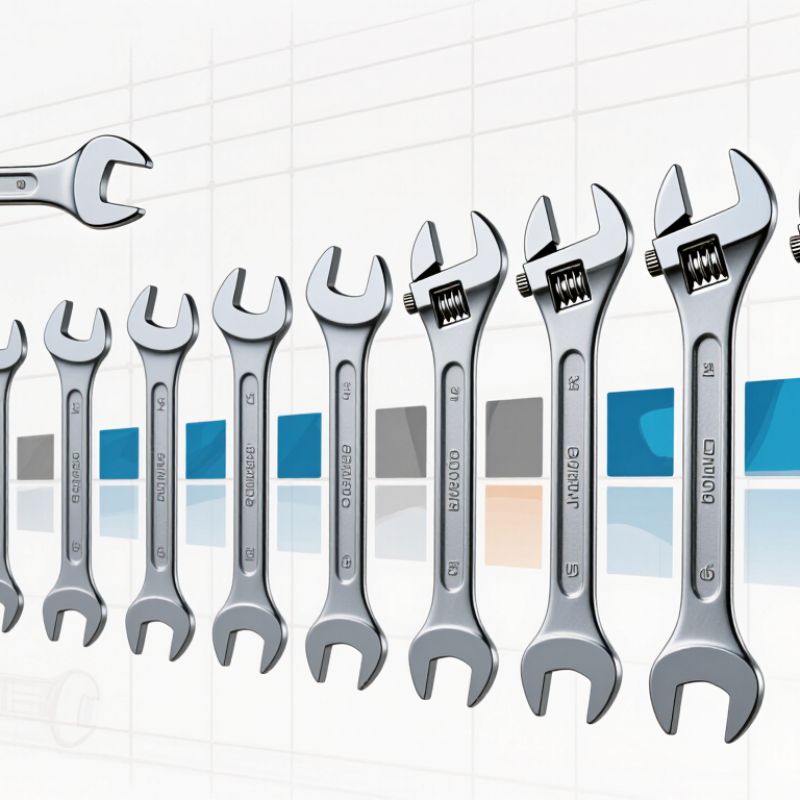
| Standard combination wrench | One open end and one closed box end, usually the same nominal size. | A versatile general-purpose tool for turning hexagonal fasteners. | The open end allows quick placement; the box end generally provides more contact around the fastener. |
| Stubby combination wrench | A shortened handle with the same basic open-end and box-end layout. | Fits into some confined spaces where a standard-length handle will not fit. | Its shorter handle provides less leverage, so it may be unsuitable for fasteners requiring high torque. |
| Long-pattern combination wrench | A longer handle than a standard-pattern wrench of the same size. | Provides greater reach and can offer more leverage. | Requires more working space; use controlled force to avoid damaging a fastener. |
| Ratcheting combination wrench | Has a ratcheting mechanism in the box end; the open end is generally conventional. | Allows repeated turning without removing the box end after each stroke. | Needs clearance for the ratchet head and its operating arc. Some designs are reversible; others are not. |
| Flex-head combination wrench | The box-end head pivots relative to the handle; some versions also have a ratcheting mechanism. | Helps reach fasteners at an angle or around nearby obstacles. | The pivoting head needs room to move and may require careful positioning to keep it seated. |
| Offset combination wrench | Uses an angled or offset box end to move the handle away from the fastener or nearby surfaces. | Can improve hand clearance around recessed or obstructed fasteners. | Offset geometry varies by design; confirm that the head can fully engage the fastener. |