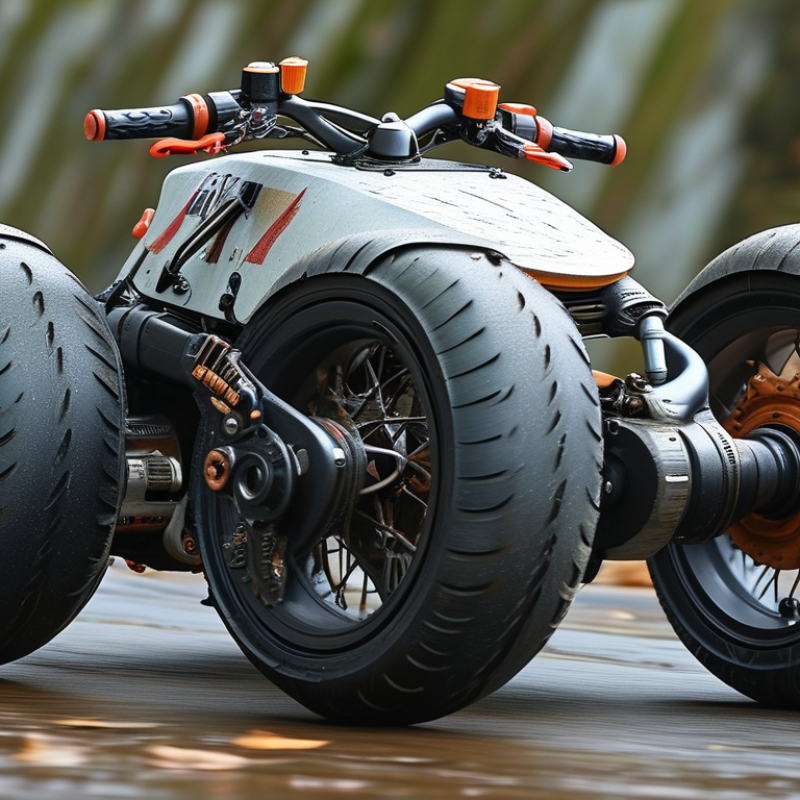
| Vehicle layout | One steerable front wheel and two rear wheels, usually with a low seat and extended frame | The narrow front contact path allows steering input to initiate a turn while the light rear end can slide outward | The layout is designed for controlled sliding rather than high-speed cornering |
| Electric motor output | Common recreational systems provide approximately 500–2,000 watts of rated or peak motor power | Instant motor torque can overcome rear-wheel grip and help start or maintain a controlled slide | Actual performance depends on rider weight, surface grip, gearing, battery voltage, and controller settings |
| Battery system | Lithium-ion battery packs commonly range from about 36–72 volts, with capacity often measured in ampere-hours | Higher voltage can support stronger acceleration and more consistent motor performance under load | Energy content is approximately calculated as volts × ampere-hours; real range is reduced by drifting, hills, and repeated acceleration |
| Rear-wheel traction | Rear tires may use hard plastic sleeves or low-grip surfaces to reduce friction | Lower friction makes it easier for the rear wheels to lose traction and rotate around the front wheel | Low-grip tires increase sliding behavior but also reduce braking performance and stability |
| Steering geometry | Handlebars control the front wheel; many designs use a relatively short turning radius | Fast steering response allows the rider to set the drift angle and correct the vehicle direction | Sharp steering can make the trike more responsive but may require greater rider coordination |
| Speed range | Many recreational electric drift trikes are designed for approximately 15–40 km/h, depending on configuration | Moderate speed provides enough momentum for sliding while keeping steering corrections manageable | The safe operating speed should match the surface, riding area, protective equipment, and local regulations |
| Throttle control | A thumb throttle or twist throttle regulates the motor controller's power demand | Small throttle changes let the rider add torque to extend a slide or reduce power to regain traction | Smooth, progressive control is easier to manage than abrupt full-power acceleration |
| Braking system | Mechanical or hydraulic disc brakes are commonly used; some systems may include regenerative braking | Braking transfers speed control from the motor to the wheel brakes and helps end a drift | Regenerative braking can recover a small amount of energy, but it does not replace friction brakes |
| Weight and center of gravity | A low seat and long wheelbase commonly place the rider close to the ground and distribute mass along the frame | A low center of gravity helps reduce the likelihood of tipping during a controlled turn | A longer or heavier frame may feel stable but can require more space to turn |
| Riding surface | Smooth, clean, dry pavement generally offers more predictable handling than loose gravel, wet pavement, or uneven ground | Consistent surface friction makes the transition between grip and slide easier to anticipate | Wet or contaminated surfaces can sharply increase stopping distance and reduce steering control |
| Estimated riding range | Approximately 15–50 km per charge for many recreational configurations | Electric power provides repeated acceleration without fuel, but aggressive drifting consumes energy faster than steady cruising | Range varies with battery energy, rider mass, speed, tire pressure, temperature, and terrain |
| Control principle | Drifting combines steering angle, motor torque, speed, and rear-wheel traction | The rider initiates a turn, applies measured power to reduce rear traction, and countersteers to control the slide | Practice should take place in an open, legal, controlled area while wearing a helmet and suitable protective gear |