| Definition | Primary operating principle | Pascal’s law | Pressure applied to an enclosed hydraulic fluid is transmitted throughout the fluid, allowing a relatively small input force to produce a much larger output force. | Hydraulic circuits must be designed for the maximum rated pressure, including pressure spikes and blocked-flow conditions. |
| Capacity | Rated pressing force | Approximately 100 to more than 10,000 metric tonnes, depending on machine design | Force capacity is selected according to material strength, part geometry, tooling requirements, and the required forming or straightening load. | Never exceed the rated force, eccentric-load limit, daylight opening, or stroke capacity specified for the press. |
| Hydraulic system | Typical working pressure | Approximately 160 to 700 bar for heavy-duty systems | A hydraulic pump supplies pressurized fluid to one or more cylinders. Directional valves control extension, holding, and retraction. | Pressure relief valves, properly rated hoses, rigid tubing, and regular leak inspections are essential. |
| Force calculation | Basic cylinder-force equation | F = P × A | F is cylinder force, P is hydraulic pressure, and A is the effective piston area. Increasing pressure or piston area increases available force. | Use the manufacturer’s rated effective area and account for mechanical losses, friction, and pressure variation. |
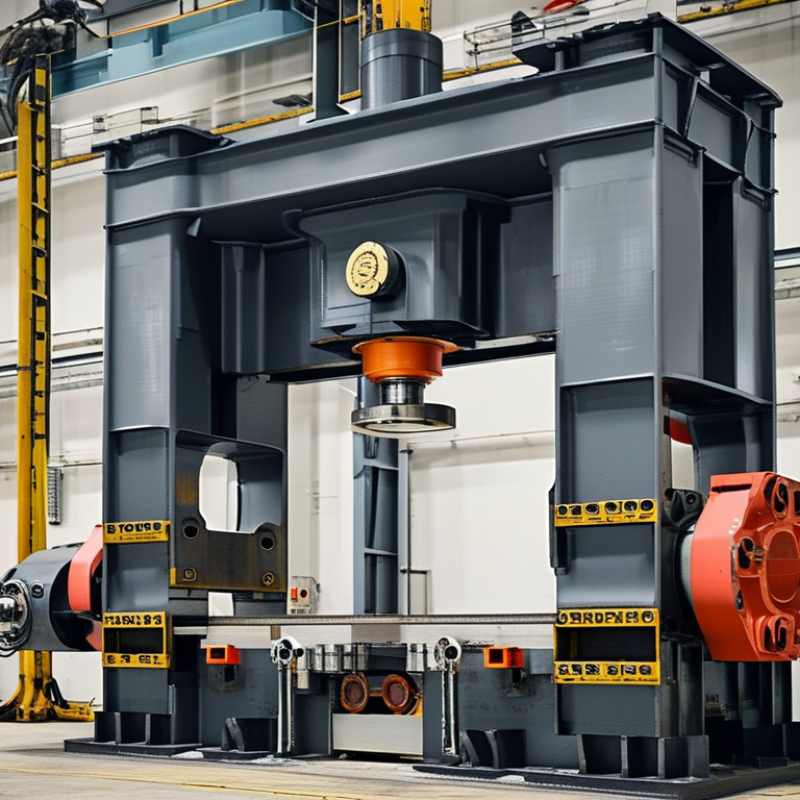
| Machine structure | Frame configuration | Four-column, straight-side, or C-frame construction | Four-column and straight-side frames are commonly used for high-force, centered operations. C-frame presses provide easier side access but may have greater frame deflection. | Inspect the frame, columns, tie rods, bed, and bolted connections for cracks, deformation, looseness, or abnormal wear. |
| Motion | Press stroke and speed | Stroke: commonly 100–1,000 mm; speed varies by cycle phase | Many presses use rapid approach, slower forming, controlled pressure holding, and faster return to improve productivity and part quality. | Install guarding and controls that prevent access to the point of operation during hazardous movement. |
| Control | Common control functions | Pressure, position, dwell time, stroke length, and cycle mode | Programmable controls can repeat multi-step cycles and maintain consistent forming force and position. | Emergency stops should remove hazardous motion without creating additional risks. Control-system faults should be identified and corrected before operation. |
| Industrial application | Metal forming and fabrication | Stamping, bending, deep drawing, embossing, and blanking | Hydraulic force is applied gradually and can be held at a set pressure, making the process suitable for forming large or complex metal parts. | Use correctly rated dies, die blocks, bolsters, and positive tool-retention methods. Keep hands outside the die area. |
| Industrial application | Assembly and maintenance | Bearing installation, bushing insertion, shaft straightening, and component separation | Controlled force and adjustable stroke make hydraulic presses useful for interference fits, disassembly, and structural correction. | Support workpieces securely and align them with the ram. Do not use makeshift spacers or unstable stacks of material. |
| Industrial application | Composite and polymer processing | Compression molding and laminated-part production | The press applies controlled pressure while heat and dwell time may be used to cure or consolidate materials. | Follow the tooling temperature and pressure limits. Provide ventilation where the process can release fumes or vapors. |
| Performance benefit | Force control and repeatability | Adjustable force and programmable cycle control | Compared with many mechanical systems, hydraulic presses can provide smooth force application, controlled dwell, and adjustable working speed. | Verify pressure gauges, sensors, switches, and position feedback devices during scheduled maintenance. |
| Performance benefit | Load distribution | Force can be distributed through multiple cylinders or a synchronized hydraulic circuit | Multiple-cylinder arrangements help support large tooling and workpieces when the load must be applied over a wide area. | Synchronization must be maintained to prevent tilting, uneven loading, tool damage, or unexpected workpiece movement. |
| Energy and maintenance | Energy efficiency | Highly dependent on pump type, duty cycle, pressure level, and idle time | Variable-displacement pumps, efficient motors, and automatic unloading can reduce energy use during holding or idle periods. | Keep hydraulic fluid clean, maintain correct fluid level, and replace filters according to operating conditions rather than appearance alone. |
| Hydraulic fluid | Fluid condition | Clean, compatible fluid at the viscosity specified by the equipment design | The fluid transmits power, lubricates components, and carries heat away from the pump, valves, and cylinders. | Contamination, water, overheating, and incorrect viscosity can cause valve sticking, seal failure, pump wear, and loss of control. |
| Main hazards | Mechanical and hydraulic risks | Crushing, shearing, ejection, unexpected movement, stored pressure, and high-pressure fluid injection | Hazards are concentrated at the point of operation, between the ram and tooling, and around hoses, fittings, and moving components. | Use fixed or interlocked guards, presence-sensing devices where appropriate, safe-distance controls, and clearly marked exclusion zones. |
| Safe operation | Operator protection | Two-hand controls, guarding, emergency stop, lockout/tagout, and task-specific PPE | Safety systems prevent or limit access to dangerous movement and help isolate the machine during setup, clearing, inspection, and maintenance. | Never bypass guards or controls. Wear suitable eye, face, foot, hand, and hearing protection based on the task and risk assessment. |
| Maintenance | Inspection intervals | Before each shift for visible hazards; periodic inspection according to duty cycle and risk assessment | Routine checks typically include leaks, hose condition, guards, controls, gauges, lubrication, fasteners, tooling, and abnormal noise or vibration. | Depressurize and isolate all energy sources before maintenance. Hydraulic accumulators and elevated rams may retain stored energy. |
| Standards and compliance | Common reference requirements | ISO 4413, ISO 16092-3, OSHA machine-guarding and lockout/tagout requirements, plus applicable local regulations | These references address hydraulic-system safety, press-machine risks, machine guarding, control functions, and hazardous-energy isolation. | Applicable requirements depend on the country, machine type, installation, and workplace. A documented risk assessment is necessary before commissioning. |