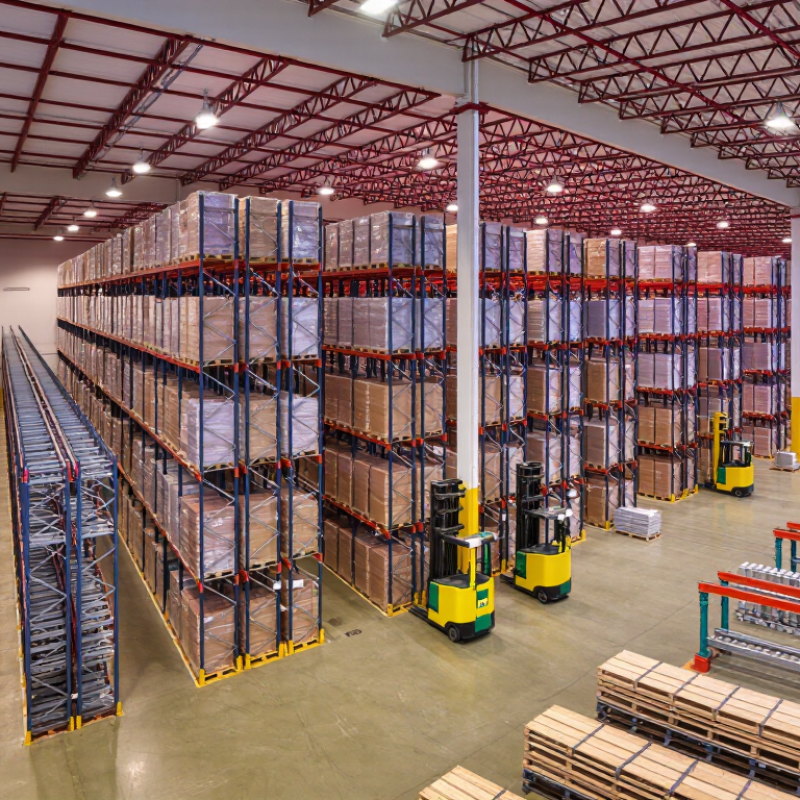
| 1. Selective Pallet Rack | Direct access to every pallet; typically 100% selectivity. | Low–Medium | Capacity is determined by beam ratings, frame height and depth, pallet load, and configuration. Commonly used for heavy unit loads when properly engineered. | Warehouses with many SKUs, frequent picking, or varied inventory. | Excellent access, but aisles take up more floor area than in high-density systems. |
| 2. Double-Deep Rack | Two pallets deep; front pallets must be moved to reach rear pallets. Requires a deep-reach truck. | Medium–High | Uses standard pallet rack components in a deeper arrangement; all beams, frames, and loads still require configuration-specific ratings. | Moderate-SKU operations with multiple pallets per SKU. | More positions per aisle, but reduced selectivity and more specialized handling equipment. |
| 3. Push-Back Rack | Multiple pallets deep; loading and retrieval generally operate last-in, first-out (LIFO). | High | Capacity depends on the engineered carts, rails, rack structure, and pallet load; loads must be compatible with the system. | High-volume products stored in batches with several pallets per SKU. | High density and good access from the aisle, but inventory rotation is generally LIFO. |
| 4. Pallet Flow Rack | Usually loaded from one side and retrieved from the other; supports first-in, first-out (FIFO). | High | Roller lanes and rack structure must be designed for pallet dimensions, load, lane length, and operating conditions. | High-throughput, date-sensitive, or batch-controlled inventory. | Enables FIFO and dense storage, but requires compatible pallets and routine lane maintenance. |
| 5. Drive-In Rack | Forklifts enter the rack structure; commonly operated as LIFO from an aisle at one end. | Very High | Rack capacity is affected by bay geometry, rail design, impact protection, forklift clearances, and load distribution. | Large quantities of a limited number of SKUs with relatively uniform pallets. | Strong space utilization, but fewer accessible faces and greater care needed during forklift operation. |
| 6. Drive-Through Rack | Forklifts can enter from both ends; can support FIFO when loading and retrieval are managed from opposite sides. | Very High | Similar structural considerations to drive-in systems; through-aisle layout and operating clearances must be engineered. | High-volume products requiring through-flow or more deliberate stock rotation. | Offers dense storage and potential FIFO operation, but requires access aisles at both ends. |
| 7. Pallet Shuttle Rack | A powered shuttle moves pallets along storage lanes; forklifts typically work at the lane entrance. | Very High | System limits depend on shuttle and rail ratings, pallet condition, lane design, and rack engineering. | Deep-lane storage with many pallets per SKU and frequent movement of full loads. | Reduces forklift travel inside lanes, but adds equipment, controls, and maintenance requirements. |
| 8. Mobile Pallet Rack | Rack rows move on powered bases to open an aisle where needed; access is available to the selected aisle. | High | Rack structure and mobile bases must be designed for the loads, floor conditions, seismic requirements, and operating controls. | Facilities seeking higher storage density while retaining access to many individual pallet locations. | Can reduce the number of permanent aisles, but retrieval requires aisle movement and system controls. |
| 9. Cantilever Rack | Open-front access to stored items; arms are accessed from the aisle. | Low–Medium | Arm and column capacity depends on arm length, load position, column spacing, and whether the load is evenly distributed. | Long, bulky, or irregular goods such as lumber, pipe, and metal stock; palletized loads may also be stored where suitable. | Handles long loads well, but generally offers less pallet-position density than multi-level pallet rack. |
| 10. Pallet AS/RS (Automated Storage and Retrieval System) | Automated cranes or other equipment retrieve pallets through system-controlled storage aisles. | Very High | Capacity is specific to the system design, storage height, load unit, building conditions, and equipment ratings. | High-throughput operations needing dense storage, controlled inventory movement, or reduced manual handling. | Can use space efficiently and automate handling, but involves substantial design, integration, and investment requirements. |