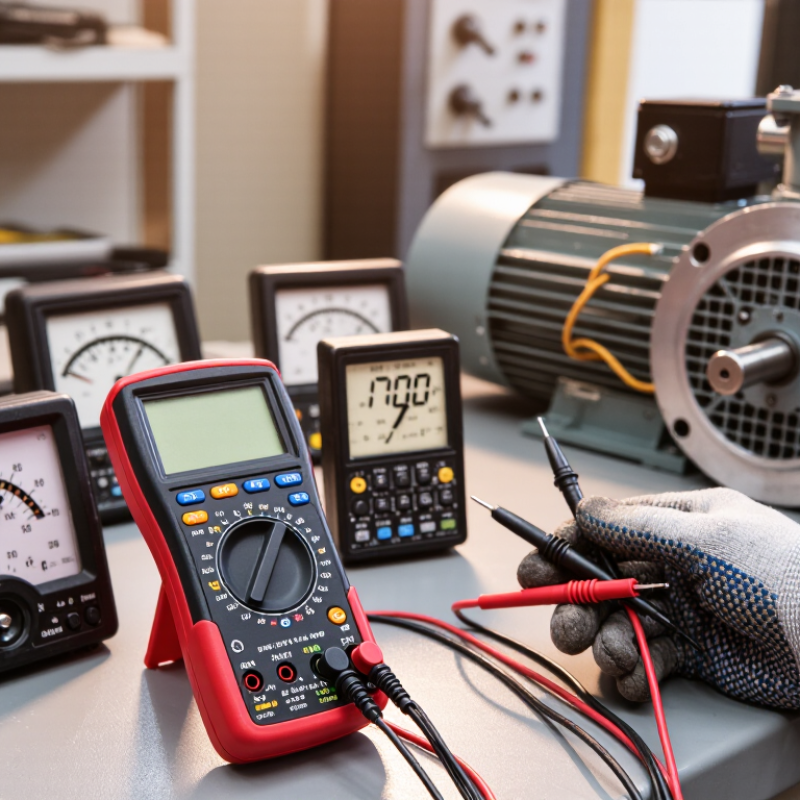
| Basic Handheld Digital Multimeter | Approximately ±0.5% to ±1.0% of reading | DC voltage: up to 600–1,000 V
DC current: up to 10 A
Resistance: up to 20–40 MΩ | Typically up to 10–100 kHz | About 2–3 readings per second | Usually 3½ to 4 digits | General electrical maintenance, continuity checks, batteries, and household or light industrial work | Limited accuracy and slower updates compared with professional or bench instruments |
| Professional Handheld Digital Multimeter | Approximately ±0.05% to ±0.2% of reading | DC voltage: up to 600–1,000 V
DC current: up to 10 A
Resistance: up to 40–60 MΩ | Typically up to 100–500 kHz | About 3–5 readings per second | Usually 4½ to 5½ digits | Industrial troubleshooting, control cabinets, motor drives, and field service | Higher cost and generally less display area than a bench meter |
| True-RMS Handheld Meter | Approximately ±0.1% to ±0.5% of reading | AC/DC voltage: up to 600–1,000 V
AC/DC current: up to 10 A
Resistance: up to 40 MΩ | Typically 10 Hz–50 kHz, depending on crest factor and waveform | About 2–5 readings per second | Usually 4½ to 5½ digits | Variable-frequency drives, non-linear loads, switch-mode power supplies, and distorted AC waveforms | True-RMS measurements can be slower and less accurate near the upper frequency limit |
| High-Precision Bench Multimeter | Approximately ±0.002% to ±0.02% of reading | DC voltage: typically 100 mV to 1,000 V
DC current: from µA to 10 A
Resistance: from mΩ to 100 MΩ or more | Typically up to 300 kHz–1 MHz for frequency functions | About 5–50 readings per second, depending on resolution and filtering | Usually 6½ to 8½ digits | Laboratory measurement, calibration, production test, and precision electronics | Excellent accuracy but lower portability; fast measurements may reduce displayed resolution |
| Graphing or Data-Logging Multimeter | Approximately ±0.05% to ±0.2% of reading | DC voltage: up to 600–1,000 V
Current: µA ranges to 10 A
Resistance: up to 40–60 MΩ | Typically up to 100 kHz–500 kHz | Fast display updates; logging commonly from 1 sample per second to several samples per second | Usually 4½ to 5½ digits | Intermittent faults, battery discharge tests, thermal drift, and long-duration monitoring | Recording speed, memory, and wireless functions may affect battery life and measurement duration |
| Process and Loop Calibrator | Typically ±0.02% to ±0.1% of reading for current output or measurement | Commonly 0–24 mA for current loops
Voltage functions often include 0–10 V
Some models support thermocouples or RTDs | Usually not intended for high-frequency measurements | Typically 2–10 updates per second | Often displays 4–6 digits or equivalent engineering units | Industrial process loops, transmitters, valves, PLC inputs, and instrumentation commissioning | Narrower electrical range than a general-purpose multimeter and limited suitability for waveform analysis |
| Insulation Resistance Tester | Low-voltage accuracy is commonly around ±1% to ±3%; insulation readings vary by test range | Test voltages commonly 50–1,000 V
Insulation resistance from tens of MΩ to tens of GΩ | Not designed for conventional frequency measurement | Usually 1–3 seconds for a stable insulation result | Often 3–5 digits, with automatic range selection | Cable testing, motor windings, transformers, and electrical safety inspections | Specialized high-voltage testing; not a replacement for a general multimeter |